


TABLE OF CONTENTS
Research and Knowledge Exchange on Reducing Inequalities
Inclusive Education Toolkit for Underrepresented Groups
Faculty Research on Inequality and Social Inclusion
International Conference on Women's Rights
Non-Discrimination and Inclusive Admissions
Institutional Non-Discrimination Policy
Non-Discriminatory Admission Policy
Dedicated Admission Policy for Underrepresented Groups
Monitoring Access and Participation of Underrepresented Groups
International Student Admission and Support
Financial Support for Disadvantaged Students
Scholarships Targeted at Underrepresented Groups
Need-Based Financial Assistance
On-Campus Employment and Financial Opportunities
Institutional Commitment to Full Scholarships
Admission Policy for Students with Disabilities
Financial and Academic Support for Students with Disabilities
Disability Awareness and Community Inclusion
Diversity Governance and Inclusive Campus Culture
Diversity and Equality Committee
Equality, Diversity and Inclusion (EDI) Center
Protection Against Discrimination and Harassment
Mentoring, Counselling and Mental Health Support
Promoting Diversity Through Cultural and Academic Engagement
Community Outreach and Partnerships
AIUB Social Welfare Club – Shomoy
Promoting Women's Participation in the Power Sector
Research on Inclusive Development and Social Inequalities
Assistive Technology for Inclusive Early Childhood Education
Research on Employment Inclusion for Persons with Disabilities
Research on Socioeconomic Inequalities in Healthcare Access
SDG 10: REDUCED INEQUALITIES
Research and Knowledge Exchange on Reducing Inequalities
Inclusive Education Toolkit for Underrepresented Groups
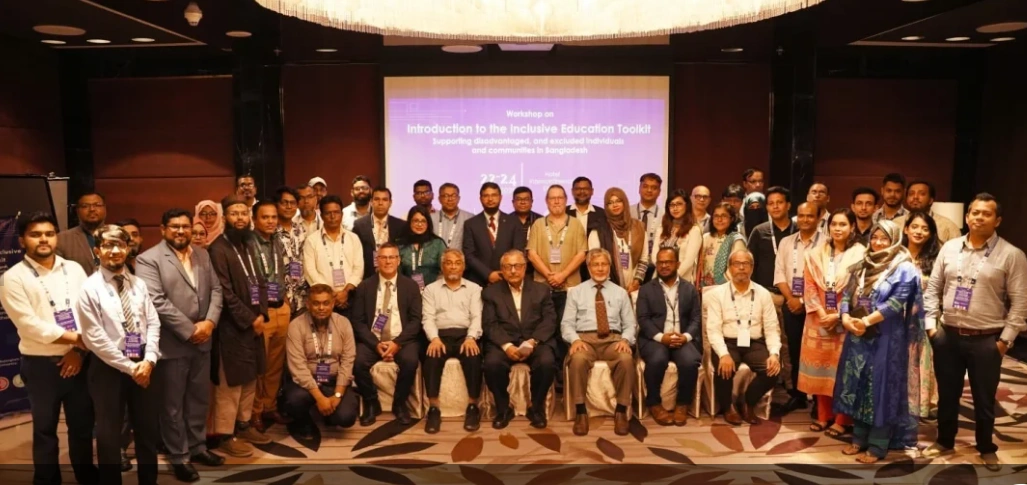
AIUB leads an international initiative that leverages artificial intelligence to expand access to higher education and promote inclusive learning opportunities for underrepresented groups. As part of this initiative, AIUB hosted a three-day workshop entitled Introduction to the Inclusive Education Toolkit in Dhaka in June 2025. The project is funded by the British Council's TransNational Education (TNE) initiative under the Generative AI for Good programme and is implemented in collaboration with Jahangirnagar University, the Bangladesh University of Engineering and Technology (BUET), and Nottingham Trent University, United Kingdom [1].
The workshop featured ten practical sessions demonstrating how AI-powered tools and inclusive teaching approaches can help address educational barriers and improve access to tertiary education for underrepresented communities in Bangladesh. The opening ceremony brought together representatives of the University Grants Commission (UGC) of Bangladesh and senior officials from the British Council, highlighting the initiative's engagement with national higher education stakeholders [1].
Faculty Research on Inequality and Social Inclusion
AIUB faculty contribute to research addressing issues related to discrimination, social exclusion, and sustainable development, generating knowledge that supports a better understanding of inequality and its implications [2], [3].
1. Deep-BERT: A Transfer Learning-Based Deep Learning Model for Classifying Multilingual Offensive Texts on Social Media. This research develops a deep learning model to identify offensive content across multiple languages on social media platforms. By addressing the automated detection of harmful and discriminatory language, the study contributes to research on online discrimination and the challenges faced by individuals and vulnerable communities in digital environments [2].
2. COVID-19 and Sustainable Development Goals: Bangladesh Perspective. This study examines the implications of the COVID-19 pandemic for Bangladesh's progress towards the Sustainable Development Goals. Its findings contribute to understanding the pandemic's broader socioeconomic consequences and the challenges associated with achieving inclusive and sustainable development [3].
International Conference on Women's Rights
On 17 February 2024, AIUB hosted the Second Virtual International Conference on Women's Rights in Emerging Societies, providing an international academic platform for discussing gender equality, women's empowerment, and policy development. The conference featured 106 research papers presented by 129 participants, including eight presenters from AIUB. Its discussions addressed gender-related challenges, intersectionality, and policy reforms, encouraging academic exchange on the multiple and overlapping forms of inequality affecting women in emerging societies [4], [5].
Non-Discrimination and Inclusive Admissions
Institutional Non-Discrimination Policy
AIUB is committed to maintaining an academic and working environment free from discrimination and harassment. Its Non-Discrimination Policy prohibits discriminatory practices against students and employees based on religion, race, colour, age, disability, nationality, marital status, sexual orientation, and gender identity. This commitment extends to student admissions, employment opportunities, and access to and participation in all university programmes and activities. Institutional decisions are guided by individual merit and the principle of equal treatment [6], [7].
Non-Discriminatory Admission Policy
AIUB's Non-Discriminatory Admission Policy establishes equal access to educational opportunities regardless of an applicant's personal or social background. The policy explicitly prohibits discrimination based on the following characteristics and circumstances [6], [8]:
- Age.
- Gender or gender identity.
- Sexual orientation.
- Race and colour.
- Disability.
- Religion.
- National or ethnic group.
- Membership in underrepresented or underprivileged groups.
- Non-traditional educational background.
These principles apply to the university's educational policies, admission procedures, scholarship programmes, and other institutional programmes, ensuring that applicants are considered within an inclusive framework of equal opportunity [6].
Admission of applicants with non-traditional educational backgrounds. AIUB also recognises applicants whose academic qualifications are equivalent to national requirements but are not explicitly listed by the University Grants Commission. Their qualifications are assessed by the admission interview committee, the relevant faculty dean, or the university administration following document verification. This provision facilitates access for individuals with alternative educational pathways and broadens opportunities for participation in higher education [6].
Dedicated Admission Policy for Underrepresented Groups
AIUB implements a dedicated Admission Policy for Underrepresented Groups as part of its commitment to promoting inclusive access to higher education and supporting individuals from disadvantaged backgrounds [9]. The policy explicitly identifies five groups eligible for consideration under this admission framework [6]:
- Ethnic minorities.
- Low-income applicants.
- Non-traditional students.
- Third-gender applicants.
- Newly settled refugees.
Applicants belonging to these groups provide supporting documentation to verify their eligibility and are assessed against the university's minimum academic requirements. Their applications undergo a review process involving recommendations from the admission interview committee, the relevant faculty dean, or the university administration [6].
The policy also specifically recognises individuals from the bottom 20% of household income as a designated group for inclusive admission opportunities. This provision establishes an institutional mechanism to facilitate access for applicants experiencing economic disadvantage and reinforces AIUB's commitment to expanding educational opportunities across different socioeconomic groups [10].
Monitoring Access and Participation of Underrepresented Groups
AIUB monitors applications and admissions involving underrepresented groups as part of its institutional efforts to promote equal access to higher education [11]. This monitoring supports the assessment of admission opportunities and the implementation of inclusive institutional policies, reinforcing the university's commitment to equitable participation in its academic programmes.
International Student Admission and Support
AIUB promotes an internationally inclusive academic environment by providing dedicated admission procedures and administrative assistance for international applicants. The university's Public Relations Department supports foreign applicants with essential documentation and administrative processes, including visa processing, migration certificates, and offer letters [12].
International students, including those originating from low-income and lower-middle-income countries, receive institutional assistance through the AIUB International Support Center. The centre coordinates with the International Office, the Office of Student Affairs, and the Office of Public Relations to facilitate student support and integration into the university community [13].
Furthermore, AIUB's Internationalization Policy promotes the recruitment and participation of international students, scholars, and faculty members, contributing to a diverse academic community and strengthening the university's international engagement [14].
Financial Support for Disadvantaged Students
AIUB promotes equitable access to higher education by providing scholarships, tuition fee waivers, and financial assistance to students from disadvantaged socioeconomic backgrounds and underrepresented groups. Its Scholarship (Tuition Fee Waiver) and Financial Aid Policy establishes different forms of financial support to address economic barriers and enable students to pursue and continue their university education regardless of their financial circumstances [15].
Scholarships Targeted at Underrepresented Groups
AIUB provides dedicated scholarships and tuition fee waivers to support students from groups that face particular barriers to accessing higher education. These initiatives include [15]:
1. Scholarship for Students from Underrepresented Groups. This scholarship supports full-time students belonging to ethnic minorities, low-income households, non-traditional student groups, third-gender communities, and newly settled refugee populations. Applicants must provide documentation verifying their eligibility, while the Scholarship Committee determines the applicable tuition fee waiver.
2. Scholarship for Students with Disabilities. AIUB provides financial assistance to full-time students with disabilities, as defined under the Bangladesh Persons with Disabilities Rights and Protection Act 2013, supporting their participation in higher education.
3. Dr. Anwarul Abedin Scholarship for Female Undergraduates. This scholarship grants a 100% tuition fee waiver to one high-achieving female undergraduate student from each faculty, promoting women's access to higher education and supporting their academic advancement.
Need-Based Financial Assistance
AIUB also implements financial assistance schemes that address different socioeconomic circumstances and help students manage educational expenses. These mechanisms include [15], [16]:
- General Need-Based Tuition Fee Waiver: Provides tuition assistance to students experiencing financial difficulties who maintain good academic standing.
- Freedom Fighter Waiver: Supports children of freedom fighters in accordance with relevant ministry guidelines and the University Grants Commission (UGC) quota policy.
- July Injured Waiver: Provides financial assistance to students affected by the events of July 2024, with eligibility assessed by the Waiver Committee based on the applicable ministry guidelines and supporting documentation.
- Sibling Waiver: Reduces the financial burden on families with more than one child enrolled at AIUB.
- Hardship Scholarships: Provides additional financial assistance to students experiencing unexpected economic difficulties arising from family crises or other challenging circumstances, following an individual assessment [16].
Together, these financial assistance mechanisms address different forms of economic disadvantage and support students in continuing their higher education.
On-Campus Employment and Financial Opportunities
AIUB provides students with opportunities to undertake temporary part-time employment on campus, enabling them to combine academic activities with paid work. Additionally, certain volunteer positions at university events provide daily allowances, offering students further opportunities to participate in institutional activities while receiving financial compensation [15].
Institutional Commitment to Full Scholarships
In accordance with Bangladesh's Private University Act, AIUB allocates full scholarships to at least 6% of its student population. This provision includes a minimum allocation of 3% for children of freedom fighters, while the remaining 3% is designated for students from other eligible categories [15].
This institutional commitment reinforces AIUB's efforts to expand access to higher education by providing full tuition support to students from different socioeconomic backgrounds and promoting greater equity in educational opportunities.
Disability Inclusion
AIUB promotes an inclusive academic environment by implementing admission procedures, financial assistance mechanisms, academic counselling services, and support arrangements that address the needs of students with disabilities. These initiatives reflect the university's commitment to facilitating equitable access to higher education and supporting the academic participation of individuals with disabilities [17].
Admission Policy for Students with Disabilities
AIUB's Admission Policy for Students with Disabilities establishes specific provisions to facilitate access to higher education for applicants with disabilities, reinforcing the university's commitment to an inclusive academic environment [18]. Applicants provide documentation verifying their disability status in accordance with the Bangladesh Persons with Disabilities Rights and Protection Act 2013 and must satisfy the university's minimum academic admission requirements.
As part of the admission process, the admission committee evaluates applicants' individual circumstances and recommends appropriate arrangements to ensure that campus facilities can accommodate their needs. This approach incorporates disability-related considerations into the admission process and supports more inclusive participation in university life [17].
Financial and Academic Support for Students with Disabilities
AIUB provides financial and academic support mechanisms to address the specific needs of students with disabilities and facilitate their continued participation in higher education. These include:
- Dedicated Financial Assistance. Students with disabilities are eligible to apply for tuition fee waivers each semester. The Scholarship Committee determines the applicable waiver percentage based on an individual assessment, providing financial support in accordance with each student's circumstances [15], [17].
- Academic Counselling and Guidance. The Office of Probation provides regular academic counselling through assigned academic advisors to students requiring additional academic support. It also offers specific support and benefits to students with disabilities and individuals from underrepresented groups. Female counsellors are available upon request, providing an additional consideration in the delivery of student support services [17], [19].
- Individual Support Arrangements. Students with disabilities can contact the Office of Student Affairs in advance to communicate their requirements and request appropriate support services. This arrangement provides an institutional channel for identifying and addressing individual needs within the university environment [17].
Disability Awareness and Community Inclusion
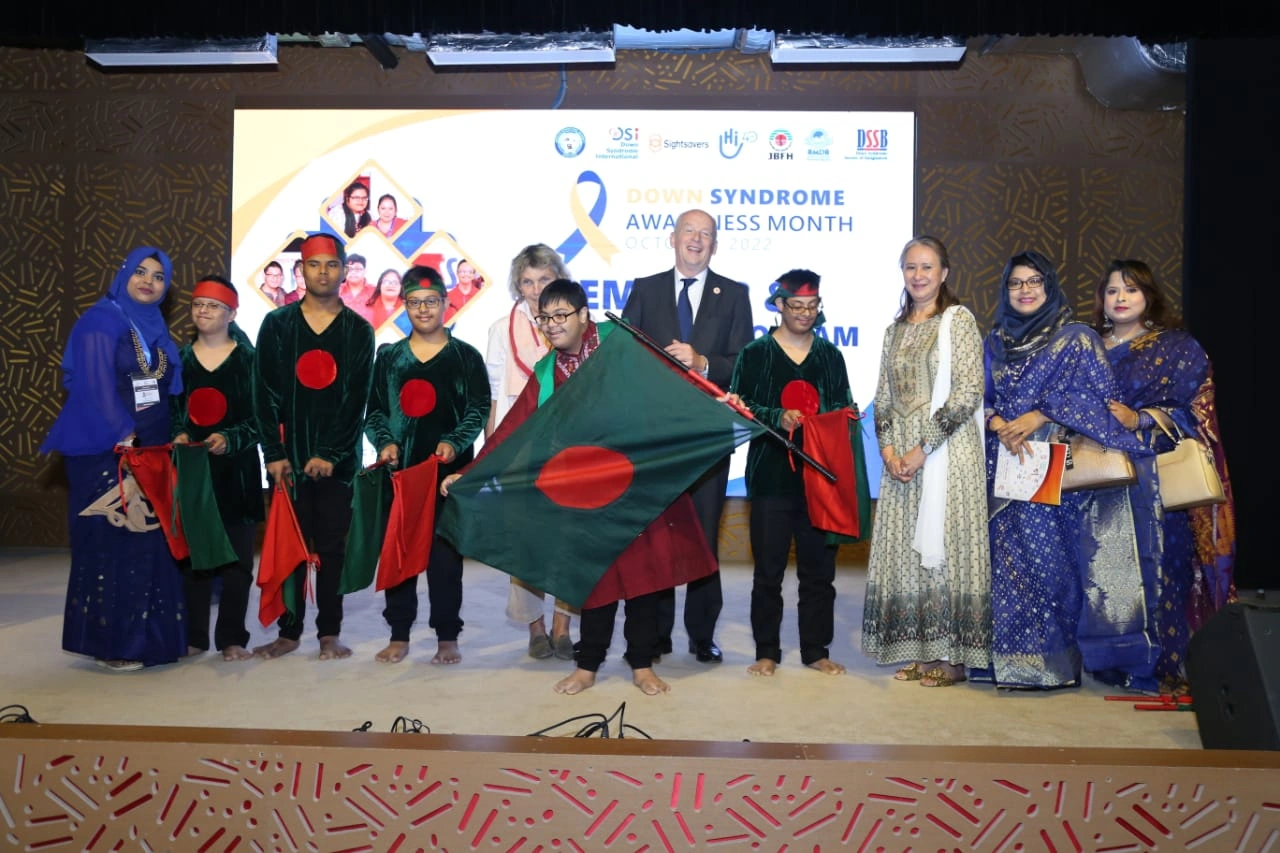
AIUB promotes disability awareness and social inclusion through activities that engage students, faculty members, and external organisations. On 20 October 2022, the Department of Public Health, in collaboration with the Down Syndrome Society of Bangladesh (DSSB), organised a campus event to celebrate Down Syndrome Awareness Month under the theme #InclusionMeans [20], [21].
The programme commenced with an awareness rally involving children with Down syndrome, DSSB representatives, students, and faculty members. The event highlighted the importance of promoting awareness and encouraging the inclusion of people with Down syndrome in all aspects of society. The participation of university stakeholders and members of the wider community reinforced AIUB's engagement in advancing disability awareness and fostering a more inclusive society [20], [21].
Diversity Governance and Inclusive Campus Culture
AIUB promotes diversity, equality, and inclusion as integral elements of its institutional governance and campus culture. The university has established dedicated structures, support services, reporting procedures, and community engagement activities to foster an environment in which students and employees from diverse backgrounds can participate and contribute to university life [22], [23].
Diversity and Equality Committee
AIUB has established a Diversity and Equality Committee to integrate diversity, equality, inclusion, and human rights into its institutional activities and strategic direction. Chaired by the Vice-Chancellor, the committee brings together representatives from each faculty, administrative staff, and the student community, ensuring participation from different university stakeholders in institutional diversity initiatives [22].
The committee is responsible for the following activities [22]:
1. Periodically reviewing institutional policies on diversity, equality, inclusion, and human rights, and recommending relevant updates.
2. Encouraging and supporting students, faculty members, and employees participating in diversity and equality initiatives.
3. Organising capacity-building activities on diversity and equality for students, faculty members, and administrative staff.
4. Evaluating institutional progress in diversity and equality and assessing its impact on different stakeholder groups.
These responsibilities establish an institutional framework for promoting inclusive practices, strengthening stakeholder participation, and monitoring progress in diversity and equality across the university.
Equality, Diversity and Inclusion (EDI) Center
AIUB's Equality, Diversity and Inclusion (EDI) Center provides dedicated resources, support, and advocacy for minority employees, students, and communities. The centre promotes awareness and understanding of diversity through training sessions and educational workshops involving students, faculty members, and administrative staff.
It also serves as an institutional resource for addressing diversity-related conflicts by providing mediation and support to individuals requiring assistance. These activities strengthen AIUB's capacity to foster an inclusive academic and working environment and promote respect for individuals from diverse backgrounds [23].
Protection Against Discrimination and Harassment
AIUB provides established procedures for reporting incidents of discrimination and harassment within the university community. Students can submit complaints to the Office of Student Affairs, while employees can raise concerns through the Office of Human Resources. Standardised complaint forms are made available on the university website to facilitate access to these reporting mechanisms [6], [24].
By assigning responsibilities to designated administrative offices and providing formal reporting procedures, AIUB establishes institutional channels for addressing discrimination and harassment and supporting members of its academic and working communities.
Mentoring, Counselling and Mental Health Support
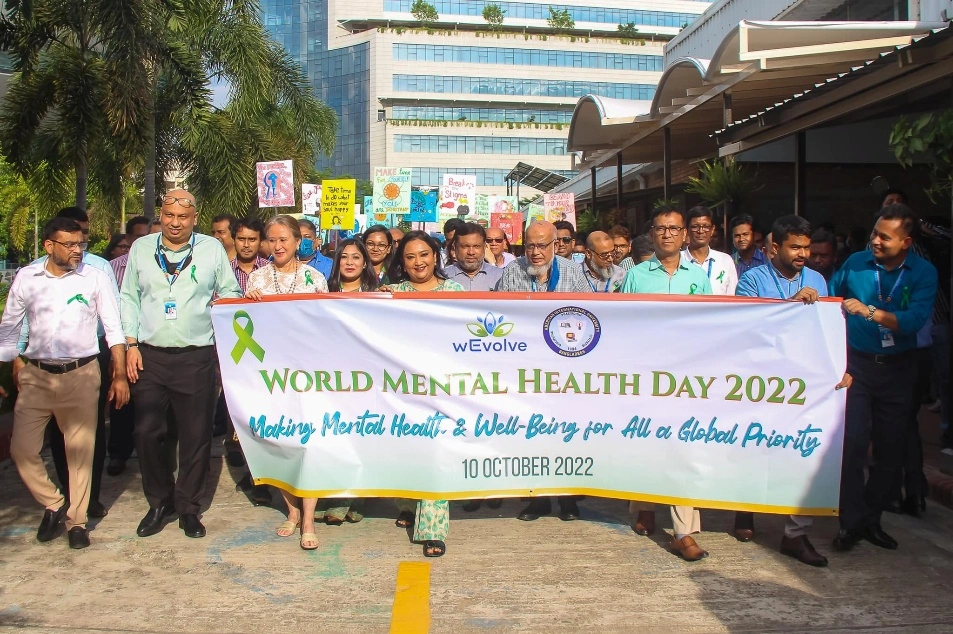
AIUB supports students from diverse backgrounds through mentoring, counselling, and peer support initiatives that provide academic guidance and additional assistance throughout their university experience [11].
As part of its commitment to student well-being, AIUB introduced wEvolve, a mental health support service, on campus in 2022 during its World Mental Health Day celebration. This initiative expanded the university's student support services and reinforced the importance of mental health awareness and access to support within the academic community [25].
Promoting Diversity Through Cultural and Academic Engagement
AIUB encourages respect for cultural, linguistic, and individual differences through university events and student-led activities that promote diversity and inclusion [11]. Examples include:
- International Mother Language Day. AIUB student clubs commemorate the Language Martyrs of 1952 through activities that recognise the importance of linguistic heritage and cultural identity. These celebrations promote appreciation of linguistic diversity and the preservation of cultural traditions within the university community [26].
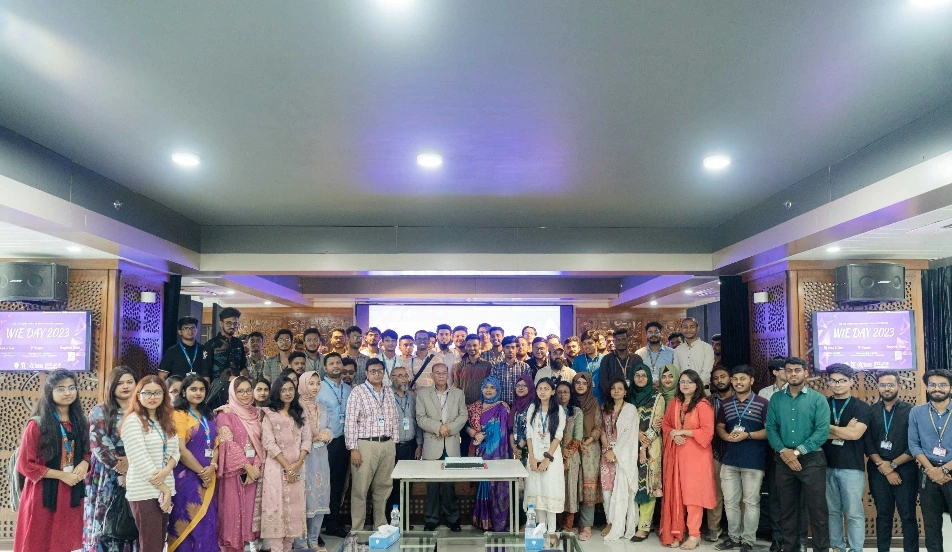
- Women in Engineering (WIE) Day. The IEEE AIUB Student Branch Women in Engineering (WIE) Affinity Group organises activities to celebrate WIE Day and promote women's participation in engineering and technology. These initiatives encourage greater recognition of women's contributions to technical fields and support efforts to broaden female participation in traditionally male-dominated disciplines [27].
Community Outreach and Partnerships
AIUB Social Welfare Club – Shomoy
Founded in 2009, the AIUB Social Welfare Club – Shomoy engages students in community service, social welfare initiatives, and volunteer activities that promote social responsibility and leadership development. The club collaborates with various non-governmental organisations to support disadvantaged communities through humanitarian assistance, blood donation campaigns, winter clothing distribution, and educational activities for underprivileged children [28].
Its community outreach initiatives include:
| Date | Activity | Reach |
| 5 April 2024 | Oder Eid, Amader Khushi ("Their Eid, Our Joy"): distribution of Eid gift packages to underprivileged children at Kathpencil Pathshala. | Approximately 150 families [29], [32] |
| September 2024 | Standing with the Flood-Affected: distribution of food and provision of medical assistance across flood-affected districts. | 1,200 families [29], [30] |
| Winter 2024–2025 | Winter Clothing Drive: distribution of blankets to support people facing seasonal hardship. | 350 blankets distributed [31] |
| 30 July 2025 | Awareness and voluntary blood donation programme organised in collaboration with the Bangladesh Red Crescent Society. | Members of the campus community [32] |
| 6 September 2025 | Rongin Shomoy 2025: a day-long recreational and community engagement event for underprivileged children at Kathpencil Pathshala. | Children from the school [33] |
A key component of the club's community engagement is its collaboration with Kathpencil Pathshala, a non-profit organisation dedicated to the education and well-being of underprivileged children. Shomoy members regularly volunteer at the school, supporting initiatives that promote children's educational opportunities and social inclusion [34], [33].
These activities demonstrate AIUB's engagement in community-based initiatives addressing socioeconomic vulnerability, supporting families affected by natural disasters, and expanding opportunities for children from disadvantaged backgrounds.
Promoting Women's Participation in the Power Sector
AIUB contributes to gender inclusion in the energy sector as an institutional partner of WePOWER, the Women in Power Sector Professional Network in South Asia. As part of this partnership, AIUB developed a dedicated Gender Activities Plan and established a 10-member committee responsible for coordinating and implementing the planned initiatives [35], [36].
In September 2024, AIUB further advanced this collaboration by co-organising the seminar Female Students Career-Building Opportunities in Power Sector with the WePOWER Bangladesh Chapter. The event provided an academic platform to highlight professional development opportunities for female students in the energy and power industries. Combined with AIUB's institutional gender activities plan and its dedicated 10-member implementation committee, this initiative reinforces the university's engagement in promoting women's participation in STEM education and professional careers within the power sector [37].
This institutional engagement provides a framework for promoting women's participation and professional development in the power sector, strengthening collaboration around gender inclusion and supporting greater representation of women in a traditionally male-dominated industry.
Research on Inclusive Development and Social Inequalities
Assistive Technology for Inclusive Early Childhood Education
AIUB contributes to inclusive education through research and technological innovation addressing the learning needs of children with disabilities and neurodevelopmental differences. An example is Kids Play: A Touch Screen Application for Early Childhood Education of Autistic and Learning-Disabled Children, a research project developed by AIUB-affiliated researchers and published in 2020 [38].
The study presents an interactive touchscreen application designed to support preschool learning among children with autism and learning disabilities. Its development incorporated user research to identify the educational and interaction requirements of the intended learners, followed by evaluations conducted in three schools involving children aged 3–5, teachers, and parents.
By exploring accessible and engaging digital learning experiences, this research contributes to the development of assistive educational technologies and supports broader efforts to expand inclusive learning opportunities for children with diverse educational needs [38].
Research on Employment Inclusion for Persons with Disabilities
AIUB faculty contribute to research addressing the employment inclusion and workplace welfare of persons with disabilities in Bangladesh. In 2019, Dr. Sahin Akter Sarker published Corporate Scenario Analysis of Physically Challenged Human Resources in Bangladesh, examining human resource management practices related to the employment opportunities and welfare of persons with disabilities [39].
The study draws on primary survey data collected from public and private companies, multinational corporations, and non-governmental organisations in and around Dhaka. Its research scope examines the role of human resource administration in addressing the workplace needs of persons with disabilities and contributes to the academic discussion on workforce diversity, equal employment opportunities, and inclusive organisational practices [39].
Research on Socioeconomic Inequalities in Healthcare Access
AIUB contributes to international research examining socioeconomic inequalities in access to essential healthcare services. An example is Wealth Stratified Inequalities in Service Utilisation of Breast Cancer Screening Across the Geographical Regions: A Pooled Decomposition Analysis, co-authored by Rezwanul Haque of AIUB's Department of Economics and published in 2020 [40].
The study analyses data from 140,974 women across 14 low-resource countries, examining how household wealth, geographical location, health insurance coverage, and other socioeconomic factors influence access to breast cancer screening services. Its findings provide evidence on the relationship between socioeconomic conditions and access to preventive healthcare, contributing to the development of more equitable health financing and service-delivery strategies [40].
Digital Technologies and Worker Empowerment in Bangladesh
AIUB contributes to research exploring how digital technologies can support worker empowerment and organisational development in Bangladesh's manufacturing sector. In 2021, Taimur Ahad, from AIUB's Department of Computer Science, co-authored the study Bangladeshi Ready-Made Garment Development via Ubiquitous and Mobile Computing, published in The Electronic Journal of Information Systems in Developing Countries [41].
Based on 39 interviews, the research examines the application of mobile-based ubiquitous systems in Bangladesh's ready-made garment industry. It identifies five key technological dimensions: connectivity, mobility, agility, empowerment, and governance. The study highlights the potential of mobile information systems to improve communication, coordination, and worker empowerment, contributing to research on more inclusive and technologically enabled working environments [41].
References
| [1] | Dhaka Tribune, “AIUB Hosts 3-Day Workshop on Inclusive Education Toolkit,” [Online]. Available: https://www.dhakatribune.com/bangladesh/384919/aiub-hosts-3-day-workshop-on-inclusive-education. [Accessed 2026]. |
| [2] | tsp, “Deep-BERT: Transfer learning based deep learning model for classifying multilingual offensive texts on social media,” [Online]. Available: https://www.techscience.com/csse/v44n2/48287. [Accessed 2026]. |
| [3] | Inderscience, “COVID-19 and Sustainable Development Goals: Bangladesh perspective,” [Online]. Available: https://www.inderscience.com/info/inarticle.php?artid=125098. [Accessed 2026]. |
| [4] | American International University-Bangladesh, “The Second Virtual International Conference on Women's Rights in Emerging Societies,” [Online]. Available: https://www.aiub.edu/the-second-virtual-international-conference-on-womens-rights-in-emerging-societies. [Accessed 2026]. |
| [5] | Daily Sun, “Second virtual international conference on women's rights in emerging societies.,” [Online]. Available: https://www.daily-sun.com/printversion/details/554907. [Accessed 2026]. |
| [6] | American International University-Bangladesh, “Equality, Diversity and Inclusion Policy,” [Online]. Available: https://aiub.edu/sustainability/equality-diversity-and-inclusion-policy-. [Accessed 2026]. |
| [7] | American International University-Bangladesh, “AIUB Non-Discrimination Policy,” [Online]. Available: https://www.aiub.edu/administration/institutional-policy/aiub-non-discrimination-policy. [Accessed 2026]. |
| [8] | American International University-Bangladesh, “Non-Discriminatory Admission Policy,” [Online]. Available: https://www.aiub.edu/admission/admission-policy/aiub-non-discriminatory-admission-policy. [Accessed 2026]. |
| [9] | American International University-Bangladesh, “Admission Policy for Underrepresented Group,” [Online]. Available: https://www.aiub.edu/admission/admission-policy/aiub-admission-policy-for-underrepresented-group-. [Accessed 2026]. |
| [10] | Bottom Financial Quintile Admission Target, “American International University-Bangladesh,” [Online]. Available: https://aiub.edu/sustainability/sdg1/initiative/bottom-financial-quintile-admission-target. [Accessed 2026]. |
| [11] | American International University-Bangladesh, “AIUB SDG Activity Report 2023 | SDG 10: Reduced Inequalities,” [Online]. Available: https://www.aiub.edu/iqac/sdgs/aiub-sdg-activity-report-2023/sdg10-aiubactivityreportof2023. [Accessed 2026]. |
| [12] | American International University-Bangladesh, “International Students,” [Online]. Available: https://aiub.edu/admission/international-students. [Accessed 2026]. |
| [13] | American International University-Bangladesh, “Low or Lower-middle Income Countries Student Support,” [Online]. Available: https://aiub.edu/sustainability/sdg1/initiative/low-or-lower-middle-income-countries-student-support. [Accessed 2026]. |
| [14] | American International University-Bangladesh, “AIUB Internationalization Policy,” [Online]. Available: https://aiub.edu/administration/institutional-policy/aiub-internationalization-policy. [Accessed 2026]. |
| [15] | American International University-Bangladesh, “Scholarship (tuition fee waiver only) and Financial Aid Policy,” [Online]. Available: https://www.aiub.edu/admission/scholarships. [Accessed 2026]. |
| [16] | The Daily Star, “Higher education made affordable: A scholarship guide for aspiring students,” [Online]. Available: https://epfs.thedailystar.net/TDS/2025/02/02/Bangladesh/SUP/5_06/fbea1bcfd89fdc8f_06.pdf. [Accessed 2026]. |
| [17] | American International University-Bangladesh, “Support Services for Individuals with Disabilities at American International University-Bangladesh (AIUB),” [Online]. Available: https://aiub.edu/sustainability/support-services-for-individuals-with-disabilities-at-american-international-university-bangladesh-aiub. [Accessed 2026]. |
| [18] | American International University-Bangladesh, “Admission Policy for Students with Disability,” [Online]. Available: https://www.aiub.edu/admission/admission-policy/aiub-admission-policy-for-students-with-disability. [Accessed 2026]. |
| [19] | American International University-Bangladesh, “Office of Probation.,” [Online]. Available: https://www.aiub.edu/offices/op. [Accessed 2026]. |
| [20] | The Business Standard, “Down syndrome awareness month celebrated at AIUB,” [Online]. Available: https://www.tbsnews.net/bangladesh/education/down-syndrome-awareness-month-celebrated-aiub-517054. [Accessed 2026]. |
| [21] | American International University-Bangladesh, “Down Syndrome Awareness Month Celebrated at AIUB,” [Online]. Available: https://www.aiub.edu/down-syndrome-awareness-month-celebrated-at-aiub. [Accessed 2026]. |
| [22] | American International University-Bangladesh, “Diversity and Equality Committee,” [Online]. Available: https://aiub.edu/administration/institutional-policy/diversity-and-equality-committee. [Accessed 2026]. |
| [23] | American International University-Bangladesh, “Equality, Diversity and Inclusion (EDI) Center.,” [Online]. Available: https://aiub.edu/oncampus/equality-diversity-and-inclusion-edi-center. [Accessed 2026]. |
| [24] | American International University-Bangladesh, “Policy at AIUB that Protects Those Reporting Discrimination from Educational or Employment Disadvantages,” [Online]. Available: https://aiub.edu/sustainability/sdg5/sdg5-initiative/policy-at-aiub-that-protects-those-reporting-discrimination-from-educational-or-employment-disadvantages. [Accessed 2026]. |
| [25] | American International University-Bangladesh, “World Mental Health Day 2022 celebration and introducing wEvolve at AIUB,” [Online]. Available: https://www.aiub.edu/world-mental-health-day-2022-celebration-and-introducing-wevolve-at-aiub. [Accessed 2026]. |
| [26] | American International University-Bangladesh, “AIUB Student Clubs paid tribute to the Language Martyrs,” [Online]. Available: https://www.aiub.edu/aiub-student-clubs-paid-tribute-to-the-language-martyrs. [Accessed 2026]. |
| [27] | American International University-Bangladesh, “IEEE AIUB Student Branch WIE Affinity Group Successfully Celebrated ‘WIE Day’,” [Online]. Available: https://www.aiub.edu/ieee-aiub-student-branch-wie-affinity-group-successfully-celebrated-wie-day. [Accessed 2026]. |
| [28] | American International University-Bangladesh, “AIUB Social Welfare Club – SHOMOY,” [Online]. Available: https://www.aiub.edu/oncampus/clubs/aiub-social-welfare-club--shomoy. [Accessed 2026]. |
| [29] | American International University-Bangladesh, “Programmes for Services Access,” [Online]. Available: https://aiub.edu/sustainability/sdg1/initiative/programmes-for-services-access. [Accessed 2026]. |
| [30] | American International University-Bangladesh, “Students of AIUB: Standing with the Flood-Effected,” [Online]. Available: https://www.aiub.edu/students-of-aiub-standing-with-the-flood-effected. [Accessed 2026]. |
| [31] | American International University-Bangladesh, “"AIUB Social Welfare Club–Shomoy Carried Out Winter Clothing Drive 2024-25,” [Online]. Available: https://www.aiub.edu/aiub-social-welfare-clubshomoy-carried-out-winter-clothing-drive-2024-25. [Accessed 2026]. |
| [32] | TBS Graduates, “AIUB Hosts 'Awareness Building and Voluntary Blood Donation Programme',” [Online]. Available: https://tbsgraduates.net/?p=18662. [Accessed 2026]. |
| [33] | The Daily Star, “AIUB Social Welfare Club–Shomoy organises 'Rongin Shomoy 2025' for underprivileged children at Kathpencil Pathshala,” [Online]. Available: https://online91.thedailystar.net/campus/noticeboard/news/aiub-social-welfare-club-shomoy-organises-rongin-shomoy-2025. [Accessed 2026]. |
| [34] | American International University-Bangladesh, “'Oder Eid, Amader Khushi' by the AIUB Social Welfare Club – Shomoy,” [Online]. Available: https://www.aiub.edu/oder-eid-amader-khushi-by-the-aiub-social-welfare-club---shomoy. [Accessed 2026]. |
| [35] | American International University-Bangladesh, “AIUB Is an Institutional Partner of WePOWER,” [Online]. Available: https://www.aiub.edu/aiub-is-an-institutional-partner-of-wepower. [Accessed 2026]. |
| [36] | American International University-Bangladesh, “SDG 5: Gender Equality,” [Online]. Available: https://www.aiub.edu/sustainability/sdg5. [Accessed 2026]. |
| [37] | American International University-Bangladesh, “AIUB is an institutional partner of WePOWER,” [Online]. Available: https://aiub.edu/aiub-is-an-institutional-partner-of-wepower. [Accessed 2026]. |
| [38] | K. Nur, F. Jahan, and M. Mostafa, “Kids Play: A touch screen application for early childhood education of autistic and learning-disabled children,” [Online]. Available: https://dl.acm.org/doi/10.1145/3377049.3377123. [Accessed 2026]. |
| [39] | S. A. Sarker, “Corporate scenario analysis of physically challenged human resources in Bangladesh,” [Online]. Available: https://iba-du.edu/upload_images/Vol.40_No.1_Article_5.pdf. [Accessed 2026]. |
| [40] | R. A. Mahumud, K. Alam, S. A. Keramat, A. M. N. Renzaho, M. G. Hossain, R. Haque, G. M. Ormsby, J. Dunn, and J. Gow, “Wealth stratified inequalities in service utilisation of breast cancer screening across the geographical regions: A pooled decomposition analysis,” [Online]. Available: https://pubmed.ncbi.nlm.nih.gov/32528677/. [Accessed 2026]. |
| [41] | T. Ahad, P. Busch, Y. Blount, and W. Picoto, “Bangladeshi ready-made garment development via ubiquitous and mobile computing,” [Online]. Available: https://onlinelibrary.wiley.com/doi/10.1002/isd2.12170. [Accessed 2026]. |