


TABLE OF CONTENTS
Solar Irrigation for Climate Adaptation
Renewable Energy Systems for Climate-Vulnerable Areas
Student Research on Climate Risks and Adaptation
Institutional Research Infrastructure and Climate Action
Low-Carbon Energy and the Commitment to Net Zero
Renewable Energy Generation and Low-Carbon Campus Operations
Climate Education and Awareness
Climate Change Education and Curriculum Integration
Public Dialogues, Seminars and Climate Knowledge Exchange
Student-Led Climate Awareness Campaigns
Disaster Resilience and Cooperation for Climate Action
Collaborative Approaches to Disaster Management and Climate Resilience
Community Response to Climate-Related Disasters
Partnerships with Government, Development Organisations and Industry
Research on Climate Vulnerability and Community-Led Adaptation
Machine Learning for Flood Prediction and Disaster Risk Reduction
Climate Change, Forced Migration and Indigenous Community Resilience
Indigenous Women-Led Climate Solutions and Adaptation Strategies
Youth Engagement and Climate Policy Dialogue
Bangladesh International Model United Nations: Addressing Climate Vulnerability
Climate Justice and Academic Dialogue
Institutional Reporting on Progress Towards SDG 13
SDG 13: CLIMATE ACTION
Research on Climate Change
Solar Irrigation for Climate Adaptation
AIUB participates in an international research project titled Social Innovation Through Technology Nudging: Developing a Behavioural Toolkit for Diffusing Solar Irrigation. Led by Durham University (United Kingdom), the project brings together Curtin University (Australia), AIUB, the University of Rajshahi and Khulna University as research partners [1]. The initiative aims to develop a social innovation model that applies behavioural nudging strategies to encourage farmers to adopt solar-powered irrigation technologies as a climate-smart alternative. By facilitating the adoption of renewable energy solutions in agricultural practices, the project contributes to strengthening climate adaptation and agricultural resilience [1].
The project received funding from the World Bank through the Asian Disaster Preparedness Centre (ADPC), Thailand, under the Innovations for Climate Adaptation and Resilience (iCARE) fund [2]. AIUB actively contributed to the project's implementation and dissemination through two major activities:
Policy Engagement Workshop (7 February 2024). AIUB hosted the project's initiation workshop on its campus, bringing together stakeholders to discuss the research background, objectives, proposed activities and expected outcomes. The event established a collaborative foundation for exploring behavioural approaches to promoting solar irrigation among farming communities [1].
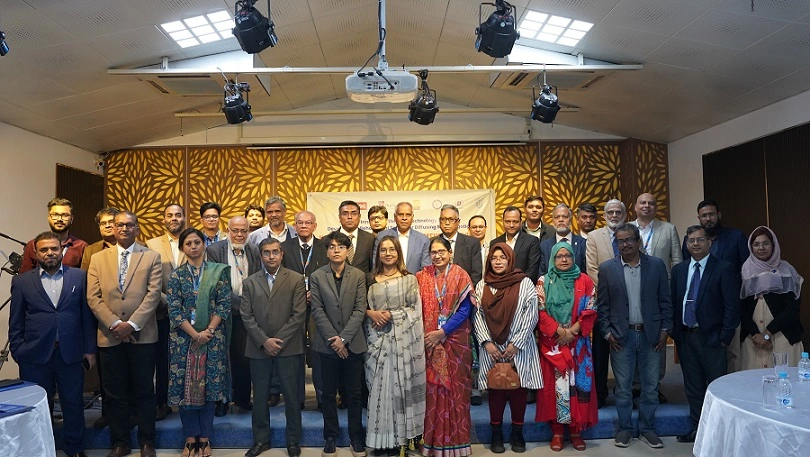
Dissemination Workshop (December 2024). AIUB organised a dissemination workshop in Dhaka to present the findings of the year-long research project and encourage policy discussions on sustainability, climate change adaptation and the adoption of solar irrigation technologies. The event gathered more than 100 participants, including academics, policymakers, subject-matter experts and government officials from Bangladesh, the United Kingdom, Australia and Thailand [2], [3].
The discussions highlighted the potential of solar-powered irrigation as an innovative solution for strengthening agricultural resilience and supporting climate adaptation among farming communities in Bangladesh [2].
Renewable Energy Systems for Climate-Vulnerable Areas
AIUB contributes to research on renewable energy solutions designed to address energy challenges in geographically isolated and climate-vulnerable regions of Bangladesh. Its research includes the development and assessment of hybrid energy systems that combine renewable resources to support reliable and sustainable electricity generation.
Notable research contributions include:
- Hybrid Renewable Energy System for Kuakata. AIUB researchers conducted a techno-economic assessment of an off-grid hybrid renewable energy system for Kuakata, a coastal region of Bangladesh. Published in the journal Energies in 2024, the study explores the feasibility of integrating renewable energy technologies to provide sustainable electricity in coastal areas [4].
- Solar-Wind-Biomass Hybrid Power System for Chapainawabganj. Researchers from AIUB developed a design for an off-grid hybrid power generation system combining solar, wind and biomass energy resources to serve remote areas of Chapainawabganj district. The research was presented at the IEEE ICREST 2023 conference, demonstrating the university's contribution to innovative renewable energy solutions for geographically underserved communities [5].
These research activities strengthen AIUB's contribution to exploring decentralized renewable energy technologies that can support sustainable development and improve energy resilience in vulnerable regions.
Student Research on Climate Risks and Adaptation
AIUB promotes student engagement in climate-related research, encouraging the investigation of environmental changes and their implications for communities across Bangladesh. One student research study examined the effects of climate change on flood dynamics in the country, with particular attention to the implications for climate adaptation and planning.
Using historical climate and flood data, the study identified an approximately 30% increase in rainfall in Bangladesh between 1980 and 2024 [6]. This research contributes to understanding changing precipitation patterns and their relationship with flood risks, providing relevant insights to support evidence-based climate adaptation strategies and disaster preparedness.
Institutional Research Infrastructure and Climate Action
AIUB supports climate-related research through the Center for Sustainable Energy Research (CSER), operating under the Dr. Anwarul Abedin Institute of Innovation (D2A2I). This institutional research centre provides a framework for advancing research and innovation in sustainable energy technologies and related environmental challenges [7].
Furthermore, AIUB's Climate Action Plan establishes an institutional framework for strengthening research and academic engagement in climate action. The plan promotes interdisciplinary climate research across academic departments, encourages student participation in climate-related research projects, and fosters collaborative initiatives with industry, government agencies and non-governmental organisations [8].
These institutional mechanisms reinforce AIUB's commitment to advancing climate research, developing sustainable technological solutions and strengthening collaboration among academic, public and private stakeholders to address climate change.
Low-Carbon Energy and the Commitment to Net Zero
AIUB Climate Action Plan
AIUB has established an institutional commitment to climate action through its Climate Action Plan (CAP), initiated following a directive from the university's Board of Trustees approximately a decade ago. Its development involved the establishment of a Climate Action Task Force comprising faculty members, administrative staff and students. The plan provides a strategic framework for reducing greenhouse gas emissions, strengthening campus resilience and progressively transitioning toward a carbon-neutral campus [8].
The CAP follows a continuous improvement cycle involving the establishment of climate targets, assessment of proposed measures, evaluation of implementation costs and periodic revision of objectives. This process incorporates feedback from students, faculty, staff and other stakeholders, promoting shared responsibility for the university's climate action agenda [8].
The plan addresses five key operational areas:
| Operational area | Main measures |
| Energy | Adoption of energy-efficient appliances, lighting, heating and cooling systems, alongside renewable energy solutions such as solar panels. |
| Waste Management | Recycling and composting programmes, reusable alternatives and initiatives to reduce single-use plastics. |
| Green Infrastructure | Expansion of green spaces, diverse tree planting, use of environmentally friendly construction materials and biodiversity conservation. |
| Water Management | Installation of water-efficient fixtures, monitoring of water consumption and promotion of responsible water-use practices. |
| Sustainable Procurement | Prioritisation of environmentally friendly products, materials and suppliers. |
AIUB also collaborates with Krishi Shwapno, a youth-led agri-tech and clean-tech start-up focused on technology-driven circular economy solutions, to support campus climate action initiatives and advance its carbon-neutrality objectives [8].
The university further reinforces these efforts with its Sustainable Procurement Policy, which prioritises energy-efficient products and promotes environmentally responsible delivery and transportation practices [9]. Together, these institutional measures integrate climate considerations into campus operations, resource management and procurement decisions.
Race to Zero Commitment
On 16 April 2024, AIUB announced its commitment to the United Nations-backed Race to Zero campaign, a global initiative that mobilises businesses, cities, educational institutions and other non-state actors to achieve substantial emissions reductions by 2030 and contribute to a net-zero global economy [10].
By joining Race to Zero, AIUB became part of the Climate Ambition Alliance, strengthening its engagement with international efforts to accelerate climate action. Its participation is also registered on the United Nations Global Climate Action portal [10]. Furthermore, AIUB is recognised among the signatories of Race to Zero for Universities and Colleges, reinforcing its institutional commitment to advancing decarbonisation within the higher education sector [11].
This commitment aligns AIUB's campus sustainability agenda with broader international climate objectives and supports its long-term transition toward net-zero emissions.
Renewable Energy Generation and Low-Carbon Campus Operations
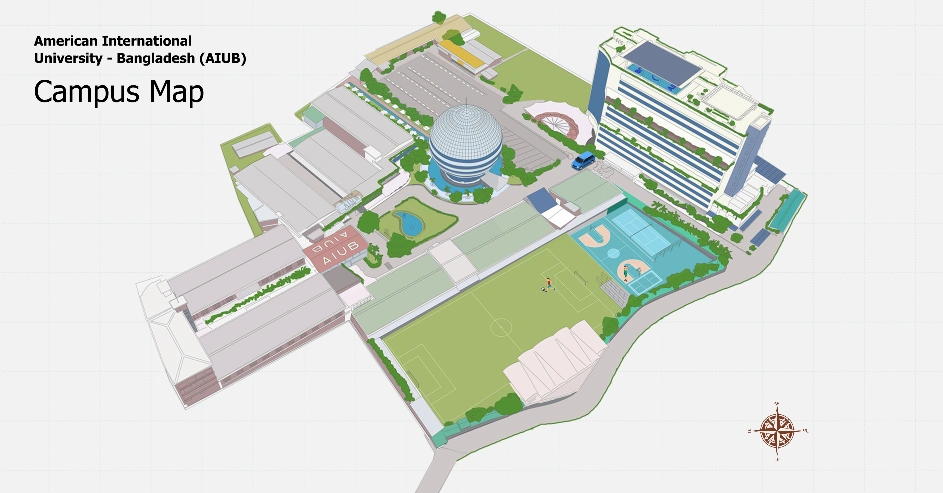
AIUB has strengthened its transition toward low-carbon campus operations by expanding the use of renewable energy. The university has installed solar energy systems with a combined capacity exceeding 130 kW, contributing to clean energy generation on campus and supporting the reduction of reliance on conventional energy sources [12].
In addition, AIUB monitors the proportion of its energy consumption supplied by low-carbon sources, providing an institutional basis for tracking progress in its energy transition [13].
The university has also assessed its campus environmental footprint and greenhouse gas emissions to inform its decarbonisation strategy. These assessments support the identification of opportunities to expand renewable energy use, improve infrastructure energy efficiency and promote sustainable practices across campus operations [14].
Collectively, these initiatives demonstrate AIUB's commitment to integrating renewable energy, emissions monitoring and sustainable resource management into its institutional climate action strategy.
Climate Education and Awareness
Climate Change Education and Curriculum Integration
AIUB incorporates climate change and sustainability into its academic activities and curricula, promoting environmental awareness and knowledge development among students [13]. Its Climate Action Plan establishes a framework for further integrating the Sustainable Development Goals (SDGs) into existing courses, introducing multidisciplinary courses focused on climate change, and promoting experiential learning activities, including energy conservation challenges. The plan also encourages the development of student climate ambassadors through university clubs, fostering student engagement in institutional climate action initiatives [8].
In addition, AIUB maintains a catalogue of sustainability-related courses offered across its academic programmes, demonstrating the integration of environmental and sustainability topics into its educational activities [15]. These initiatives strengthen students' understanding of climate-related challenges and encourage the development of knowledge and practical skills relevant to sustainable development.
Public Dialogues, Seminars and Climate Knowledge Exchange
AIUB promotes climate awareness and knowledge exchange by organising academic dialogues, seminars and webinars that bring together policymakers, diplomats, researchers, industry representatives and students. These activities provide opportunities to discuss climate challenges, explore innovative solutions and strengthen collaboration among different stakeholders.
Notable initiatives include:
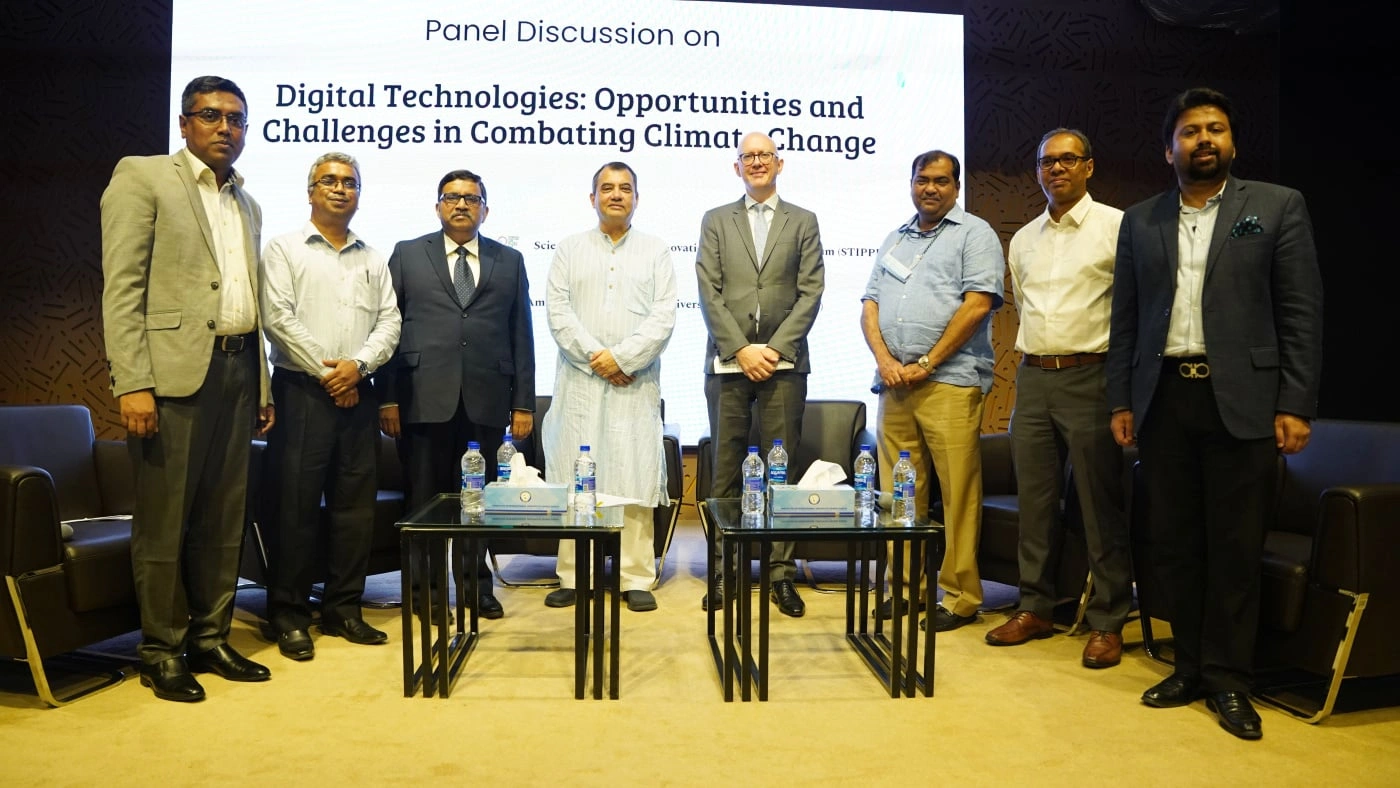
1. Digital Technologies and Climate Change (6 June 2023). AIUB, in collaboration with the Science, Technology, Innovation & Public Policy Forum, organised a panel discussion examining the role of digital technologies in addressing climate change. The event brought together prominent representatives from government, diplomacy, academia and industry, including the Chairman of the Parliamentary Standing Committee on the Ministry of Environment, Forest and Climate Change and the Ambassador and Head of the European Union Delegation to Bangladesh [16], [17]. The discussion highlighted the potential of technological innovation and cross-sector collaboration in advancing climate action.
2. Women Empowerment for Climate Mitigation and Resilience (29 July 2023). The IEEE AIUB Student Branch Women in Engineering Affinity Group organised a webinar titled Women Empowerment for Mitigating Climate Change and Building Climate Resilience. Featuring the 2023 IEEE Women in Engineering Chair as keynote speaker, the event attracted more than 70 participants and highlighted the importance of women's empowerment and leadership in climate mitigation and resilience-building initiatives [18], [19].

3. Smart Power Systems and Climate Change (10 October 2023). As part of IEEE Day 2023, AIUB students organised a seminar exploring the contribution of automation and renewable energy technologies to the development of more sustainable and climate-resilient power systems. The activity encouraged student engagement with technological solutions to contemporary energy and climate challenges [20].
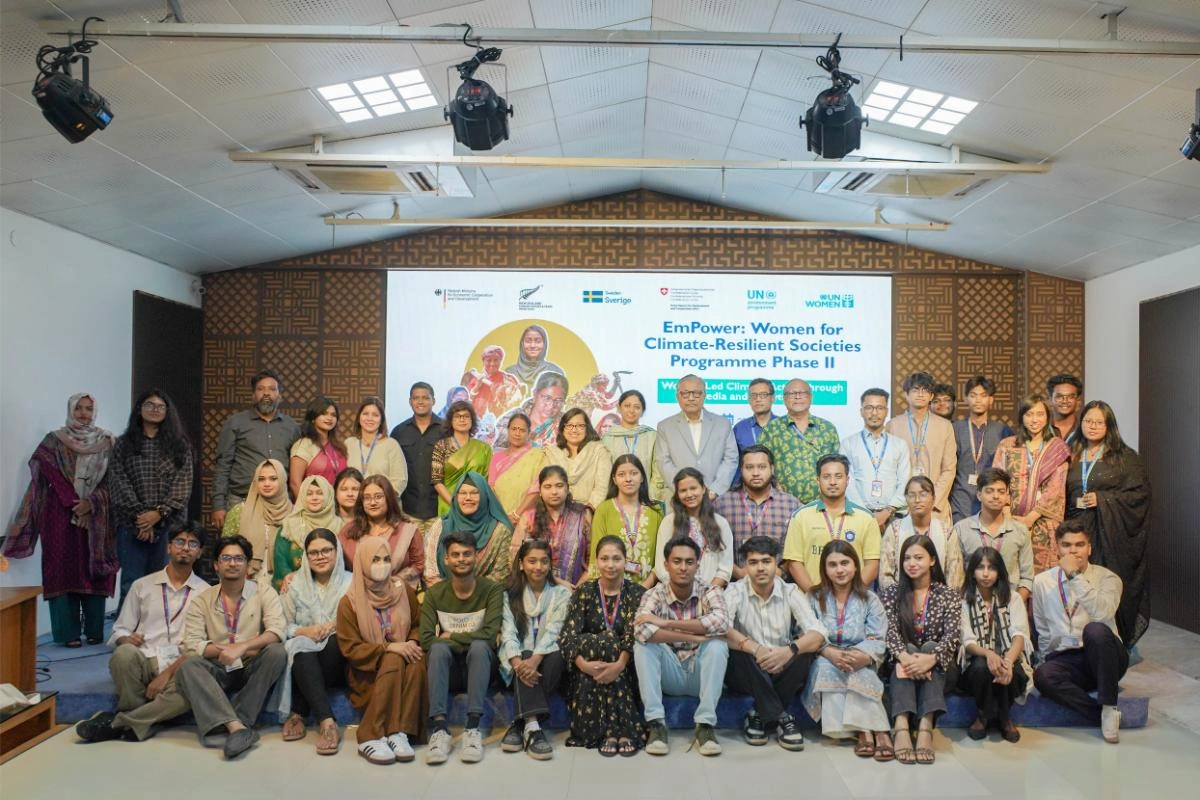
4. Women-Led Climate Action Through Media (25 June 2026). AIUB's Department of Journalism and Mass Communication organised a dialogue examining how media can recognise and strengthen women's roles as leaders in climate resilience. The event was conducted under Phase II of the EmPower: Women for Climate Resilient Societies programme, implemented by UN Women in partnership with the United Nations Environment Programme (UNEP) [21]. The initiative highlighted the importance of inclusive communication and women's leadership in promoting climate awareness and resilience.
Through these academic and public engagement activities, AIUB facilitates the exchange of climate-related knowledge and encourages the participation of diverse stakeholders in addressing environmental challenges.
Student-Led Climate Awareness Campaigns
AIUB encourages student participation in environmental awareness and climate action through campaigns and activities organised in connection with World Environment Day. These initiatives combine educational activities, public engagement and practical environmental actions.
Notable activities include:
1. 2022 – Climate Awareness Rally and Seminar. AIUB students, faculty members and administrative staff participated in a campus rally to raise awareness of climate change. The activity was complemented by a seminar featuring a programme officer from the International Labour Organization (ILO), providing an opportunity to discuss environmental challenges and their broader social implications [22].
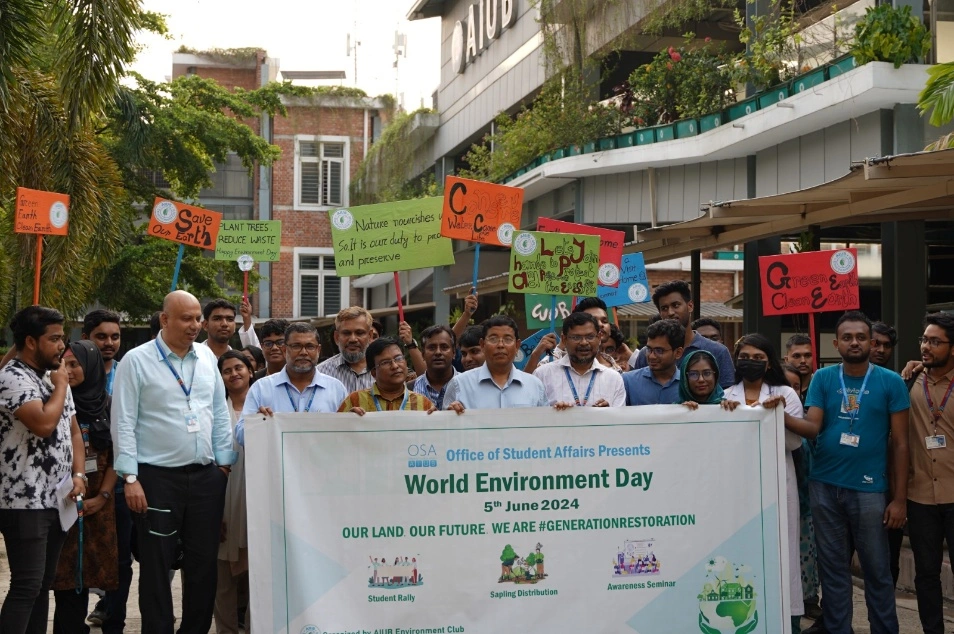
2. 2024 – Land Restoration and Drought Resilience. The AIUB Environment Club organised a World Environment Day campaign featuring the distribution of saplings and seeds, alongside a rally focused on land restoration and drought resilience. These activities encouraged environmental responsibility and highlighted the importance of ecosystem restoration in addressing climate-related challenges [23].
3. 2026 – Restore Nature for a Sustainable Future. The AIUB Environment Club organised a poster competition, an awareness rally and a sapling distribution campaign under the theme Restore Nature for a Sustainable Future. The activities encouraged creative student engagement and promoted awareness of nature restoration and environmental sustainability [24].
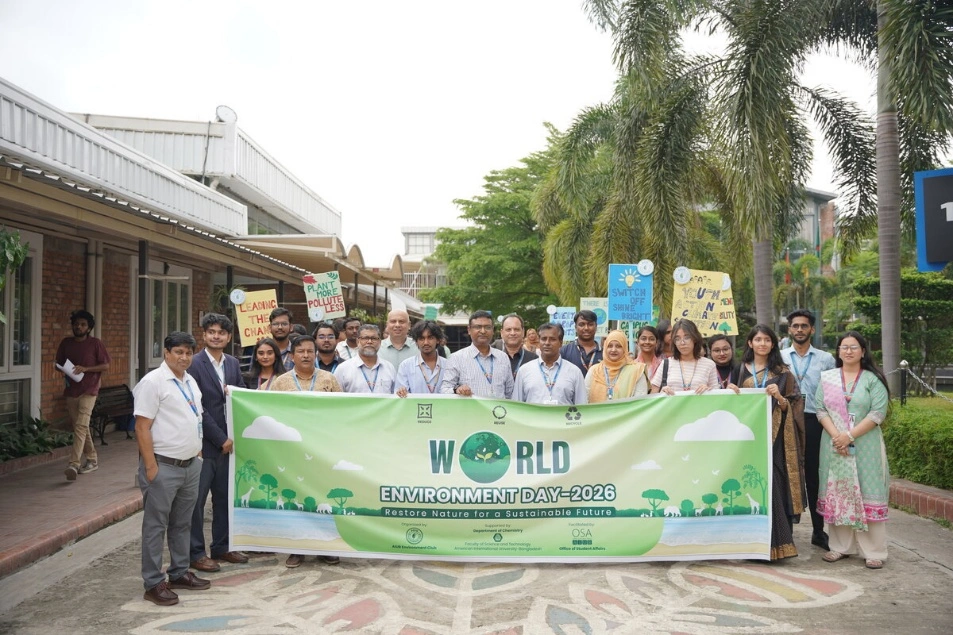
4. Established in 2023, the AIUB Environment Club plays an active role in promoting environmental awareness and addressing issues related to environmental degradation and climate change. Its activities extend beyond the university through a nationwide network of educational institutions, supporting broader student engagement in environmental protection and climate awareness across Bangladesh [25].
These student-led initiatives demonstrate AIUB's commitment to fostering environmental responsibility, encouraging youth participation and strengthening climate awareness within the university community and beyond.
Disaster Resilience and Cooperation for Climate Action
Collaborative Approaches to Disaster Management and Climate Resilience
AIUB promotes collaborative approaches to disaster management and climate resilience by engaging with local and international stakeholders in discussions on climate impacts, environmental sustainability and the governance of ecological resources. The university participates in conferences and knowledge-sharing activities that facilitate the exchange of expertise and encourage coordinated responses to environmental challenges [13].
Furthermore, AIUB's Climate Action Plan establishes a framework for strengthening partnerships with local organisations, businesses, non-governmental organisations and government agencies. It also encourages public engagement through workshops, seminars and lectures, supporting broader stakeholder participation in climate action and resilience-building initiatives [8].
Community Response to Climate-Related Disasters
 |
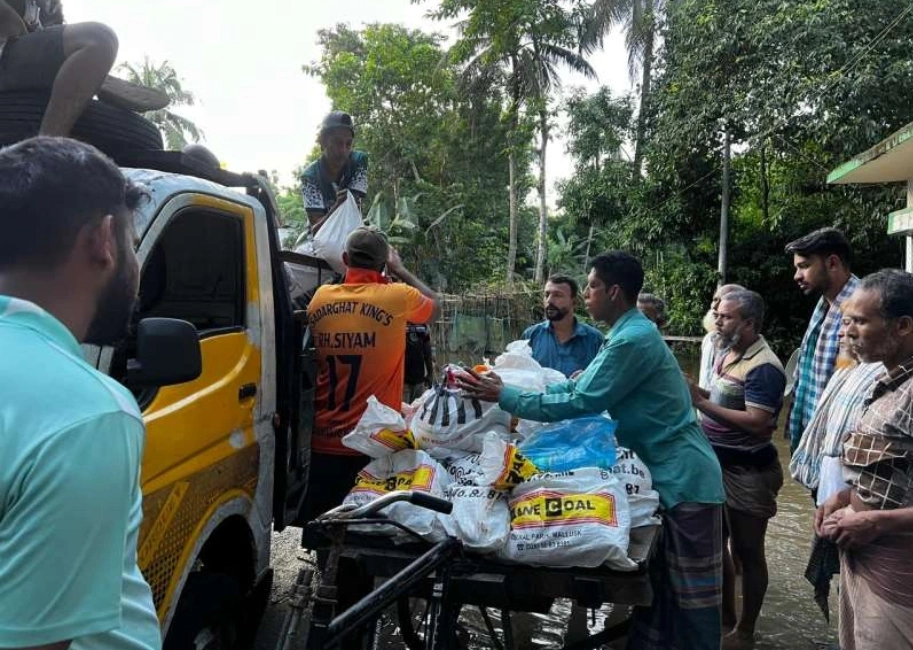 |
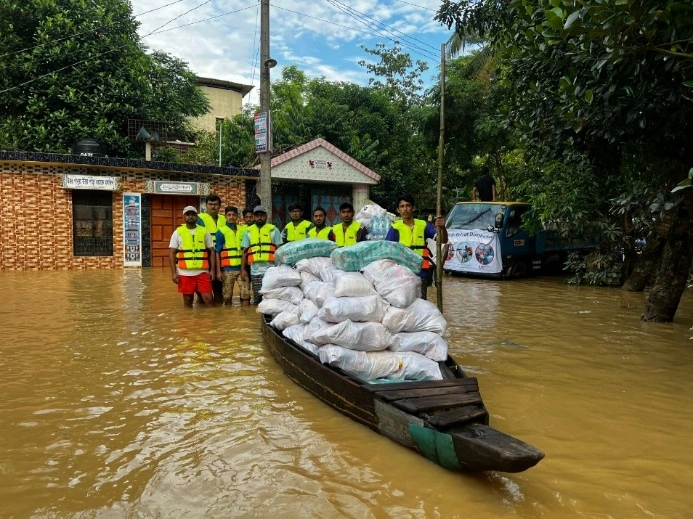
AIUB demonstrates its commitment to community resilience through student-led humanitarian initiatives responding to natural disasters in Bangladesh. In September 2024, following severe floods that affected several parts of the country, multiple AIUB student groups organised a comprehensive relief programme to support affected communities in Chagolnaiya, Porshuram, Shonagazi and Hajigonj [26].
The initiative delivered essential food supplies and medical assistance to 1,200 families affected by the floods [27]. This collective effort reflects the university community's commitment to humanitarian support, social responsibility and solidarity with vulnerable populations during climate-related emergencies.
Partnerships with Government, Development Organisations and Industry
AIUB strengthens its contribution to climate action by engaging with government agencies, international development organisations and non-governmental partners. These collaborations facilitate knowledge exchange, promote sustainable technologies and support initiatives addressing environmental and energy-related challenges.
Notable partnerships and collaborative activities include:
| Partner | Type of organisation | Collaborative activity |
| Sustainable and Renewable Energy Development Authority (SREDA) | Government agency | AIUB hosted a workshop on net-metered rooftop solar energy in Bangladesh, promoting knowledge exchange on renewable energy technologies and their adoption [28]. |
| Grameen Shakti | Non-governmental organisation | Collaboration on a workshop addressing sustainable energy solutions and the promotion of renewable energy technologies [13], [29]. |
| Japan International Cooperation Agency (JICA) | International development organisation | AIUB hosted a seminar on next-generation environmental purification systems on 18 May 2024, facilitating knowledge exchange on innovative environmental technologies [30]. |
These collaborations demonstrate AIUB's commitment to engaging diverse stakeholders in the development and dissemination of sustainable solutions. By providing platforms for dialogue and technical knowledge exchange, the university contributes to strengthening institutional cooperation and advancing environmental sustainability in Bangladesh.
Research on Climate Vulnerability and Community-Led Adaptation
Machine Learning for Flood Prediction and Disaster Risk Reduction
AIUB contributes to technological research aimed at improving flood forecasting and disaster risk reduction in Bangladesh. One notable research contribution is the publication A Location-Independent Flood Prediction Model for Bangladesh's Rivers, co-authored by AIUB researcher Md. Sajid Hossain and presented at the 2023 IEEE 35th International Conference on Tools with Artificial Intelligence (ICTAI) [31], [32].
The study develops a district-independent flood prediction framework using the Random Forest machine learning algorithm and Synthetic Minority Over-sampling Technique for Nominal and Continuous features (SMOTENC) to address data imbalance. The proposed model achieved improvements of up to 9% compared with previously reported results across the evaluated performance metrics [32].
This research contributes to the development of data-driven approaches for flood forecasting, supporting improved risk assessment, disaster preparedness and the development of strategies to reduce the social and economic impacts of flooding in Bangladesh.
Climate Change, Forced Migration and Indigenous Community Resilience
AIUB contributes to research examining the social consequences of climate change, particularly its effects on Indigenous communities and their livelihoods. In 2024, AIUB faculty member Dr. Arifatul Kibria co-authored the book chapter The Impact of the Climate Crisis on Forced Migration among Indigenous Communities in the Chittagong Hill Tracts (CHT) of Bangladesh, published in Indigenous Land-Based Knowledge and Sustainability: Settler Colonialism and the Environmental Crisis [33].
The research examines how changing rainfall patterns, rising temperatures, floods and droughts affect Indigenous populations in the Chittagong Hill Tracts, where traditional land-based agriculture and natural resources are essential to community livelihoods. It also explores the relationship between environmental changes, agricultural disruption and forced migration, highlighting the importance of recognising Indigenous land rights, traditional sustainable agricultural practices and access to climate-resilient infrastructure [33].
This contribution strengthens AIUB's research engagement with climate vulnerability, environmental justice and inclusive adaptation strategies, highlighting the importance of integrating Indigenous knowledge and community perspectives into climate resilience policies.
Indigenous Women-Led Climate Solutions and Adaptation Strategies
AIUB advances research on inclusive climate adaptation by examining the contributions of Indigenous women and traditional knowledge systems to community resilience.
In 2025, Dr. Arifatul Kibria, an AIUB faculty member, co-authored the research article Indigenous Women-Led Climate Crisis Solutions: A Decolonial Perspective from the Garo Indigenous Community in Bangladesh, published in the journal Political Geography [34].
The study explores the relationship between climate change, land-based cultural practices and the social structures of the Garo Indigenous community in Bangladesh. It highlights how Indigenous women's traditional knowledge, leadership and land-based practices contribute to community adaptation and resilience in the face of environmental changes [34].
Furthermore, AIUB faculty member Dr. Arifatul Kibria contributed to the 2025 Routledge publication Rethinking and Relearning Disaster Adaptations from and within Indigenous Land-Based Perspectives, which examines community-based approaches to disaster adaptation across Indigenous communities in Bangladesh [35]. The publication brings together research on the Munda, Manipuri and Marma communities, traditional land-based resilience practices, Indigenous women's perspectives in coastal areas and youth participation in community resilience initiatives.
These scholarly contributions strengthen AIUB's engagement with inclusive climate adaptation, recognising the importance of Indigenous knowledge, women's leadership and community participation in developing context-sensitive responses to climate change.
Youth Engagement and Climate Policy Dialogue
Bangladesh International Model United Nations: Addressing Climate Vulnerability
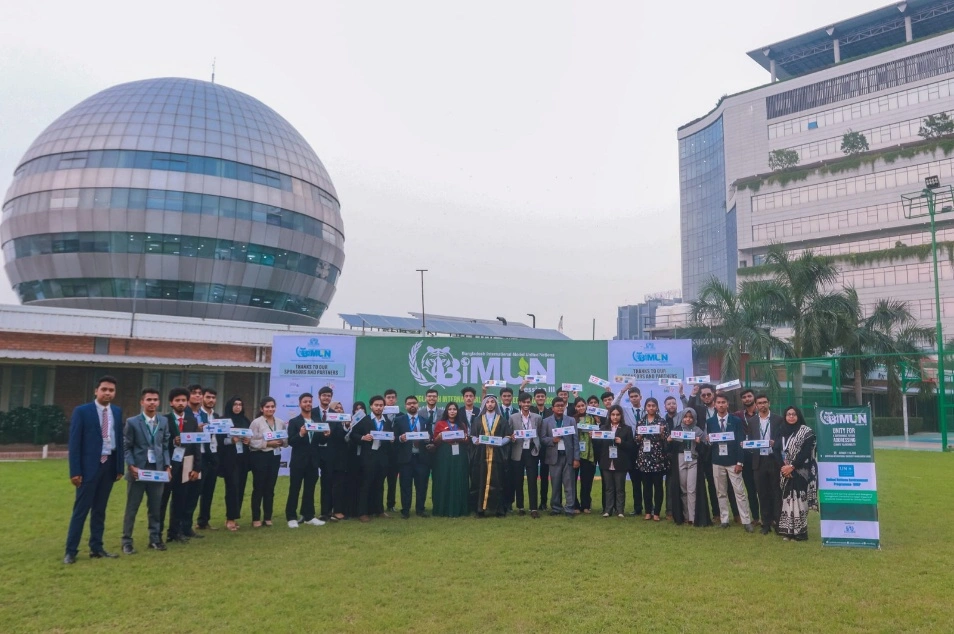
AIUB promotes youth engagement in climate action and international policy dialogue by providing platforms for students to examine global sustainability challenges. From 11 to 14 October 2023, the university served as the venue partner for the Bangladesh International Model United Nations (BiMUN 2023), organised by the United Nations Youth and Students Association of Bangladesh (UNYSAB) [36].
Under the theme Unity for a Sustainable Future: Addressing Climate Vulnerability, the event brought together 350 students from national and international educational institutions as delegates and organisers [36]. The opening ceremony featured representatives from AIUB, the United Nations Resident Coordinator's Office in Bangladesh and the Ministry of Foreign Affairs, among other distinguished participants.
The event provided an international platform for young people to engage in discussions on climate vulnerability, sustainable development and global cooperation. By hosting this initiative, AIUB supported student participation in climate-related policy dialogue and encouraged the development of informed perspectives on global environmental challenges [36].
Climate Justice and Academic Dialogue
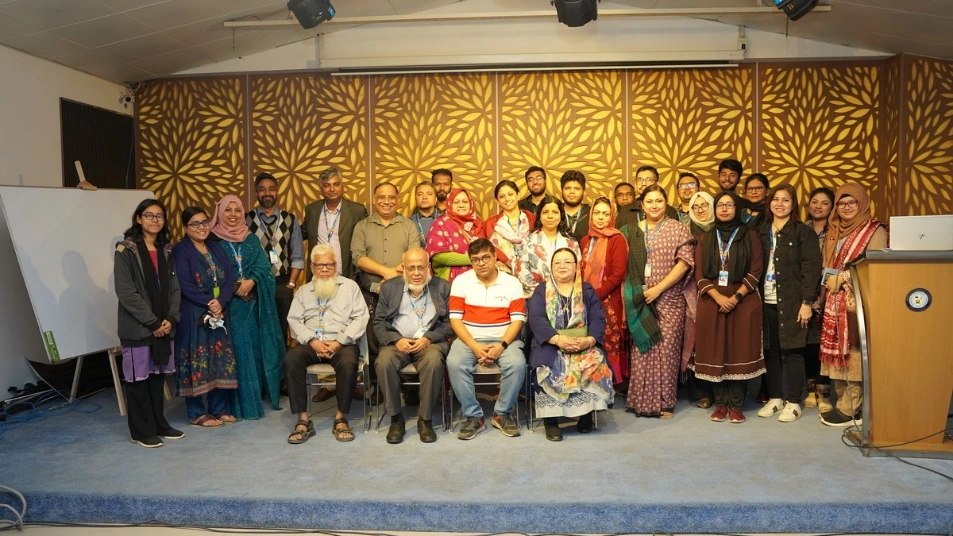
AIUB encourages academic engagement with the social and ethical dimensions of climate change. On 14 December 2023, its Department of English organised a scholarly talk titled Rethinking Climate Action: Climate Justice for Whom, featuring climate action specialist Dr. Sajal Roy as the invited speaker [37].
The session brought together faculty members from the Faculty of Arts and Social Sciences to examine climate justice and its implications across different social groups. Discussions addressed the need for equitable and collective responses to the climate crisis, highlighting the role of academic institutions in advancing environmental awareness and critical reflection on climate-related inequalities [37].
This academic initiative broadened the university's approach to climate education by incorporating social justice, equity and collective responsibility into discussions on climate action.
Institutional Reporting on Progress Towards SDG 13
Public Reporting of Climate Action Initiatives
AIUB demonstrates its commitment to transparency and accountability in sustainable development by publishing institutional reports documenting its contributions to the United Nations Sustainable Development Goals.
As part of this commitment, AIUB published the AIUB SDG Activity Report 2023 | SDG 13: Climate Action, a dedicated institutional report documenting the university's climate-related initiatives and achievements from 2020 to 2024 [31]. The report consolidates evidence across several dimensions, including university activities, faculty research and publications, environmental education, renewable energy, community engagement and institutional climate action.
The publication documents initiatives such as climate-focused academic events, student activities, research contributions on flood prediction and climate change impacts, and renewable energy innovations. It also presents AIUB's institutional approach to monitoring carbon emissions, promoting sustainable energy solutions and strengthening climate resilience [31].
AIUB further provides public access to its SDG 13 reporting through a dedicated sustainability webpage, which presents the university's climate action commitments and provides access to its full SDG 13 activity report [38].
By publishing SDG-specific reports and making supporting evidence publicly accessible, AIUB establishes an institutional mechanism for communicating its progress, documenting its contributions and demonstrating accountability towards the global climate action agenda [31], [38].
References
| [1] | American International University-Bangladesh, “Policy Engagement Workshop on collaborative research — 'Social Innovation Through Technology Nudging: Developing a Behavioral Toolkit for Diffusing Solar Irrigation',” [Online]. Available: https://www.aiub.edu/policy-engagement-workshop-on-collaborative-research---social-innovation-through-technology-nudging-developing-a-behavioral-toolkit-for-diffusing-solar-irrigation. [Accessed 2026]. |
| [2] | Dhaka Tribune, “AIUB Hosts Dissemination Workshop on Solar Irrigation and Climate Adaptation,” [Online]. Available: https://www.dhakatribune.com/bangladesh/education/368162/aiub-hosts-dissemination-workshop-on-solar. [Accessed 2026]. |
| [3] | American International University-Bangladesh, “AIUB hosts dissemination workshop on solar irrigation and climate adaptation,” [Online]. Available: https://www.aiub.edu/aiub-hosts-dissemination-workshop-on-solar-irrigation-and-climate-adaptation. [Accessed 2026]. |
| [4] | S. M. N. Hasan et al., “Techno-economic performance and sensitivity analysis of an off-grid renewable energy-based hybrid system: A case study of Kuakata, Bangladesh,” [Online]. Available: https://dspace.aiub.edu/jspui/handle/123456789/2149. [Accessed 2026]. |
| [5] | M. K. Saifullah, R. Halder, S. Afroz, A. H. Shatil, and K. F. Ahmed, “Design of an off-grid solar-wind-bio hybrid power generation for remote areas of Chapainawabgonj district in Bangladesh using HOMER,” [Online]. Available: https://dspace.aiub.edu/jspui/handle/123456789/1030. [Accessed 2026]. |
| [6] | American International University-Bangladesh, “Climate Change and Escalating Flood Risks in Bangladesh: Analyzing Trends and Adaptation Strategies,” [Online]. Available: https://aiub.edu/Files/student-research/Climate_Change_and_Escalating_Flood_Risks_in_Bangladesh_Analyzing_Trends_and_Adaptation_Strategies..html. [Accessed 2026]. |
| [7] | Dr. Anwarul Abedin Institute of Innovation (D2A2I), “Center for Sustainable Energy Research (CSER),” [Online]. Available: https://d2a2i.aiub.edu/center-CSER.html. [Accessed 2026]. |
| [8] | American International University-Bangladesh, “AIUB Climate Action Plan,” [Online]. Available: https://www.aiub.edu/sustainability/aiub-climate-action-plan. [Accessed 2026]. |
| [9] | American International University-Bangladesh, “Sustainable Procurement Policy of AIUB,” [Online]. Available: https://www.aiub.edu/sustainability/sustainable-procurement-policy-of-aiub. [Accessed 2026]. |
| [10] | American International University-Bangladesh, “AIUB's Commitment to Race to Zero: A Step Towards Environmental Sustainability,” [Online]. Available: https://www.aiub.edu/aiubs-commitment-to-race-to-zero-a-step-towards-environmental-sustainability. [Accessed 2026]. |
| [11] | Race to Zero for Universities and Colleges, “Current Signatories.,” [Online]. Available: https://www.educationracetozero.org/current-signatories. [Accessed 2026]. |
| [12] | American International University-Bangladesh, “Why Study Here.,” [Online]. Available: https://www.aiub.edu/about/why-study-here. [Accessed 2026]. |
| [13] | American International University-Bangladesh, “AIUB SDG Activity Report 2023 | SDG 13: Climate Action,” [Online]. Available: https://www.aiub.edu/iqac/sdgs/aiub-sdg-activity-report-2023/SDG13-AIUBActivityReportof2023. [Accessed 2026]. |
| [14] | American International University-Bangladesh, “Campus Building Footprint, CO₂ Emission and Race to Net Zero,” [Online]. Available: https://aiub.edu/sustainability/aiub-campus-footprint-co2-emission-and-race-to-net-zero. [Accessed 2026]. |
| [15] | American International University-Bangladesh, “AIUB Sustainable Courses,” [Online]. Available: https://www.aiub.edu/sustainability/aiub-sustainable-courses. [Accessed 2026]. |
| [16] | The Business Standard, “AIUB holds panel discussion on digital technologies,” [Online]. Available: https://www.tbsnews.net/node/646406. [Accessed 2026]. |
| [17] | American International University-Bangladesh, “AIUB holds a panel discussion on Digital Technologies: The Opportunities & Challenges in Combatting Climate Change,” [Online]. Available: https://images.thedailystar.net/node/3341256. [Accessed 2026]. |
| [18] | American International University-Bangladesh, “Women Empowerment for Mitigating Climate Change and Building Climate Resilience,” [Online]. Available: https://www.aiub.edu/women-empowerment-for-mitigating-climate-change-and-building-climate-resilience. [Accessed 2026]. |
| [19] | IEEE vTools, “Women Empowerment for mitigating climate change and building Climate resilience,” [Online]. Available: https://events.vtools.ieee.org/event/register/368143. [Accessed 2026]. |
| [20] | IEEE vTools, “Celebration of IEEE Day 2023: Seminar on 'Smart Power Systems: Automating Sustainability in the Age of Climate Change',” [Online]. Available: https://events.vtools.ieee.org/m/379054. [Accessed 2026]. |
| [21] | American International University-Bangladesh, “Dialogue on Women-Led Climate Action through Media and Storytelling held at JMC Department,” [Online]. Available: https://aiub.edu/dialogue-on-women-led-climate-action-through-media-and-storytelling-held-at-jmc-department-. [Accessed 2026]. |
| [22] | The Business Standard, “World Environment Day 2022 celebrated at AIUB,” [Online]. Available: https://www.tbsnews.net/economy/corporates/world-environment-day-2022-celebrated-aiub-435558. [Accessed 2026]. |
| [23] | American International University-Bangladesh, “World Environment Day 2024 celebrated at AIUB,” [Online]. Available: https://www.aiub.edu/world-environment-day-2024-celebrated-at-aiub. [Accessed 2026]. |
| [24] | American International University-Bangladesh, “AIUB Celebrates World Environment Day 2026 with Poster Competition, Rally and Sapling Distribution,” [Online]. Available: https://aiub.edu/aiub-celebrates-world-environment-day-2026-with-poster-competition-rally-and-sapling-distribution. [Accessed 2026]. |
| [25] | American International University-Bangladesh, “AIUB Environment Club.,” [Online]. Available: https://www.aiub.edu/oncampus/clubs/aiub-environment-club. [Accessed 2026]. |
| [26] | American International University-Bangladesh, “Students of AIUB: Standing with the Flood-Effected,” [Online]. Available: https://www.aiub.edu/students-of-aiub-standing-with-the-flood-effected. [Accessed 2026]. |
| [27] | American International University-Bangladesh, “Programmes for Services Access,” [Online]. Available: https://aiub.edu/sustainability/sdg1/initiative/programmes-for-services-access. [Accessed 2026]. |
| [28] | American International University-Bangladesh, “SREDA Organized a Workshop on 'Net Metered Rooftop Solar in Bangladesh' at AIUB,” [Online]. Available: https://www.aiub.edu/sreda-organized-a-workshop-on-net-metered-rooftop-solar-in-bangladesh-at-aiub. [Accessed 2026]. |
| [29] | American International University-Bangladesh, “Workshop Conducted by 'Grameen Shakti´,” [Online]. Available: https://www.aiub.edu/workshop-conducted-by-grameen-shakti. [Accessed 2026]. |
| [30] | The Business Standard, “Seminar on 'Next Generation Environmental Purification System' held at AIUB,” [Online]. Available: https://www.tbsnews.net/node/854896. [Accessed 2026]. |
| [31] | American International University-Bangladesh , “AIUB SDG Activity Report 2023: SDG 13—Climate Action. Dhaka, Bangladesh, 2023,” [Online]. Available: https://www.aiub.edu/Files/Uploads/sdg-13-activity-report-2023.pdf. [Accessed 2026]. |
| [32] | M. A. Hasan, N. T. Rouf, M. S. Hossain, L. B. Latif, A. Tasnim, and M. Grzegorzek, “A Location-Independent Flood Prediction Model for Bangladesh's Rivers,” [Online]. Available: https://www.semanticscholar.org/paper/A-Location-Independent-Flood-Prediction-Model-for-Hasan-Rouf/f785c1a152fc30fc67aa2c67625442d0797c1dcb. [Accessed 2026]. |
| [33] | A. Kibria and R. Datta, “The Impact of the Climate Crisis on Forced Migration among Indigenous Communities in the Chittagong Hill Tracts (CHT) of Bangladesh,” [Online]. Available: https://www.taylorfrancis.com/chapters/edit/10.4324/9781003471486-8/impact-climate-crisis-forced-migration-among-indigenous-communities-chittagong-hill-tracts-cht-bangladesh-arifatul-kibria-ranjan-datta. [Accessed 2026]. |
| [34] | R. Datta and A. Kibria, “Indigenous women-led climate crisis solutions: A decolonial perspective from the Garo Indigenous community in Bangladesh,” [Online]. Available: https://www.sciencedirect.com/science/article/pii/S0962629824002075. [Accessed 2026]. |
| [35] | R. Datta, M. Hurlbert, A. Kibria, R. Singha, B. Kairy, and S. Chattapadhya, “Rethinking and Relearning Disaster Adaptations from and within Indigenous Land-Based Perspectives,” [Online]. Available: https://www.routledge.com/Rethinking-and-Relearning-Disaster-Adaptations-from-and-within-Indigenous-Land-Based-Perspectives/Datta-Hurlbert-Kibria-Singha-Kairy-Chattapadhya/p/book/9781032881348. [Accessed 2026]. |
| [36] | American International University-Bangladesh, “BiMUN 2023 held at AIUB,” [Online]. Available: https://www.aiub.edu/bimun-2023-held-at-aiub. [Accessed 2026]. |
| [37] | American International University-Bangladesh, “Scholarly talk on ‘Rethinking Climate Action’,” [Online]. Available: https://www.aiub.edu/scholarly-talk-on-rethinking-climate-action. [Accessed 2026]. |
| [38] | American International University-Bangladesh, “SDG 13: Climate Action,” [Online]. Available: https://technology.aiub.edu/sustainability/sdg13. [Accessed 2026]. |