


TABLE OF CONTENTS
Research on Aquatic Ecosystems, Aquaculture and Water Pollution
Smart Technology for Sustainable Aquaculture
Technology for Cleaning Oceans and Rivers
Reducing Plastic Pollution at Its Source
Plastic Waste Recovery in Coastal Fishing Communities
Research on Sustainable Coastal Tourism and Environmental Standards
Research on Climate Change, Fisheries and Aquatic Biodiversity
Protecting Aquatic Ecosystems through Campus Policies and Practices
Water Quality Standards and Discharge Guidelines
Water Conservation and Pollution Prevention
Education, Awareness and Engagement
Education and Research on Sustainable Freshwater Management
Maritime Industry Engagement and Experiential Learning
SDG 14: LIFE BELOW WATER
Research on Aquatic Ecosystems, Aquaculture and Water Pollution
Smart Technology for Sustainable Aquaculture
AIUB advances sustainable aquaculture through research and technological innovation aimed at improving water quality monitoring, optimizing resource utilization and supporting environmentally responsible fish farming. Recognizing the importance of maintaining suitable aquatic conditions for fish growth and survival, AIUB researchers and students have developed technology-based solutions that integrate sensors, Internet of Things (IoT), image processing and renewable energy.
1. Smart Biofloc Fish Farming System (IEEE, 2022). AIUB researchers designed a smart biofloc aquaculture system that integrates sensors to monitor pH, total dissolved solids and water temperature, with real-time data accessible through a smartphone application. The system also incorporates image processing techniques to estimate fish weight underwater, enabling growth monitoring without physically handling the fish. Additionally, its recirculating aquaculture configuration and solar-powered backup contribute to efficient water and energy management while supporting reduced environmental impacts from fish farming [1].
2. Real-Time Water Quality Management for Biofloc (IEEE, 2021). AIUB researchers developed an Internet of Things (IoT)-based prototype equipped with a mobile application for continuous water quality monitoring in indoor fish farms. The system automatically regulates environmental conditions whenever monitored parameters deviate from their optimal ranges, supporting stable aquaculture environments and more efficient water management [2].
3. Solar-Powered IoT Pisciculture Management System (2023). An AIUB student-led research project designed and tested a low-cost, solar-powered monitoring system for fish farming. The solution measures pond water levels, pH, turbidity and temperature, helping maintain suitable conditions for aquatic organisms and associated plant cultivation while promoting renewable energy integration in aquaculture operations [3].
4. Integrated Fish, Plant and Poultry Farming (Capstone Project). AIUB students developed an IoT-based monitoring solution for integrated aquaculture and agricultural activities. The system connects fish farming with plant cultivation and poultry production, facilitating the monitoring of aquatic conditions and encouraging resource reuse across interconnected farming activities [4].
Technology for Cleaning Oceans and Rivers
AIUB students have explored the application of emerging technologies to address aquatic pollution, particularly the accumulation of floating waste and microplastics in marine and freshwater environments. Their research evaluates ocean-cleaning solutions incorporating drones, surface skimmers and autonomous waste-collection robots, highlighting the potential of robotics and artificial intelligence to improve the identification, collection and removal of pollutants from water bodies [5].
This work reflects AIUB's engagement with technology-driven approaches to aquatic ecosystem protection and the development of innovative solutions for addressing plastic pollution in oceans and rivers.
Reducing Plastic Pollution at Its Source
AIUB contributes to plastic pollution prevention through research on waste recycling, material recovery and consumer behaviour. These initiatives support circular economy practices by promoting the transformation of discarded plastics into useful materials and encouraging more responsible consumption and waste disposal practices.
- 3D Printing Filament from Recycled Plastic Bottles. AIUB research addresses plastic waste management through the development of a process for converting discarded plastic bottles into filament for 3D printing. By recovering and reusing plastic materials, this initiative promotes resource efficiency, supports circular economy principles and contributes to reducing the amount of plastic waste that may enter aquatic environments [6].
- A Machine That Converts Plastic Waste into Yarn. AIUB research presented in the MethodsX journal explores the design of a low-cost machine capable of transforming plastic waste into reusable yarn. This technology offers opportunities for small-scale recycling initiatives and entrepreneurship while supporting the recovery of discarded plastic materials and reducing their environmental impact [7].
- Young Consumers and Plastic Waste Management. Research published in the Journal of Material Cycles and Waste Management examines the factors influencing young consumers in Bangladesh to reduce plastic consumption and adopt appropriate plastic waste disposal practices. The findings provide insights into consumer behaviour that can support the development of strategies for responsible plastic use and pollution prevention [8].
Collectively, these research initiatives demonstrate AIUB's contribution to addressing plastic pollution through technological innovation, material recovery and greater awareness of responsible consumption and waste management practices.
Plastic Waste Recovery in Coastal Fishing Communities
AIUB advances research on marine pollution prevention by exploring circular economy solutions tailored to the needs of coastal and delta fishing communities in Bangladesh. A student-led research project, Plastic Waste Recycling Hubs in Delta Fishing Communities: Building Circular Economies to Alleviate Poverty and Reduce Marine Pollution in Bangladesh Coastal Waters, investigates opportunities to establish community-based recycling hubs for the collection, recovery and reuse of plastic waste.
Supervised by Associate Professor Md. Mortuza Ahmmed, the research examines coastal areas across the Khulna and Barisal divisions, as well as pollution hotspots and affected areas in Cox's Bazar and Kuakata. The study analyzes plastic waste generation, the composition of municipal solid waste, fishing household income and plastic litter density along coastal areas, providing an evidence base for developing localized recycling initiatives.
By connecting plastic waste recovery with livelihood opportunities in fishing communities, this research promotes circular economy approaches that support marine pollution prevention, responsible resource management and the protection of coastal environments [9].
Research on Sustainable Coastal Tourism and Environmental Standards
AIUB contributes to research on coastal environmental sustainability by examining internationally recognized approaches to responsible beach management and marine ecosystem protection. A student-led study, Cox's Bazar & the Blue Flag Standard: A Study on Coastal Tourism Sustainability, explores the applicability of the Blue Flag framework to Cox's Bazar, Bangladesh.
Supervised by Associate Professor Md. Mortuza Ahmmed, the research examines the relationship between sustainable coastal tourism and environmental management, focusing on water quality, waste management, beach safety and environmental education. The study also considers tourism practices, policy frameworks and stakeholder perspectives in the context of coastal sustainability.
This research strengthens AIUB's academic engagement with sustainable coastal development and highlights the relevance of internationally recognized environmental standards in promoting responsible tourism and protecting marine and coastal environments [10].
Research on Climate Change, Fisheries and Aquatic Biodiversity
AIUB expands its research contributions to aquatic ecosystem protection by examining the relationship between climate change, fisheries and biodiversity in Bangladesh. A student-led study titled Climate Change Impacts on Fisheries and Aquatic Biodiversity in Bangladesh, supervised by Associate Professor Md. Mortuza Ahmmed, investigates the environmental factors affecting aquatic ecosystems and fisheries resources.
The research analyzes secondary data covering the period from 2013 to 2023, examining changes in water sustainability, soil quality, climate resilience, biodiversity and agricultural productivity. Its analytical approach provides insights into the interconnected effects of environmental and climatic conditions on fisheries and aquatic life.
By strengthening the understanding of climate-related pressures on aquatic biodiversity, this research contributes to the knowledge base needed to support fisheries sustainability, ecosystem resilience and the conservation of aquatic resources in Bangladesh [11].
Protecting Aquatic Ecosystems through Campus Policies and Practices
Water Quality Standards and Discharge Guidelines
AIUB incorporates water quality standards and appropriate wastewater discharge guidelines into its campus environmental management practices. These measures help ensure that water discharged from university facilities is managed responsibly and complies with established quality requirements, preventing potential harm to surrounding aquatic ecosystems [12] [12].
Water Conservation and Pollution Prevention
AIUB's Climate Action Plan establishes operational measures to promote responsible water use, minimize waste generation and prevent pollutants from reaching natural water bodies [13]. These measures include:
1. Water Conservation: AIUB promotes efficient water consumption through the installation of water-saving fixtures, regular monitoring of water use and awareness initiatives that encourage responsible water consumption across the university community.
2. Waste Management and Plastic Reduction: The university implements recycling and composting programmes, encourages reusable alternatives and promotes reductions in single-use plastics. These practices support responsible waste management and help prevent plastic waste from entering rivers, coastal areas and marine ecosystems.
3. Green Infrastructure and Biodiversity: AIUB maintains green spaces, supports tree planting and promotes campus biodiversity as part of its broader environmental management approach, contributing to a more sustainable campus environment.
In addition, AIUB monitors water consumption per person and provides free drinking water fountains for students, faculty members, staff and visitors. These facilities encourage access to drinking water while reducing dependence on single-use plastic bottles and the associated generation of plastic waste [12].
Responsible Procurement
AIUB integrates environmental considerations into its procurement practices through a Sustainable Procurement Policy that promotes waste minimization and more sustainable packaging solutions. The policy encourages the reduction of packaging materials, the adoption of reusable and refillable packaging, and collaboration with suppliers through take-back programmes [14].
These procurement practices support responsible material consumption and reduce the generation of packaging waste, particularly plastics, helping prevent potential sources of pollution from reaching terrestrial and aquatic environments.
Education, Awareness and Engagement
Education and Research on Sustainable Freshwater Management
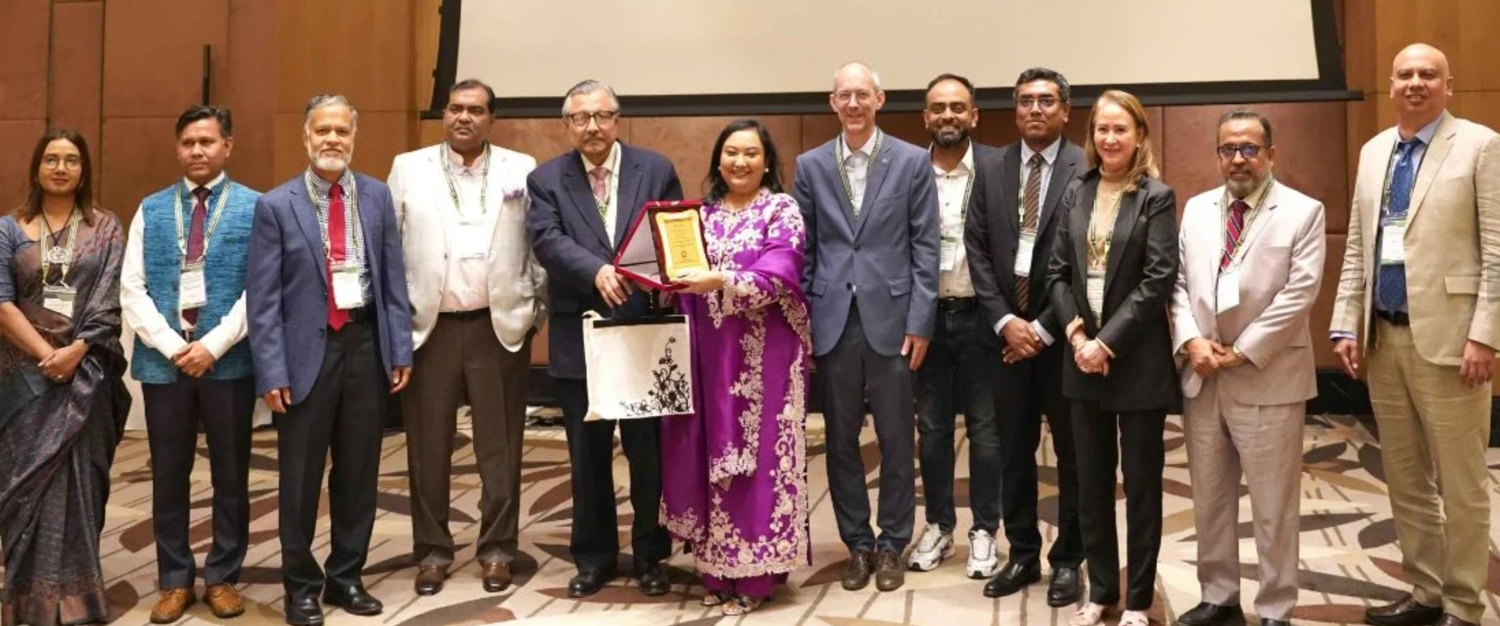
AIUB promotes education and research on the sustainable management of freshwater resources, incorporating topics such as efficient irrigation practices, water conservation and climate adaptation into its academic and research activities [2].
A notable example is AIUB's participation in an international research project on solar-powered irrigation and climate adaptation, led by Durham University in collaboration with Curtin University, the University of Rajshahi and Khulna University. In December 2024, AIUB hosted a dissemination workshop in Dhaka, bringing together more than 100 scholars, policymakers and government officials from Bangladesh, the United Kingdom, Australia and Thailand. The event facilitated the exchange of research findings and policy discussions on sustainable irrigation practices and climate-resilient water management [15].
This initiative highlights AIUB's contribution to knowledge exchange, international research collaboration and the promotion of sustainable approaches to freshwater resource management.
Maritime Industry Engagement and Experiential Learning
AIUB provides students and faculty members with opportunities to engage with Bangladesh's maritime and port industries through educational visits to naval institutions, shipyards and port facilities. These activities expose participants to maritime operations, shipbuilding, dockyard management and port activities, strengthening their understanding of the maritime sector and its relationship with coastal and river environments.
The university has organized several visits involving its Faculty of Engineering:
| Date | Institution / Facility | Participants and Activities |
| 26 December 2022 | Bangladesh Naval Academy, located near the mouth of the Karnaphuli River, Chattogram | 14 faculty members and 37 EEE and IPE students [16] |
| 26 December 2022 | Commodore Superintendent Dockyard, located on the banks of the Karnaphuli River | 14 faculty members and 37 students [17] |
| 27 December 2022 | Chittagong Dry Dock Limited, within the Chittagong Port area | 14 faculty members and 37 students [18] |
| December 2022 | Chittagong Port Authority | Faculty of Engineering students and faculty members participating in the Chattogram study tour [19] |
| 6 May 2024 | Bangladesh Navy Dockyard, Narayanganj | 22 Industrial and Production Engineering (IPE) students and 2 faculty members, with exposure to shipbuilding and dockyard maintenance [20] |
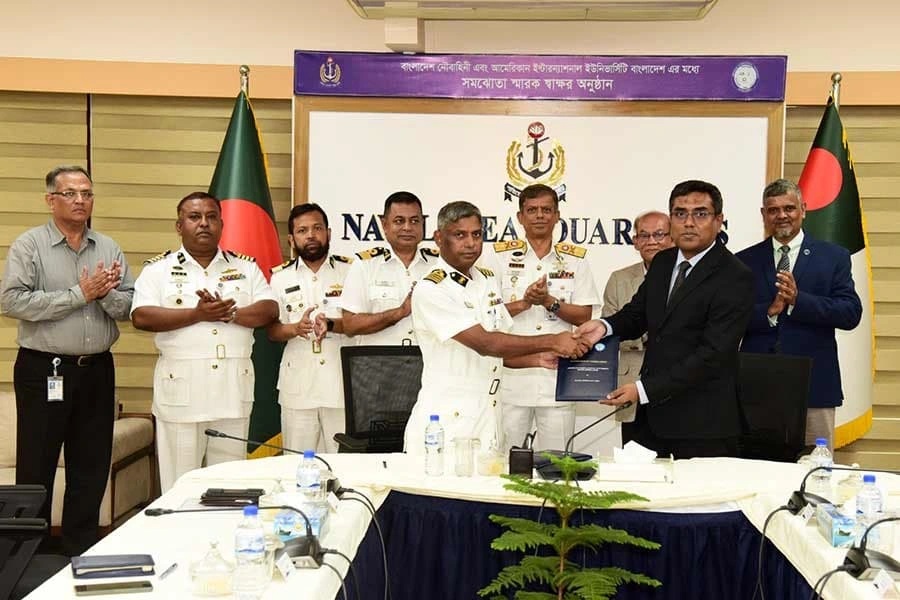
AIUB further strengthened its institutional engagement with Bangladesh's maritime sector on 25 June 2024, when the university and the Bangladesh Navy signed a five-year Memorandum of Understanding (MoU) establishing a framework for academic and professional collaboration [21].
These educational engagements and institutional partnerships expand opportunities for experiential learning and interdisciplinary collaboration in areas related to maritime activities and coastal development.
Student-Led Campaigns against Plastic Pollution
AIUB encourages student participation in environmental awareness initiatives addressing plastic pollution and its impacts on aquatic ecosystems. On World Environment Day 2023, under the global theme #BeatPlasticPollution, the AIUB Environment Club organized a campus awareness campaign featuring posters and educational messages highlighting the environmental consequences of plastic pollution and the importance of responsible consumption [22].
Established in 2023, the AIUB Environment Club also engages with a nationwide network of educational institutions to promote environmental awareness. Its activities address plastic production, excessive plastic consumption, water pollution and recycling, encouraging students and communities across Bangladesh to adopt more responsible waste management practices [23].
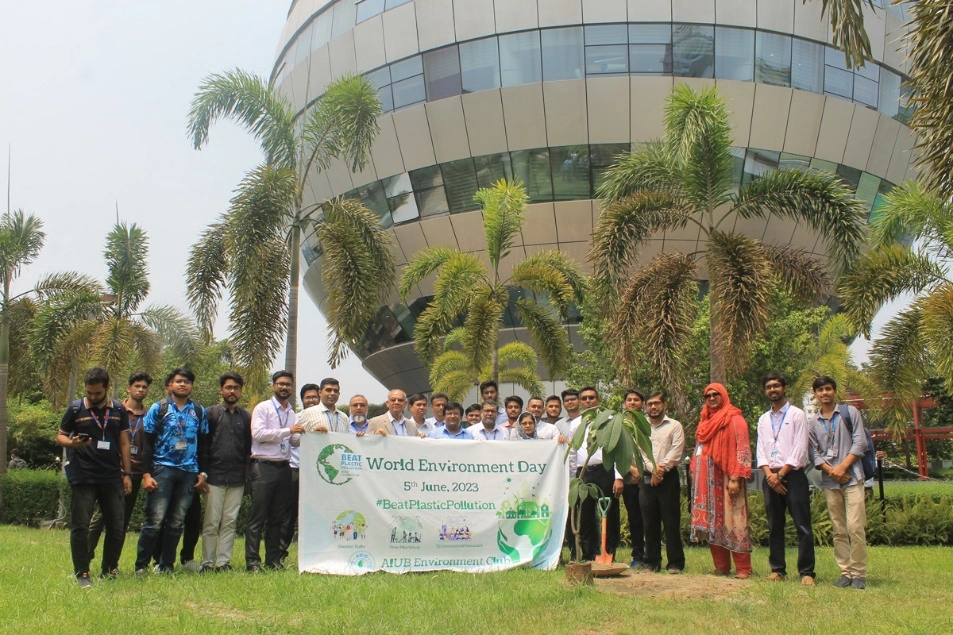
These student-led initiatives strengthen environmental awareness and promote collective action to reduce plastic pollution, contributing to the protection of freshwater and marine ecosystems.
References
| [1] | N. Goswami, S. A. Sufian, M. S. Khandakar, K. Z. H. Shihab, and M. S. R. Zishan,, “Design and development of smart system for biofloc fish farming in Bangladesh,” [Online]. Available: https://dspace.aiub.edu/jspui/handle/123456789/1493. [Accessed 2026]. |
| [2] | I. Ahamed and A. Ahmed, “Design of smart biofloc for real-time water quality management system,” [Online]. Available: https://dspace.aiub.edu/jspui/handle/123456789/451. [Accessed 2026]. |
| [3] | M. H. Bhuyan, M. A. Ali, S. A. Khan, M. R. Islam, T. Islam, and J. Akter, “Design and implementation of solar power and an IoT-based pisciculture management system,” [Online]. Available: https://dspace.aiub.edu/jspui/handle/123456789/893. [Accessed 2026]. |
| [4] | American International University-Bangladesh, “IoT Based Autonomous Integrated Fish, Plant and Poultry Farming,” [Online]. Available: https://dspace.aiub.edu/jspui/handle/123456789/858. [Accessed 2026]. |
| [5] | American International University-Bangladesh, “Ocean Cleanup Technology: Robotics & AI in Marine Sustainability – Evaluating the Role of Drones, Skimmers, and Trash-Collecting Robots,” [Online]. Available: https://as-proceeding.com/index.php/ijanser/article/download/2127/2070/4021. [Accessed 2026]. |
| [6] | M. M. Hasan, N. M. N. I. Taj, M. M. H. Naime, M. M. Islam, M. M. R. Biswas, and M. T. Rana, “Production of 3D printing filament from recycled plastic bottles using fused deposition modeling,” [Online]. Available: https://dspace.aiub.edu/jspui/handle/123456789/2572. [Accessed 2026]. |
| [7] | N. Alam et al., “Development of a recycling machine for constructing synthetic yarn from plastic waste,” [Online]. Available: https://dspace.aiub.edu/jspui/handle/123456789/2150. [Accessed 2026]. |
| [8] | M. H. Islam, M. M. Sabbir, M. Z. Anam, and M. T. Islam, “Exploring sustainable plastic management behavior among young consumers in Bangladesh,” [Online]. Available: https://link.springer.com/article/10.1007/s10163-024-02144-w. [Accessed 2026]. |
| [9] | S. Rahman, S. Sadib, T. Billah, and N. A. Khondoker, “Plastic Waste Recycling Hubs in Delta Fishing Communities: Building Circular Economies to Alleviate Poverty and Reduce Marine Pollution in Bangladesh Coastal Waters,” [Online]. Available: https://databank.aiub.edu/Files/student-research/Plastic_Waste_Recycling_Hubs_in_Delta_Fishing_Communities_Building_Circular_Economies_to_Alleviate_P.html. [Accessed 2026]. |
| [10] | N. S. Sami, J. Ferdous, K. W. Tabassum, and M. T. Zaman, “Cox's Bazar & the Blue Flag Standard: A Study on Coastal Tourism Sustainability,” [Online]. Available: https://extension.aiub.edu/Files/student-research/COXS_BAZAR__THE_BLUE_FLAG_STANDARD_A_STUDY_ON_COASTAL_TOURISM_SUSTAINABILITY.html. [Accessed 2026]. |
| [11] | T. Billah, M. M. Akib, T. Hasan, I. Aarafat, and S. T. A. Apurba, “Climate Change Impacts on Fisheries and Aquatic Biodiversity in Bangladesh,” [Online]. Available: https://admissions.aiub.edu/Files/student-research/Climate_change_impacts_on_Fisheries_and_Aquatic_Biodiversity_in_Bangladesh.html. [Accessed 2026]. |
| [12] | American International University-Bangladesh, “AIUB SDG Activity Report 2023 | SDG 14: Life Below Water,” [Online]. Available: https://www.aiub.edu/iqac/sdgs/aiub-sdg-activity-report-2023/SDG14-AIUBActivityReportof2023. [Accessed 2026]. |
| [13] | American International University-Bangladesh, “AIUB Climate Action Plan,” [Online]. Available: https://www.aiub.edu/sustainability/aiub-climate-action-plan. [Accessed 2026]. |
| [14] | American International University-Bangladesh, “Sustainable Procurement Policy of AIUB,” [Online]. Available: https://www.aiub.edu/sustainability/sustainable-procurement-policy-of-aiub. [Accessed 2026]. |
| [15] | Dhaka Tribune, “AIUB hosts dissemination workshop on solar irrigation and climate adaptation,” [Online]. Available: https://www.dhakatribune.com/bangladesh/education/368162/aiub-hosts-dissemination-workshop-on-solar. [Accessed 2026]. |
| [16] | American International University-Bangladesh, “Visit to Bangladesh Naval Academy (BNA),” [Online]. Available: https://www.aiub.edu/visit-to-bangladesh-naval-academy-bna. [Accessed 2026]. |
| [17] | American International University-Bangladesh , “Visit to Commodore Superintendent Dockyard (CSD),” [Online]. Available: https://www.aiub.edu/visit-to-commodore-superintendent-dockyard-csd. [Accessed 2026]. |
| [18] | American International University-Bangladesh, “Visit to Chittagong Dry Dock Limited (CDDL),” [Online]. Available: https://www.aiub.edu/visit-to-chittagong-dry-dock-limited-cddl. [Accessed 2026]. |
| [19] | American International University-Bangladesh, “Visit to Chittagong Port Authority (CPA),” [Online]. Available: https://www.aiub.edu/visit-to-chittagong-port-authority-cpa. [Accessed 2026]. |
| [20] | American International University-Bangladesh, “Industrial Tour at Bangladesh Navy Dockyard,” [Online]. Available: https://www.aiub.edu/industrial-tour-at-bangladesh-navy-dockyard. [Accessed 2026]. |
| [21] | The Financial Express, “Bangladesh Navy, AIUB sign MoU for academic, professional collaboration,” [Online]. Available: https://thefinancialexpress.com.bd/education/bangladesh-navy-aiub-sign-mou-for-academic-professional-collaboration. [Accessed 2026]. |
| [22] | American International University-Bangladesh, “AIUB Environment Club celebrated World Environment Day,” [Online]. Available: https://www.aiub.edu/aiub-environment-club-celebrated-world-environment-day. [Accessed 2026]. |
| [23] | American International University-Bangladesh, “AIUB Environment Club.,” [Online]. Available: https://www.aiub.edu/oncampus/clubs/aiub-environment-club. [Accessed 2026]. |
| [24] | American International University-Bangladesh, “AIUB SDG Activity Report 2023 | SDG 6: Clean Water and Sanitation.,” [Online]. Available: https://www.aiub.edu/iqac/sdgs/aiub-sdg-activity-report-2023/SDG6-AIUBActivityReportof2023. [Accessed 2026]. |