


TABLE OF CONTENTS
Research on Land Ecosystems, Agriculture and Plant Health
Early Detection of Plant Diseases
Non-Destructive Monitoring of Plants and Roots
Soil Contamination and Environmental Assessment
Precision Agriculture and Sustainable Crop Production
Green Spaces and Nature-Integrated Campus Design
Green Infrastructure and Biodiversity Conservation
Sustainable Waste Management and Protection of Terrestrial Environments
Education, Environmental Awareness and Community Engagement
Tree Planting Initiatives and World Environment Day
Youthful Roots: Planting Harmony for Tomorrow
Student-Led Environmental Awareness and Community Engagement
Research on Mangrove Ecosystems and Biodiversity
Spatial Assessment of Vegetation and Soil Conditions in the Sundarbans Mangrove Ecosystem
Spatial Distribution and Ecological Risk Assessment of Mangrove Soil Contamination
Forest Ecosystem Functioning and Belowground Carbon Dynamics
Species-Specific Soil Respiration and Forest Carbon Dynamics
Research on Wetland Ecosystems and Soil Carbon Storage
Soil Organic Carbon Assessment in Arial Beel Wetlands
Soil Health and Sustainable Soil Management
Effects of Waste-Derived Biochar on Soil Microbial Activity
Wildlife Conservation and Human-Wildlife Conflict Prevention
SDG 15: LIFE ON LAND
Research on Land Ecosystems, Agriculture and Plant Health
Agricultural activities play a significant role in Bangladesh's land use, making sustainable farming practices essential for maintaining soil quality, protecting plant health and preserving terrestrial biodiversity. AIUB contributes to this area through research on artificial intelligence, electrical sensing technologies and precision agriculture. These investigations support the development of innovative approaches to crop disease detection, non-destructive plant monitoring, soil contamination assessment and resource-efficient agricultural production.
Early Detection of Plant Diseases
Early and accurate identification of plant diseases is essential for effective crop management and sustainable agricultural practices. AIUB researchers investigate artificial intelligence (AI) techniques that enable automated disease recognition from plant images, supporting timely interventions and more targeted crop protection strategies. Their research includes:
1. Multi-plant disease diagnosis (2021). AIUB researchers developed a deep learning model capable of identifying both plant species and associated diseases from a single leaf image. The approach uses convolutional neural networks (CNNs) to analyse visual characteristics and classify plant diseases automatically [1].
2. Plant disease identification using EfficientNet (2022). This research evaluated the application of the EfficientNet deep learning architecture for classifying multiple plant diseases from leaf images, demonstrating its potential for automated plant health assessment [2].
3. PlantDet (2023). AIUB researchers developed a robust ensemble-based approach that integrates multiple deep learning models to improve the accuracy and reliability of plant disease detection [3].
4. Neural networks for leaf disease diagnosis (2025). This study introduced a CNN-based model for automated, real-time plant disease diagnosis, highlighting the potential of AI-driven technologies to support timely crop protection and more sustainable agricultural management [4].
5. Student research on AI-based crop protection. AIUB students have also investigated image classification techniques for crop disease monitoring, developing approaches designed to provide farmers with rapid diagnostic feedback and support more targeted pesticide applications [5]. Additional research has explored AI-based identification of crop diseases and pests using drone and field imagery, demonstrating the potential of computer vision technologies for agricultural monitoring and precision crop management [6].
Non-Destructive Monitoring of Plants and Roots
AIUB researcher Dr. Rinku Basak has contributed to the development of electrical sensing technologies for non-invasive plant monitoring and agricultural assessment. These methods provide opportunities to evaluate plant characteristics and physiological conditions without damaging the plants or disturbing their growing environments. Relevant research includes:
- In situ electrical impedance tomography (EIT) for root biomass estimation. Published in 2022, this research introduced an EIT sensor system capable of estimating tap-root biomass directly in soil, achieving prediction accuracy of 93% or higher. The system enables real-time, non-destructive monitoring of root development, an important indicator of plant growth and responses to environmental conditions [7].
- Low-cost EIT data acquisition for plant phenotyping. Another 2022 study presented a rapid, cost-effective and high-precision EIT data acquisition system for plant phenotyping, enabling the assessment of plant characteristics associated with growth and development [8].
- Electrical impedance spectroscopy for leaf nitrogen assessment. This research developed a method for predicting leaf nitrogen concentration across multiple crops. The approach supports the assessment of plant nutritional conditions and provides information that can contribute to more precise fertilizer management [9].
Soil Contamination and Environmental Assessment
AIUB faculty members contributed to a 2022 research study investigating nickel contamination in agricultural soils and its accumulation in rice and wheat cultivated in contaminated areas. The research assessed nickel concentrations in soil, crop straw and edible grains, examining the potential transfer of this metal through agricultural production systems. It also evaluated the associated human health implications of exposure to nickel through contaminated agricultural products [10].
This research contributes to understanding the relationship between soil contamination, crop quality and environmental health. By investigating heavy metal accumulation in agricultural soils and crops, AIUB supports scientific efforts to assess environmental risks and promote the protection of terrestrial ecosystems and sustainable food production.
Precision Agriculture and Sustainable Crop Production
AIUB researchers developed an Internet of Things (IoT) and machine learning-based greenhouse farming system, published in 2025, integrating intelligent monitoring, automated environmental control and data-driven agricultural recommendations. The system monitors and regulates temperature, humidity, light intensity and soil moisture in real time, while incorporating crop recommendation and disease detection subsystems.
The crop recommendation and disease detection components achieved accuracies of 97.27% and 97.50%, respectively, in simulation-based evaluations. The proposed architecture also incorporates renewable energy and water conservation features, including solar-powered operation supported by a solar tracking mechanism and rainwater harvesting for irrigation [11].
By combining intelligent environmental monitoring, renewable energy and efficient water management, this research demonstrates AIUB's contribution to technological innovations for sustainable agricultural production and the responsible use of natural resources.
Sustainable Campus Land Use
Green Spaces and Nature-Integrated Campus Design
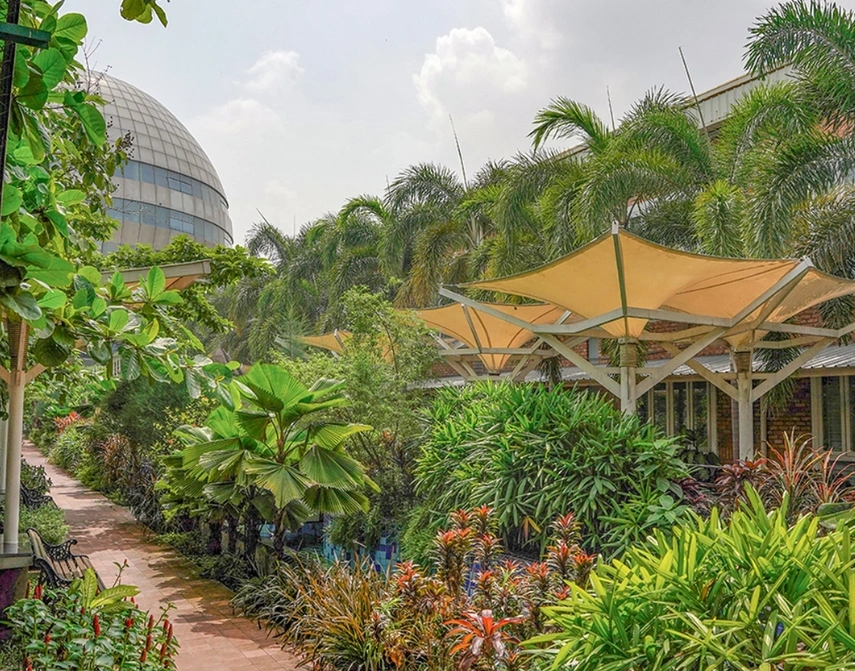
AIUB incorporates green spaces and nature-oriented design into its permanent campus in Kuratoli, Dhaka. The campus features an open architectural layout that integrates the built environment with natural surroundings [12]. Its landscaped areas include multiple gardens and green spaces, creating a welcoming outdoor environment that contributes to the presence of vegetation within the university grounds [13]. A large green field, complemented by paved pathways lined with flowers, further enhances the campus landscape and provides valuable green space within Dhaka's densely urbanised environment [14].
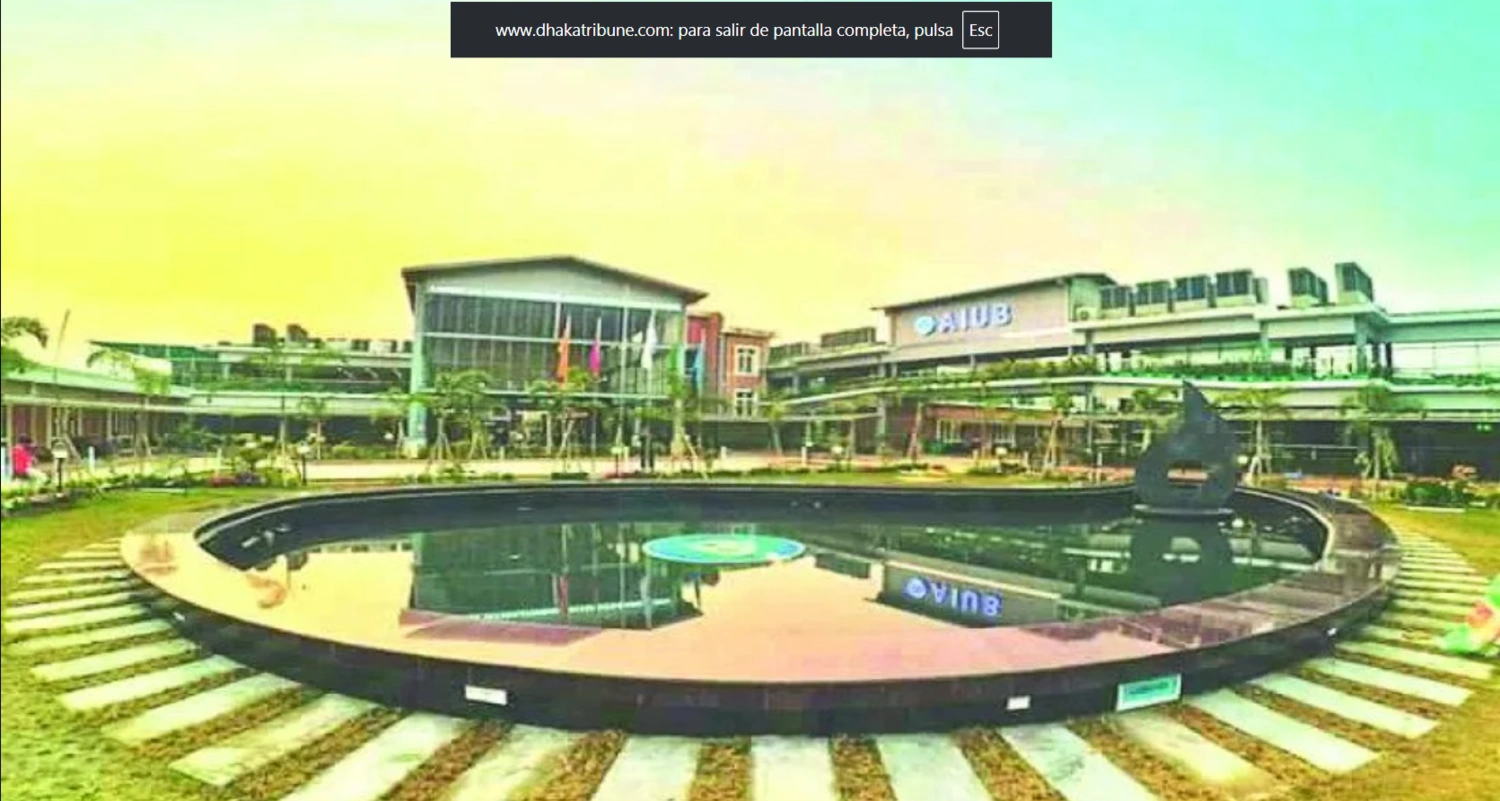
AIUB's campus landscaping also incorporates native plant species, supporting the integration of locally appropriate vegetation into the university environment. These green areas reflect the university's commitment to sustainable land use and the incorporation of nature into its institutional infrastructure [15].
Green Infrastructure and Biodiversity Conservation
AIUB's Climate Action Plan establishes institutional commitments to integrating green infrastructure and supporting biodiversity across its campus. These commitments include [16]:
1. Green space development and maintenance: Maintaining existing green areas and creating additional spaces to enhance campus vegetation.
2. Tree planting and vegetation diversity: Planting a diverse range of trees to strengthen the campus's natural environment.
3. Environmentally responsible construction: Incorporating eco-friendly construction materials into campus infrastructure development.
4. Biodiversity support: Promoting initiatives that contribute to biodiversity within the university environment.
The Climate Action Plan also encourages experiential sustainability activities, including community gardening, as well as student and alumni participation in environmental projects and clean-up initiatives [16]. These actions reinforce AIUB's institutional commitment to integrating environmental stewardship, biodiversity awareness and community engagement into campus management.
Sustainable Waste Management and Protection of Terrestrial Environments
AIUB incorporates environmentally responsible waste management practices to minimise the potential impact of institutional activities on land and surrounding ecosystems. Its waste management approach includes reducing plastic waste and ensuring the safe disposal of hazardous materials [17].
The university's Climate Action Plan further promotes recycling and composting initiatives, the adoption of reusable alternatives and the reduction of single-use plastics across campus operations [16]. Complementing these measures, AIUB's Sustainable Procurement Policy encourages waste prevention at the purchasing stage by promoting reusable packaging and supplier take-back programmes [18].
Together, these practices support more responsible resource consumption, reduce the generation of waste and contribute to protecting the campus environment and surrounding terrestrial ecosystems.
Education, Environmental Awareness and Community Engagement
Tree Planting Initiatives and World Environment Day
AIUB regularly commemorates World Environment Day through tree plantation campaigns, sapling distribution and environmental awareness activities. These initiatives engage university leadership, faculty members, student organisations and the wider student community in promoting tree planting and environmental stewardship. Notable activities include:
| Year | Activities |
| 2022 | The Chairman of the Board of Trustees planted a tree on campus, while faculty members presented saplings to the AIUB Social Welfare Club – Shomoy to launch its tree plantation campaign and encourage broader student participation [19], [20]. |
| 2023 | The Pro-Vice Chancellor inaugurated the celebrations by planting a tree on campus. The programme also featured an environmental rally and sapling distribution among students [21]. |
| 2024 | Saplings and seeds were distributed to representatives of student clubs, accompanied by an awareness rally highlighting land restoration and drought resilience under the international theme #GenerationRestoration [22]. |
| 2026 | The AIUB Environment Club organised a poster competition and an environmental rally, concluding with sapling distribution under the theme "Restore Nature for a Sustainable Future" [23]. |
These recurring activities demonstrate AIUB's commitment to promoting tree planting, raising awareness of land restoration and encouraging students to participate actively in environmental conservation.
Youthful Roots: Planting Harmony for Tomorrow
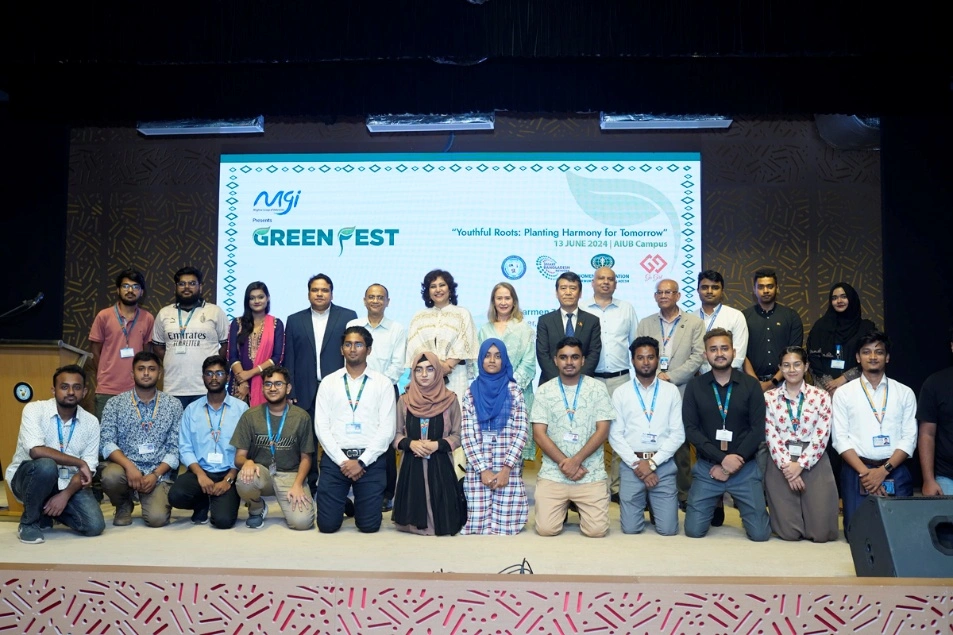
On 13 June 2024, AIUB hosted Youthful Roots: Planting Harmony for Tomorrow, an environmental initiative initiated by the Women's Federation for World Peace Bangladesh, presented by Meghna Group of Industries and organised by GO Girl Limited. The event brought together representatives from different sectors, including the Ambassador of Bhutan to Bangladesh, who attended as the chief guest.
As part of the initiative, distinguished guests planted three trees on the university campus, while three AIUB student teams assumed responsibility for their long-term care and maintenance. An advisory board was established to monitor the trees' development, with awards recognising successful teams as "Youth Green Leaders" [24].
By assigning students responsibility for nurturing the planted trees and establishing a monitoring mechanism, the initiative promotes sustained environmental engagement beyond the initial planting activity. It also encourages student leadership, accountability and active participation in campus greening and tree conservation.
Student-Led Environmental Awareness and Community Engagement
AIUB promotes student participation in environmental protection through the AIUB Environment Club, established in 2023. The club raises awareness of environmental challenges across Bangladesh, including deforestation, pollution and waste management, while extending its engagement through a nationwide network of educational institutions [25].
The university also supports educational outreach activities addressing sustainable agriculture and the conservation of land resources. In addition, AIUB encourages collaboration with local communities in initiatives aimed at maintaining and protecting shared land ecosystems [17].
These activities strengthen environmental awareness among students and community members while encouraging collective responsibility for the protection of terrestrial ecosystems and the sustainable management of natural resources.
Research on Mangrove Ecosystems and Biodiversity
Spatial Assessment of Vegetation and Soil Conditions in the Sundarbans Mangrove Ecosystem
AIUB contributes to research on mangrove ecosystem conservation through faculty participation in scientific investigations examining the relationships between vegetation characteristics and soil properties in the Sundarbans, one of Bangladesh's most important natural ecosystems.
In a 2026 study, AIUB faculty member Md. Faruque Hossain collaborated with researchers to investigate spatial and vertical variations in soil properties and their associations with vegetation structure across two contrasting locations in the Sundarbans: Dublar Char and Hiron Point. The research examined 30 permanent vegetation plots and soil samples collected at three depths, assessing parameters such as organic carbon, total nitrogen, pH, salinity and other physicochemical characteristics [26].
The findings identified significant relationships between soil depth, environmental conditions and vegetation attributes, highlighting the importance of understanding soil-vegetation interactions in mangrove ecosystems. The study provides scientific evidence to support ecosystem assessment, biodiversity conservation and informed management of mangrove forests in Bangladesh [26].
Spatial Distribution and Ecological Risk Assessment of Mangrove Soil Contamination
AIUB faculty research also contributes to the scientific assessment of environmental conditions affecting mangrove ecosystems. In a collaborative study published in 2022, AIUB researcher Md. Faruque Hossain participated in an investigation of the spatial distribution and ecological risks associated with eight potentially toxic metals in the soils of the Sundarbans mangrove forest.
The study examined iron, manganese, copper, zinc, lead, cadmium, chromium and nickel concentrations across 20 sampling locations covering four administrative ranges of the mangrove forest. Researchers applied geochemical indicators, ecological risk assessment indices and spatial analysis techniques to identify contamination patterns and evaluate potential environmental risks.
The investigation identified spatial variations in metal concentrations and established baseline information for assessing ecological conditions across the Sundarbans. Its findings provide valuable scientific evidence for environmental monitoring, identifying priority areas for conservation and supporting the long-term protection of mangrove soil ecosystems [27].
Forest Ecosystem Functioning and Belowground Carbon Dynamics
Species-Specific Soil Respiration and Forest Carbon Dynamics
AIUB contributes to research on tropical forest ecosystems by investigating the relationships between tree species, soil characteristics and belowground carbon dynamics.
In 2026, AIUB faculty member Md. Faruque Hossain collaborated with researchers from the University of Dhaka and the Bangladesh Forest Department on a study examining soil respiration and physicochemical properties in the rhizosphere of three dominant tree species in Bhawal National Park, Bangladesh: Shorea robusta, Albizia procera and Acacia auriculiformis.
The investigation assessed soil samples collected at two depths and identified significant differences in soil respiration among the three species. The study also examined soil organic carbon, total nitrogen, moisture content, calcium and other soil properties to understand their relationships with belowground ecosystem processes.
The results demonstrated that tree species identity influences rhizosphere soil conditions and carbon dynamics. Soil moisture and calcium were identified as important predictors of soil respiration, explaining 52% of the observed variation [28].
This research contributes to scientific understanding of forest ecosystem functioning, soil carbon processes and species-specific ecological characteristics, providing evidence relevant to sustainable forest restoration and management.
Research on Wetland Ecosystems and Soil Carbon Storage
Soil Organic Carbon Assessment in Arial Beel Wetlands
AIUB researchers investigate the ecological functions of wetland soils, particularly their capacity to store organic carbon and contribute to terrestrial ecosystem functioning.
In a collaborative study published in 2020, AIUB faculty member Md. Faruque Hossain and fellow researchers assessed soil organic carbon pools and storage across different locations within the Arial Beel wetland ecosystem in Bangladesh. The investigation examined soil profiles and evaluated the distribution of organic carbon across different depths.
The study identified an average soil organic carbon stock of 17.32 kg C m⁻² in wetland soils up to one metre deep. This was higher than the 11.24 kg C m⁻² measured in upland soils, highlighting the important role of wetlands in terrestrial carbon storage [29].
The research also examined different organic carbon fractions, contributing to a better understanding of carbon distribution and storage characteristics in wetland environments. These findings reinforce the ecological importance of wetlands and provide scientific evidence relevant to the conservation and sustainable management of carbon-rich terrestrial ecosystems [29].
Soil Health and Sustainable Soil Management
Effects of Waste-Derived Biochar on Soil Microbial Activity
AIUB researchers contribute to sustainable soil management by investigating the potential of waste-derived materials to improve soil properties and support beneficial microbial activity.
In a 2022 collaborative study, AIUB faculty member Md. Faruque Hossain and fellow researchers examined the effects of biochar produced from different organic and agricultural waste materials on the microbial characteristics of acidic soils in Bangladesh. The research evaluated biochars derived from sewage sludge, sugarcane bagasse, potato peels, water hyacinth and organic waste, applied at different rates under controlled incubation conditions.
The investigation assessed the development of beneficial soil microorganisms, including Rhizobium, Azotobacter and phosphate-solubilizing bacteria. Results showed that microbial populations varied significantly with incubation time and soil moisture conditions, with the beneficial bacterial groups exhibiting measurable populations across the experimental treatments [30].
This research highlights the potential of waste-derived soil amendments as a resource for investigating soil fertility, nutrient cycling and microbial processes. It also contributes to scientific understanding of sustainable soil management and the relationship between organic amendments and terrestrial ecosystem health [30].
Wildlife Conservation and Human-Wildlife Conflict Prevention
Early Detection and Warning System for Elephant Movements
AIUB explores technological approaches to supporting wildlife conservation and reducing human-wildlife conflicts through research on intelligent monitoring and early warning systems.
A research initiative led by AIUB's Dr. Nadia Anam and collaborators proposed an early detection and warning system for identifying possible elephant movements near human settlements. The proposed design incorporates digital signal processing techniques, including Finite Impulse Response (FIR) filters, to distinguish elephant-related sounds, such as footsteps and vocalisations, from surrounding environmental noise.
The system also considers the integration of vibration sensors and microcontroller-based processing to identify potential elephant movements. Once detected, the proposed architecture would transmit SMS notifications to forest officers and activate warning sirens in nearby communities, allowing residents to receive alerts and take precautionary measures [31].
This research demonstrates AIUB's application of engineering and information technologies to wildlife monitoring and human-wildlife conflict prevention. By exploring early warning mechanisms that facilitate communication between local communities and forest authorities, the initiative contributes to approaches aimed at protecting wildlife and supporting coexistence between people and terrestrial ecosystems [31].
References
| [1] | M. M. Kabir, A. Q. Ohi, and M. F. Mridha, “A multi-plant disease diagnosis method using convolutional neural network,” [Online]. Available: https://dspace.aiub.edu/jspui/bitstream/123456789/1770/1/Dspace%2038.docx. [Accessed 2026]. |
| [2] | A. R. Prodeep, A. S. M. M. Hoque, M. M. Kabir, M. S. Rahman, and M. F. Mridha, “Plant disease identification from leaf images using deep CNN's EfficientNet,” [Online]. Available: https://dspace.aiub.edu/jspui/bitstream/123456789/1717/1/Dspace%2017.docx. [Accessed 2026]. |
| [3] | Md. Sakib Hossain Shovon, et al., “PlantDet: A robust multi-model ensemble method based on deep learning for plant disease detection,” [Online]. Available: https://dspace.aiub.edu/jspui/handle/123456789/1696. [Accessed 2026]. |
| [4] | M. T. Rahman, D. R. Dipto, S. K. Shib, A. Shufian, and M. S. Hossain, “Advanced neural networks for plant leaf disease diagnosis and classification,” [Online]. Available: https://dspace.aiub.edu/jspui/bitstream/123456789/2747/1/Shufian_2025_Thailand%20Conf.docx. [Accessed 2026]. |
| [5] | American International University-Bangladesh, “ AI-Enabled Image Classification System for Crop Disease Monitoring,” [Online]. Available: https://aiub.edu/Files/student-research/AI-Enabled_Image_Classification_System_for_Crop_Disease_Monitoring.html. [Accessed 2026]. |
| [6] | American International University-Bangladesh, “AI-Based Detection of Crop Diseases and Pests Using Drone and Field Imagery,” [Online]. Available: https://aiub.edu/Files/student-research/AI-Based_Detection_of_Crop_Diseases_and_Pests_Using_Drone_and_Field_Imagery.html. [Accessed 2026]. |
| [7] | R. Basak and K. A. Wahid, “An in situ electrical impedance tomography sensor system for biomass estimation of tap roots,” [Online]. Available: https://dspace.aiub.edu/jspui/handle/123456789/2422. [Accessed 2026]. |
| [8] | R. Basak and K. A. Wahid, “A rapid, low-cost, and high-precision multifrequency electrical impedance tomography data acquisition system for plant phenotyping,” [Online]. Available: https://dspace.aiub.edu/jspui/handle/123456789/2421. [Accessed 2026]. |
| [9] | R. Basak, K. Wahid, and A. Dinh, “Determination of leaf nitrogen concentrations using electrical impedance spectroscopy in multiple crops,” [Online]. Available: https://dspace.aiub.edu/jspui/handle/123456789/2425. [Accessed 2026]. |
| [10] | S. H. Badawy, R. A. El-Motaium, M. F. Hossain, H. M. Abdel-Lattif, H. M. Ghorab, and M. A. El-Sayed, “Nickel content in soils, rice (Oryza sativa L.) and wheat (Triticum aestivum L.) grown in Damietta governorate, Egypt,” [Online]. Available: https://dspace.aiub.edu/jspui/handle/123456789/645. [Accessed 2026]. |
| [11] | M. Hemal, S. Saha, and K. Nur, “An IoT and machine learning-driven advanced greenhouse farming system for precision agriculture,” [Online]. Available: https://dspace.aiub.edu/jspui/handle/123456789/2922. [Accessed 2026]. |
| [12] | American International University-Bangladesh, “Green Campus,” [Online]. Available: https://aiub.edu/oncampus/green-campus. [Accessed 2026]. |
| [13] | American International University-Bangladesh, “Why Study Here.,” [Online]. Available: https://www.aiub.edu/about/why-study-here. [Accessed 2026]. |
| [14] | Dhaka Tribune, “Where art meets architecture,” [Online]. Available: https://www.dhakatribune.com/magazine/weekend-tribune/139596/where-art-meets-architecture. [Accessed 2026]. |
| [15] | American International University-Bangladesh, “SDG 15: Life On Land,” [Online]. Available: https://aiub.edu/sustainability/sdg15. [Accessed 2026]. |
| [16] | American International University-Bangladesh, “AIUB Climate Action Plan,” [Online]. Available: https://www.aiub.edu/sustainability/aiub-climate-action-plan. [Accessed 2026]. |
| [17] | American International University-Bangladesh, “AIUB SDG Activity Report 2023 | SDG 15: Life on Land.,” [Online]. Available: https://www.aiub.edu/iqac/sdgs/aiub-sdg-activity-report-2023/SDG15-AIUBActivityReportof2023. [Accessed 2026]. |
| [18] | American International University-Bangladesh, “Sustainable Procurement Policy of AIUB,” [Online]. Available: https://www.aiub.edu/sustainability/sustainable-procurement-policy-of-aiub. [Accessed 2026]. |
| [19] | American International University-Bangladesh, “World Environment Day 2022 Celebrated,” [Online]. Available: https://www.aiub.edu/world-environment-day-2022-celebrated. [Accessed 2026]. |
| [20] | Dhaka Tribune, “AIUB celebrates World Environment Day 2022,” [Online]. Available: https://www.dhakatribune.com/bangladesh/272081/aiub-celebrates-world-environment-day-2022. [Accessed 2026]. |
| [21] | American International University-Bangladesh, “AIUB Environment Club celebrated World Environment Day,” [Online]. Available: https://www.aiub.edu/aiub-environment-club-celebrated-world-environment-day. [Accessed 2026]. |
| [22] | American International University-Bangladesh, “World Environment Day 2024 celebrated at AIUB,” [Online]. Available: https://www.aiub.edu/world-environment-day-2024-celebrated-at-aiub. [Accessed 2026]. |
| [23] | American International University-Bangladesh, “AIUB Celebrates World Environment Day 2026 with Poster Competition, Rally and Sapling Distribution,” [Online]. Available: https://aiub.edu/aiub-celebrates-world-environment-day-2026-with-poster-competition-rally-and-sapling-distribution. [Accessed 2026]. |
| [24] | American International University-Bangladesh, “Youthful Roots: Planting Harmony for Tomorrow,” [Online]. Available: https://www.aiub.edu/youthful-roots-planting-harmony-for-tomorrow. [Accessed 2026]. |
| [25] | American International University-Bangladesh, “AIUB Environment Club.,” [Online]. Available: https://www.aiub.edu/oncampus/clubs/aiub-environment-club. [Accessed 2026]. |
| [26] | M. Ashraful Alam, A. Ahmed, A. R. Ome, S. M. Shila, M. A. Rahaman, I. Ahmed, M. I. Hasan, S. M. Ahmed, and M. F. Hossain, “Spatial and vertical patterns of soil-vegetation associations across hydrologically contrasting sites in the Sundarbans mangrove forest,” [Online]. Available: https://www.sciencedirect.com/science/article/pii/S2666719326002621. [Accessed 2026]. |
| [27] | M. M. Islam, S. M. Akther, M. F. Hossain, and Z. Parveen, “Spatial distribution and ecological risk assessment of potentially toxic metals in the Sundarbans mangrove soils of Bangladesh,” [Online]. Available: https://www.nature.com/articles/s41598-022-13609-z. [Accessed 2026]. |
| [28] | M. A. Alam, T. C. Rasif, L. Kamal, M. A. Rahaman, M. M. M. Pramanik, I. Ahmed, et al., “Species-specific controls on rhizosphere soil respiration in a tropical deciduous forest of Bangladesh,” [Online]. Available: https://onlinelibrary.wiley.com/doi/full/10.1002/pei3.70200?__cf_chl_tk=ImKozMSdhUz9G.JBJM.qYhTUAzK_NEr4obWXCiPTaHA-1795400153-1.0.1.1-GcNtRXSMwyC9JMAEJMYRj0wl8RO2of4.ccsByul9xDE. [Accessed 2026]. |
| [29] | M. F. Hossain, A. M. Kamal, M. A. Eva, S. M. Ahmed, and Z. Parveen, “Soil organic carbon pool and its storage in Arial Beel wetland soils of Bangladesh,” [Online]. Available: https://thescipub.com/ajes/ajessp.2020.55.67. [Accessed 2026]. |
| [30] | G. Rabbani, M. F. Hossain, and Z. Parveen, “Microbial abundance of waste derived biochar incubated acid soil in Bangladesh,” [Online]. Available: http://orcid.org/0000-0002-0958-5370. [Accessed 2026]. |
| [31] | American International University-Bangladesh, SDG Activity Report 2021: SDG 15 – Life on Land, section, “Early detection and warning system for possible elephant movements in localities,” [Online]. Available: https://www.aiub.edu/Files/Uploads/SDG15-AIUBActivityReportof2021.pdf. [Accessed 2026]. |