


TABLE OF CONTENTS
Global SDG Reporting and Measurement Frameworks
Times Higher Education Impact Rankings and Sustainability Impact Ratings
Race to Zero for Universities and Colleges
International Networks that Gather and Share SDG Data
International Association of Universities – Higher Education for Sustainable Development (IAU HESD)
Responsible Futures International (2024/25)
Association for the Advancement of Sustainability in Higher Education (AASHE)
WePOWER – South Asia Women in Power Sector Professional Network
International Quality Assurance Networks
International Research Collaborations and Evidence Generation for the SDGs
Solar Irrigation and Climate Adaptation (2024)
Magna Charta Observatory: "Responsive and Responsible University" Research
Erasmus+ SOHO Project (2023–2026)
JusTN0W – Just Transitions to a Net Zero World
UNESCO International Institute for Educational Planning (IIEP)
SDG 17.2.3: Does your university as a body participate in international collaboration on gathering or measuring data for the SDGs?
Global SDG Reporting and Measurement Frameworks
AIUB actively participates in international reporting, assessment and measurement frameworks that monitor universities' contributions to the Sustainable Development Goals (SDGs). By submitting institutional data, reporting its progress and engaging with global assessment initiatives, the university contributes to international efforts to track higher education's role in advancing the 2030 Agenda.
SDG Accord
AIUB is a signatory of the SDG Accord, an international commitment through which universities and colleges pledge to play an active role in achieving the SDGs by 2030 [1]. As part of this commitment, AIUB reports its progress against the SDGs annually, contributing institutional evidence to the collective data presented in the SDG Accord Progress Reports [1, 3]. These reports consolidate contributions from higher education institutions worldwide and provide information used by international organisations, governments and public and private sector stakeholders to assess progress towards the 2030 Agenda [2].
Times Higher Education Impact Rankings and Sustainability Impact Ratings
AIUB participates annually in the Times Higher Education (THE) Impact Rankings, submitting institutional evidence on its contributions to the SDGs across research, stewardship, outreach and teaching. Its participation has produced international recognition for the university's sustainability performance:
- 2025: AIUB secured a position in the 601–800 global band, ranking second among public and private universities in Bangladesh [3].
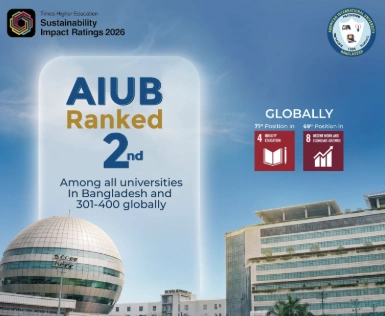
- 2026: In the THE Sustainability Impact Ratings, AIUB maintained its second position nationally and achieved the 301–400 global band. The university also ranked 69th worldwide for Decent Work and Economic Growth (SDG 8) and 71st for Quality Education (SDG 4) [4].
International methodological engagement: AIUB representatives participated in a masterclass on the evolution of THE's Sustainability Impact Ratings methodology during the Global Sustainable Development Congress 2026. The session provided an opportunity to engage with international assessment approaches, evidence-based reporting practices and sustainability impact measurement [5].
QS Stars Rating
AIUB became the first university in Bangladesh to receive a QS Stars rating, participating in an international assessment framework that evaluates institutional performance across multiple dimensions. The university achieved five stars in Environmental Impact, Employability and Academic Development [6]. Its participation demonstrates AIUB's engagement with internationally recognised evaluation frameworks and its commitment to measuring and communicating institutional performance in sustainability and higher education [1, 7].
Race to Zero for Universities and Colleges
In 2024, AIUB joined the Race to Zero campaign, reinforcing its commitment to addressing climate change and advancing institutional environmental sustainability [7]. The Race to Zero for Universities and Colleges framework encourages higher education institutions to halve emissions by 2030 and achieve net-zero emissions by 2050. Supported by international higher education and environmental organisations, the initiative provides a common framework for institutions to measure, report and reduce greenhouse gas emissions across their operations [8]. AIUB's participation connects the university with a global network of higher education institutions working towards measurable climate action and long-term decarbonisation.
International Networks that Gather and Share SDG Data
AIUB participates in international higher education networks that facilitate the collection, exchange and dissemination of information on sustainable development. These collaborations connect the university with institutions worldwide, support comparative assessments and contribute to shared knowledge on progress towards the Sustainable Development Goals (SDGs).
International Association of Universities – Higher Education for Sustainable Development (IAU HESD)
As a Satellite Higher Education Institution of the International Association of Universities (IAU), AIUB actively contributes to the global higher education community's efforts to advance the 2030 Agenda for Sustainable Development [9]. Its institutional profile on the IAU Higher Education for Sustainable Development (HESD) portal documents its engagement with the network and its contributions to collective reporting initiatives. These include the IAU HESD Activity Report 2023–24 and the IAU HESD Cluster Activity Report 2024–25, which consolidate activities and experiences shared by participating institutions and cluster members worldwide [10]. AIUB's participation helps disseminate institutional experiences and contributes to the international exchange of information on higher education's role in sustainable development.
Responsible Futures International (2024/25)
AIUB joined Responsible Futures International, a programme led by Students Organising for Sustainability (SOS-UK) in partnership with the IAU, becoming the first and only Asian university in the 2024/25 cohort [9]. The programme provides an international framework for assessing and advancing sustainability and climate justice in university curricula, institutional policies and student engagement [11].
Responsible Futures applies a structured set of criteria based on established good practices. Participating institutions undergo an external audit conducted by trained student auditors, who assess institutional progress against common standards [12]. By participating in this process, AIUB engages in an internationally recognised assessment approach that generates comparable evidence on sustainability education and supports the exchange of institutional practices among universities worldwide.
Association for the Advancement of Sustainability in Higher Education (AASHE)
AIUB is a member of the Association for the Advancement of Sustainability in Higher Education (AASHE), an international network that supports higher education institutions in assessing and advancing campus sustainability [13]. The association provides access to resources, assessment methodologies and institutional benchmarking opportunities, including its Sustainability Tracking, Assessment & Rating System (STARS) [14]. Aligned with the SDGs, STARS offers a structured framework for documenting and evaluating institutional contributions to sustainability across environmental, social and operational dimensions. AIUB's engagement with AASHE connects the university with an international community committed to sharing sustainability practices and advancing evidence-based assessment in higher education.
WePOWER – South Asia Women in Power Sector Professional Network
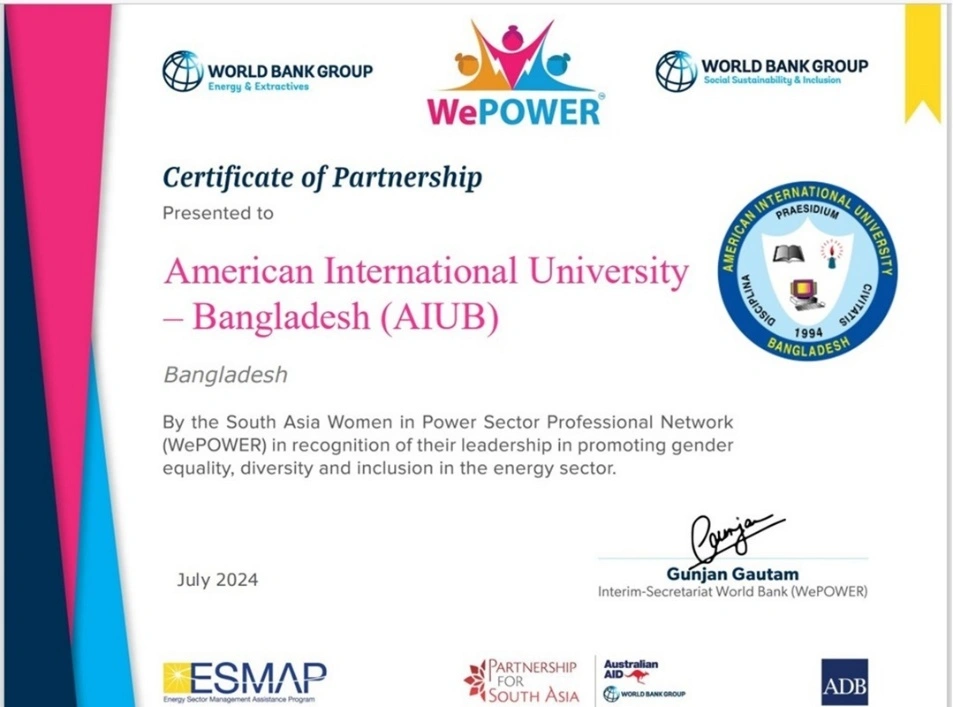
AIUB is the only educational institution among WePOWER's institutional partners in Bangladesh, participating in a regional network supported by the World Bank that promotes women's participation and professional advancement in the energy sector [15]. WePOWER coordinates institutional contributions across five pillars: STEM Education, Recruitment, Professional Development, Retention, and Policy and Institutional Change. Its partners contribute to shared metrics and targets that monitor progress in these areas [15]. AIUB's participation supports the regional exchange of information on opportunities and challenges affecting women in STEM and contributes to broader efforts to monitor gender equality and women's representation in the energy sector, particularly in relation to SDGs 5 and 7 [9].
International Quality Assurance Networks
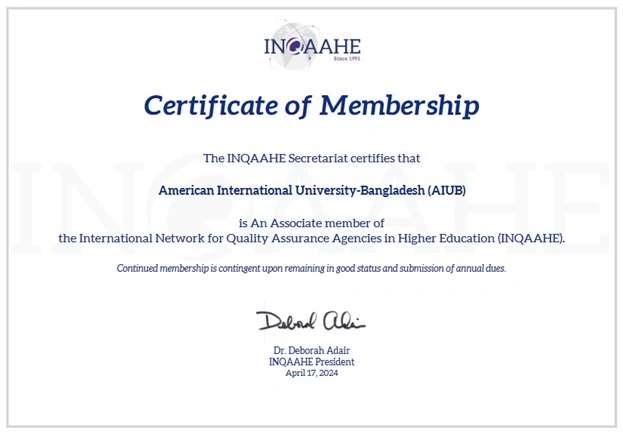
AIUB participates in international quality assurance networks that facilitate institutional benchmarking and the exchange of practices in higher education. The university is a member of the International Network for Quality Assurance Agencies in Higher Education (INQAAHE), connecting its quality assurance activities with an international community committed to advancing higher education standards [16]. AIUB also actively engages with the Asia-Pacific Quality Network (APQN), which recognised the university with its Best/Model Internal Quality Assurance Award in both 2016 and 2024 [17]. These international connections strengthen AIUB's engagement with global quality assurance practices and support the exchange of institutional experiences in higher education quality development.
International Research Collaborations and Evidence Generation for the SDGs
AIUB collaborates with international universities, research institutions and development organisations on projects that generate and disseminate knowledge about sustainable development challenges. These partnerships bring together expertise from different countries, support collaborative research and contribute evidence and insights relevant to the Sustainable Development Goals (SDGs).
Solar Irrigation and Climate Adaptation (2024)
AIUB participated in the yearlong international research project "Social Innovation Through Technology Nudging: Developing a Behavioural Toolkit for Diffusing Solar Irrigation", led by Durham University (UK) in collaboration with Curtin University (Australia), the University of Rajshahi and Khulna University. The project received funding from the World Bank through the Asian Disaster Preparedness Centre (ADPC), Thailand, under the Innovations for Climate Adaptation and Resilience (iCARE) fund [18].
The research collected evidence on farmers' adoption of solar-powered irrigation technologies and examined behavioural approaches to promoting their use. In December 2024, the project's findings were presented to an international audience of scholars, policymakers and government officials from Bangladesh, the UK, Australia and Thailand [18]. AIUB's participation contributed to collaborative research on sustainable agricultural practices, renewable energy adoption and climate resilience, supporting SDGs 2, 7 and 13.
Magna Charta Observatory: "Responsive and Responsible University" Research
AIUB participates in the Magna Charta Observatory (MCO) initiative "Responsive and Responsible University", launched in 2022 to investigate the evolving role of universities in society. Since 2023, AIUB has collaborated with Mykolas Romeris University (Lithuania) on research examining university engagement with local communities. The collaboration has also enabled AIUB to present its research at international MCO workshops in Poland in November 2023 and Vilnius, Lithuania, in 2024 [19].
The study focuses on Dhaka's Korail slum, examining how universities can contribute to women's empowerment, affordable housing, education for underprivileged children and youth entrepreneurship. Prof. Dr. Farheen Hassan presented the research as "Responsible and Responsive Universities – A Case Study of AIUB" at the IAU 2024 International Conference, held on 22–24 November 2024 [20]. This collaboration generates and shares knowledge on university-community engagement and the contribution of higher education to inclusive and sustainable urban development, addressing SDGs 1, 4, 5 and 11.
Erasmus+ SOHO Project (2023–2026)
AIUB is one of nine European and Southeast Asian institutions participating in the SOHO project (Smart, Optimized, High-quality and On-demand Tourism Innovative Education for Sustainable and Green Development), coordinated by the National University of Science and Technology Politehnica Bucharest, Romania. The consortium includes Université Lumière Lyon 2, Politecnico di Milano, Universiti Sains Malaysia and the University of Danang, among other partners [21].
The project promotes international knowledge exchange and the development of specialised expertise in sustainable tourism through knowledge and competence centres, micro-credential courses and innovative educational approaches. AIUB's participation connects Bangladesh's higher education sector with a broader international collaboration focused on sustainable and green tourism development, contributing to SDGs 8 and 12 [9], [21].
JusTN0W – Just Transitions to a Net Zero World
AIUB is a Supporting Partner of JusTN0W – Just Transitions to a Net Zero World, an international research initiative led by Durham University (UK). The initiative has committed more than £5 million in strategic research funding over four years to investigate pathways towards a fair and inclusive transition to net-zero emissions [22].
AIUB's participation connects the university with an international research collaboration addressing the social, economic and environmental dimensions of the transition to net zero. It also provides an institutional link for bringing Bangladesh's perspectives and development context into international discussions on climate action and just transitions, particularly in relation to SDGs 7 and 13 [22].
UNESCO International Institute for Educational Planning (IIEP)
AIUB has contributed to international research on higher education quality assurance as a case study in the UNESCO International Institute for Educational Planning (IIEP) research project "Exploring Innovations and Effective Internal Quality Assurance (IQA) Systems in Higher Education" [23], [23].
The study examined AIUB's internal quality assurance mechanisms, assessment tools and their contribution to educational quality and graduate employability. The findings were incorporated into a UNESCO IIEP international publication, making AIUB's institutional experience part of a broader body of knowledge on effective quality assurance practices in higher education [23]. This collaboration supports the international exchange of evidence and institutional practices that contribute to improving the quality of education, in line with SDG 4.
References
| [1] | American International University-Bangladesh, “AIUB is a Signatory of SDG Accord,” [Online]. Available: https://www.aiub.edu/iqac/sdgs/aiub-is-a-signatory-of-sdg-accord. [Accessed 2026]. |
| [2] | EAUC – The Alliance for Sustainability Leadership in Education, “SDG Accord Report 2023,” [Online]. Available: https://www.sdgaccord.org/files/2023_sdg_accord_progress_report.pdf. [Accessed 2026]. |
| [3] | Bangladesh Post, “AIUB Ranks 2nd in Bangladesh in THE Impact Rankings,” [Online]. Available: https://bangladeshpost.net/posts/aiub-ranks-2nd-in-bangladesh-in-the-impact-rankings-153328. [Accessed 2026]. |
| [4] | American International University-Bangladesh, “AIUB Retains 2nd Position in Bangladesh in Times Higher Education (THE) Sustainability Impact Ratings 2026,” [Online]. Available: https://aiub.edu/aiub-retains-2nd-position-in-bangladesh-in-times-higher-education-the-sustainability-impact-ratings-2026. [Accessed 2026]. |
| [5] | American International University-Bangladesh, “AIUB Participates in Masterclass on Evolution of THE's Sustainability Impact Ratings Methodology at GSDC 2026,” [Online]. Available: https://aiub.edu/aiub-participates-in-masterclass-on-evolution-of-thes-sustainability-impact-ratings-methodology-at-gsdc-2026. [Accessed 2026]. |
| [6] | Dhaka Tribune, “AIUB Becomes Bangladesh's First QS 4-Star University,” [Online]. Available: https://www.dhakatribune.com/bangladesh/344947/aiub-becomes-bangladesh%E2%80%99s-first-qs-4-star. [Accessed 2026]. |
| [7] | American International University-Bangladesh, “AIUB's Commitment to Race to Zero: A Step Towards Environmental Sustainability,” [Online]. Available: https://www.aiub.edu/aiubs-commitment-to-race-to-zero-a-step-towards-environmental-sustainability. [Accessed 2026]. |
| [8] | EAUC – The Alliance for Sustainability Leadership in Education, “Race to Zero for Universities and Colleges,” [Online]. Available: https://eauc.org.uk/about/projects-and-programmes/race-to-zero/. [Accessed 2026]. |
| [9] | American International University-Bangladesh, “International Collaboration of AIUB,” [Online]. Available: https://aiub.edu/sustainability/sdg17/sdg17-initiative/international-collaboration-of-aiub. [Accessed 2026]. |
| [10] | International Association of Universities, “American International University – Bangladesh (AIUB),” [Online]. Available: https://www.iau-hesd.net/university/american-international-university-bangladesh-aiub. [Accessed 2026]. |
| [11] | American International University-Bangladesh, “AIUB Joins 'Responsible Futures International 2024/25',” [Online]. Available: https://aiub.edu/aiub-joins-responsible-futures-international-2024-2025. [Accessed 2026]. |
| [12] | Students Organising for Sustainability UK, “Responsible Futures Overview,” [Online]. Available: https://www.sos-uk.org/resources-file/responsible-futures-programme-overview. [Accessed 2026]. |
| [13] | American International University-Bangladesh, “AIUB Joins AASHE to Strengthen Commitment to Sustainability,” [Online]. Available: https://www.aiub.edu/aiub-joins-aashe-to-strengthen-commitment-to-sustainability. [Accessed 2026]. |
| [14] | H. Kistner, J. King, and C. Pelton, “STARS Aligned: Using the Sustainability Tracking Assessment & Rating System to Report on Contributions to the U.N. Sustainable Development Goals,” [Online]. Available: https://www.aashe.org/wp-content/uploads/2020/05/STARS-SDGs-May-26.pdf. [Accessed 2026]. |
| [15] | American International University-Bangladesh, “AIUB Is an Institutional Partner of WePOWER,” [Online]. Available: https://www.aiub.edu/aiub-is-an-institutional-partner-of-wepower. [Accessed 2026]. |
| [16] | American International University-Bangladesh, “AIUB Is Now a Proud Member of the Prestigious INQAAHE,” [Online]. Available: https://www.aiub.edu/aiub-is-now-a-proud-member-of-the-prestigious-inqaahe. [Accessed 2026]. |
| [17] | American International University-Bangladesh, “Message from the Director,” [Online]. Available: https://www.aiub.edu/iqac/message-from-the-director. [Accessed 2026]. |
| [18] | Dhaka Tribune, “AIUB Hosts Dissemination Workshop on Solar Irrigation and Climate Adaptation,” [Online]. Available: https://www.dhakatribune.com/bangladesh/education/368162/aiub-hosts-dissemination-workshop-on-solar. [Accessed 2026]. |
| [19] | American International University-Bangladesh, “AIUB faculty members participated in Magna Charta Observatory Research Workshop II,” [Online]. Available: https://www.aiub.edu/aiub-faculty-members-participated-in-magna-charta-observatory-research-workshop-ii. [Accessed 2026]. |
| [20] | American International University-Bangladesh, “MCO project 'Responsible and Responsive Universities – A case study of AIUB' presented at IAU 2024 conference,” [Online]. Available: https://www.aiub.edu/mco-project-responsible-and-responsive-universities--a-case-study-of-aiub-presented-at-iau-2024-conference. [Accessed 2026]. |
| [21] | American International University-Bangladesh, “SOHO – Smart, Optimized, High-Quality and On-Demand Tourism Innovative Education for Sustainable and Green Development (2023–2026),” [Online]. Available: https://www.aiub.edu/soho--smart-optimized-high-quality-and-on-demand-tourism-innovative-education-for-sustainable-and-green-development-2023-2026. [Accessed 2026]. |
| [22] | American International University-Bangladesh, “AIUB Is One of the Supporting Partners of the 'JusTN0W – Just Transitions to a Net Zero World' Project of Durham University, UK,” [Online]. Available: https://www.aiub.edu/aiub-is-one-of-the-supporting-partners-of-the--justn0w--just-transitions-to-a-net-zero-world-project-of-durham-university-uk. [Accessed 2026]. |
| [23] | C. Lamagna, C. C. Villanueva, and F. Hassan, “The Effects of Internal Quality Assurance on Quality and Employability: American International University – Bangladesh,” [Online]. Available: https://unesdoc.unesco.org/ark:/48223/pf0000249495. [Accessed 2026]. |