


TABLE OF CONTENTS
SDG 6: CLEAN WATER AND SANITATION
Research on Water and Sanitation
Understanding Water Contamination
Low-Cost Water Quality Monitoring
Solar-Powered Water Purification
Smart and Eco-Friendly Sanitation
Cleaner Water from Industrial Processes
Nanotechnology-Based Desalination Research
Responsible Water Management on Campus
Free Drinking Water, Sanitation and Hygiene
Free Drinking Water for Everyone
Sanitation and Hygiene Facilities
Green Campus and Sustainable Water Management
Water Education and Community Engagement
Lecture on WASH and Digital Solutions
Student-Led Humanitarian Support During Floods
Partnerships and Policy Engagement on Water
Institutional and International Partnerships
Policy Dialogue on Sustainable Water Management for Agriculture
International Collaboration on Industrial Wastewater Recycling
SDG 6: CLEAN WATER AND SANITATION
Research on Water and Sanitation
AIUB advances research and technological innovation to address challenges related to water quality, contamination, purification and sustainable sanitation. Its researchers develop affordable monitoring technologies, renewable energy-powered purification systems and smart sanitation solutions that contribute to improving access to safe water and promoting more sustainable water management practices [1].
Understanding Water Contamination
Arsenic contamination of groundwater represents a major public health challenge in Bangladesh. AIUB-affiliated researchers contributed to the understanding of this issue through a review published in Agriculture, Ecosystems & Environment, which examined arsenic contamination in soil, water and the food chain. The study highlighted that approximately 85 million people were at risk of arsenic exposure through drinking water and food crops, while nearly 97% of the population relied on groundwater for drinking and domestic purposes [2]. This research provides valuable scientific insights into the environmental and public health implications of arsenic contamination, supporting informed approaches to water safety and pollution prevention.
Low-Cost Water Quality Monitoring
AIUB engineers developed a low-cost Internet of Things (IoT)-based water quality monitoring system that enables real-time measurement of key water quality parameters, including turbidity, total dissolved solids (TDS), pH and temperature. The system transmits monitoring data to smartphones and computers, facilitating continuous access to water quality information. Its performance was successfully evaluated using 30 different water samples, demonstrating its potential for monitoring water quality in household, industrial, agricultural and commercial applications [3]. This technological development contributes to more accessible and efficient water quality assessment, supporting efforts to ensure safer water resources.
Solar-Powered Water Purification
AIUB researchers have developed solar-powered water purification and monitoring systems that integrate filtration and disinfection technologies with real-time monitoring capabilities accessible through mobile applications and web-based dashboards. By combining solar energy generation with battery storage, these systems provide an energy-efficient approach to water purification, particularly in rural and urban areas where access to reliable electricity may be limited [4]– [5]. The latest development was presented at the International Conference on Computing and Information Technology (ICCIT) in December 2024 and published by IEEE, further demonstrating AIUB's contribution to research and innovation in sustainable water treatment technologies [4].
Smart and Eco-Friendly Sanitation
AIUB researchers designed an IoT-based smart bio-toilet incorporating an integrated hygiene management system to promote sustainable sanitation practices. The proposed solution combines several environmentally beneficial technologies: it reduces water consumption, generates electricity from biogas produced by human waste, produces biofertilizer, treats recovered wastewater and incorporates solar energy as an additional electricity source. Furthermore, its cloud-based monitoring platform enables remote supervision and control of multiple bio-toilet units, supporting more efficient sanitation management [6], [7]. This research demonstrates an integrated approach to resource recovery, wastewater treatment and environmentally sustainable sanitation infrastructure.
Cleaner Water from Industrial Processes
AIUB research also addresses industrial water pollution, particularly the removal of hazardous contaminants generated by manufacturing activities. One research contribution explores the application of nanocomposites for the photocatalytic degradation of toxic textile dyes in wastewater, offering a technological approach to reducing industrial water contamination [8]. This research supports the development of innovative treatment methods aimed at improving wastewater quality and minimizing the environmental impact of industrial activities.
Nanotechnology-Based Desalination Research
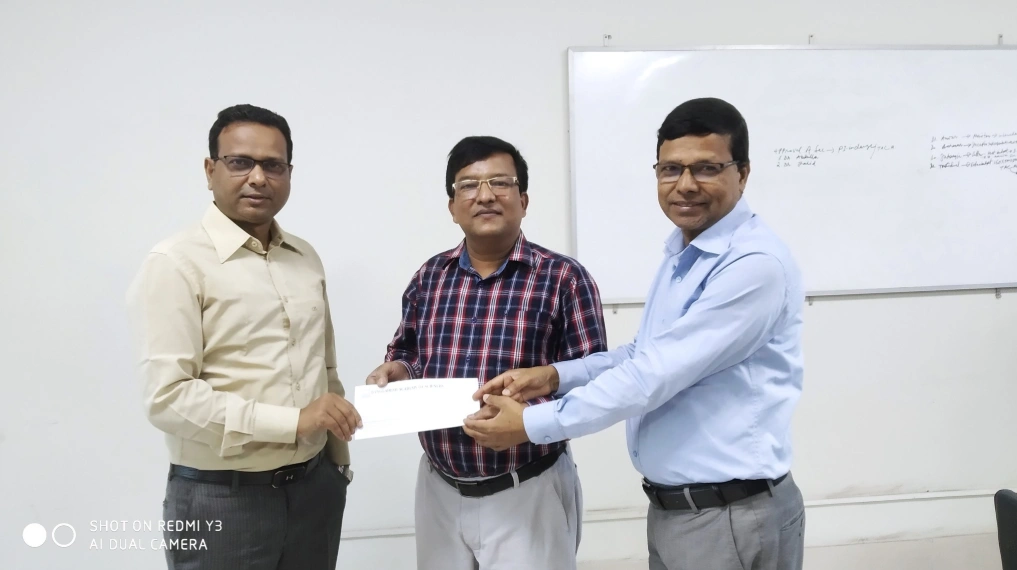
AIUB is advancing research on innovative desalination technologies to address water and soil salinity, a major environmental and agricultural challenge in Bangladesh. In June 2025, an AIUB faculty member received a research grant under the Bangladesh Academy of Sciences–United States Department of Agriculture (BAS-USDA) Endowment Program for a three-year project entitled "Desalination of Water and Soil Using Nanomaterials and Nanotechnology" (2025–2028) [9].
Led by Dr. Mohammad Mahbub Rabbani, Associate Professor in the Department of Chemistry and In-Charge of the Center for Nanotechnology Research (CNR), the project focuses on developing nanomaterial-based technologies to remediate saline water and soil. The research is conducted at AIUB's CNR in collaboration with the Department of Chemistry at the University of Dhaka and includes a dedicated PhD fellowship [9], [10].
By investigating advanced materials for reducing salinity, AIUB contributes to the development of innovative approaches to improving water quality, protecting agricultural resources and supporting sustainable water management. This research addresses challenges associated with saline groundwater and agricultural land, with potential benefits for drinking water availability and agricultural production.
Responsible Water Management on Campus
AIUB promotes responsible water management and maintains institutional practices that support efficient resource use, environmental health and hygienic conditions across its campus facilities.
Monitoring Water Use
AIUB implements processes to monitor water consumption per capita and promote the efficient use of water across its campus facilities [11]. These practices are supported by institutional policies and monitoring mechanisms that integrate water conservation, resource management and hygiene standards into campus operations [1]. This approach reinforces the university's commitment to responsible water consumption and sustainable campus management.
Clean and Hygienic Buildings
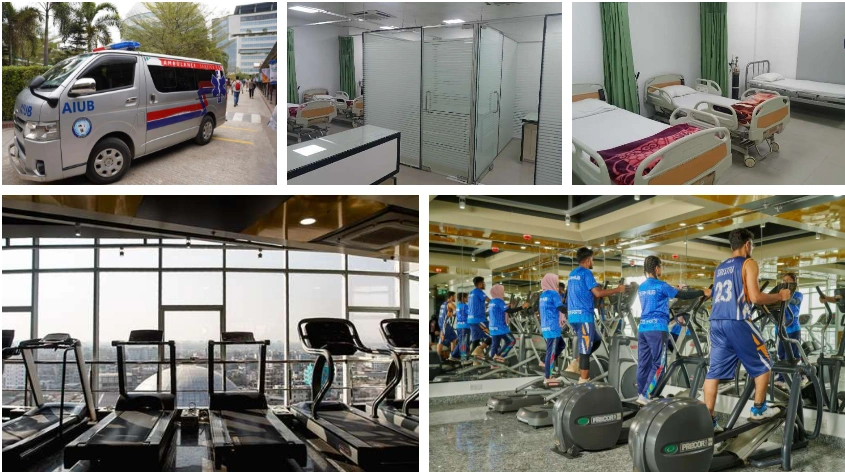
AIUB maintains clean and hygienic campus facilities through regular deep-cleaning and comprehensive disinfection activities [12]. These practices support sanitary conditions throughout university buildings and contribute to maintaining a healthy environment for students, faculty, staff and visitors.
Training Staff in Hygiene
AIUB strengthens institutional hygiene practices by providing specialized training for personnel responsible for food handling, cleaning and campus services. On September 2, 2022, the Office of Human Resources organized a full-day training programme on food hygiene, cleaning and services at the AIUB Training and Research Centre in Sreepur. Participants included support staff, supervisors, kitchen personnel, chefs, housekeepers and campus canteen employees [13]. The initiative promotes good hygiene practices and strengthens the capacity of university personnel to maintain clean and sanitary conditions in food service areas and other campus facilities.
Free Drinking Water, Sanitation and Hygiene
AIUB promotes access to drinking water, adequate sanitation and essential hygiene services across its campus, supporting the well-being, dignity and health of its university community.
Free Drinking Water for Everyone
AIUB provides free drinking water through strategically available water fountains across its campus, ensuring that students, faculty, staff and visitors can access drinking water without additional costs [11]. This initiative promotes equitable access to drinking water and encourages the use of refillable containers, contributing to reduced dependence on single-use plastic bottles and more sustainable consumption practices.
Sanitation and Hygiene Facilities
AIUB provides sanitation facilities and hygiene services to support the health and well-being of its university community [1]. Its on-campus Medical Center further strengthens these efforts by providing free hygiene products to women in emergency situations, supporting menstrual hygiene management and ensuring access to essential personal care resources when needed [14]. These services contribute to a more inclusive campus environment in which hygiene, health and personal dignity are prioritized.
Green Campus and Sustainable Water Management
AIUB's permanent campus spans 13 acres of land and features extensive green spaces, multiple gardens and diverse ecological elements that contribute to a sustainable campus environment [15]. Its landscaped areas provide natural spaces that can support rainwater infiltration, help regulate surface runoff and contribute to maintaining local environmental conditions. These green infrastructure features complement AIUB's broader sustainability efforts and highlight the environmental value of integrating natural areas into university campus planning. The campus also incorporates more than 130 kW of solar energy capacity, reinforcing its commitment to environmentally responsible infrastructure [16].
Water Education and Community Engagement
AIUB promotes awareness, education and community engagement on water, sanitation and hygiene through academic activities, environmental awareness initiatives and student-led humanitarian actions. These efforts contribute to strengthening knowledge of WASH-related challenges and supporting communities affected by environmental emergencies.
Lecture on WASH and Digital Solutions
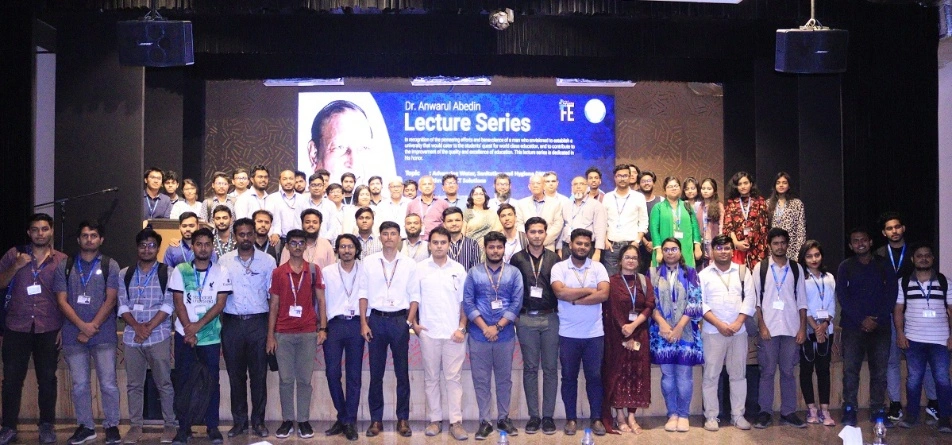
On July 25, 2023, AIUB's Faculty of Engineering organized a session of the Dr. Anwarul Abedin Lecture Series entitled "Advancing Water, Sanitation and Hygiene (WASH) through ICT Solutions" at the AIUB Auditorium. The lecture explored how information and communication technologies can improve water and sanitation services, addressing topics such as data management and monitoring, mobile applications, smart water management, modernized public toilets, digital public toilet applications, and menstrual health and hygiene. A WASH Innovation Contest was also announced to encourage participants to develop innovative ideas addressing water and sanitation challenges [17]. This academic initiative strengthened awareness of technological opportunities for improving WASH services and encouraged student engagement in sustainable solutions.
Environmental Awareness
AIUB promotes environmental awareness and sustainable practices through initiatives such as its celebration of World Environment Day 2022. The activities highlighted the importance of environmental conservation and responsible resource management, reinforcing the university's commitment to environmental sustainability [8], [18]. These initiatives complement AIUB's broader efforts to raise awareness of environmental challenges and the importance of protecting natural resources, including water.
Student-Led Humanitarian Support During Floods
AIUB students actively participate in humanitarian initiatives supporting communities affected by natural disasters, including floods that threaten access to essential resources, safe drinking water and adequate hygiene conditions.
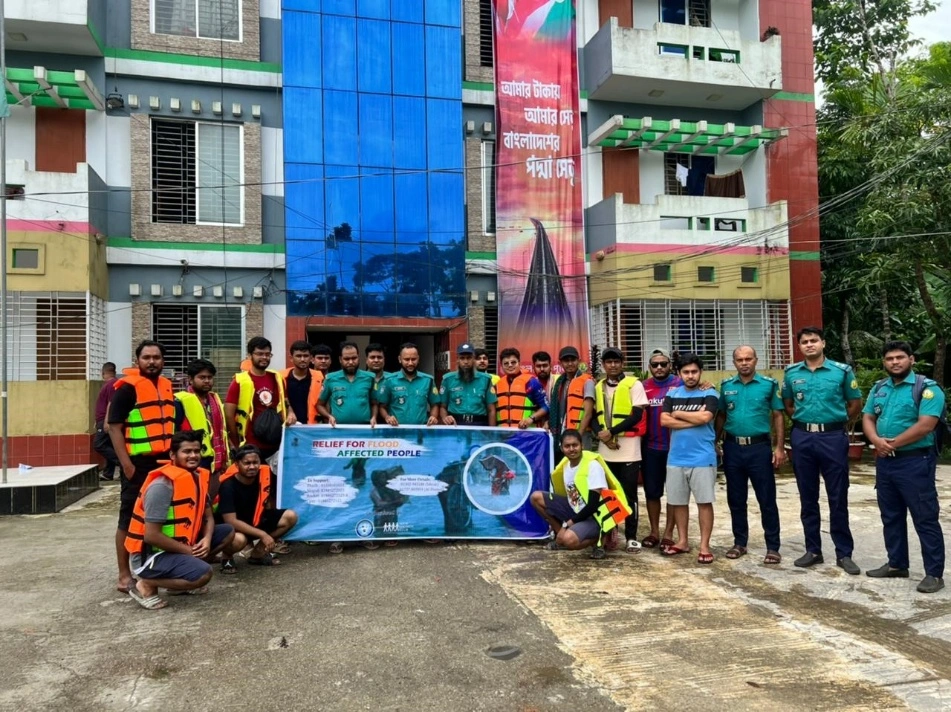
- 2024 Flood Response: AIUB student groups delivered essential food and medical supplies to more than 1,200 families in south-eastern Bangladesh and participated in rescue efforts to assist stranded residents [19]. These actions demonstrate student engagement in humanitarian assistance and community support during emergencies.
- 2022 Flood Response: The AIUB Social Welfare Club – Shomoy organized relief activities in the Sylhet region, distributing essential packages containing drinking water, oral saline, first-aid medication and sanitary pads to flood-affected communities [20]. The initiative addressed immediate needs related to hydration, health and personal hygiene, supporting vulnerable populations during a period of disruption to essential services.
Partnerships and Policy Engagement on Water
AIUB strengthens its contribution to sustainable development through institutional partnerships, international research collaboration and engagement with policymakers on water-related challenges. These efforts promote knowledge exchange, collaborative research and the development of sustainable approaches to water resource management.
Institutional and International Partnerships
AIUB maintains institutional commitments and international collaborations that support its broader contribution to the Sustainable Development Goals. The university is a signatory to the SDG Accord and maintains partnerships with organizations including BAS, the United States Department of Agriculture (USDA) and the Japan International Cooperation Agency (JICA) [1]. These institutional connections provide a framework for international engagement, knowledge exchange and collaborative efforts in support of sustainable development, complementing AIUB's initiatives in water and sanitation.
Policy Dialogue on Sustainable Water Management for Agriculture
AIUB contributes to international research collaboration addressing sustainable irrigation and agricultural water management in Bangladesh. The university is a member of an international research consortium supported by the World Bank through the Asian Disaster Preparedness Center (ADPC) and led by Durham University, which investigates the factors influencing farmers' adoption of solar-powered irrigation technologies [21].
As part of this collaboration, AIUB hosted a policy engagement workshop in February 2024, providing a platform for discussing research and policy considerations related to solar irrigation. In December 2024, the university organized a dissemination workshop attended by the Additional Secretary of the Ministry of Agriculture, where research findings on solar-powered irrigation and climate adaptation were shared with policymakers [21]– [22]. These activities strengthen the connection between academic research and public policymaking, promoting knowledge-based approaches to sustainable agricultural water management and climate resilience.
International Collaboration on Industrial Wastewater Recycling
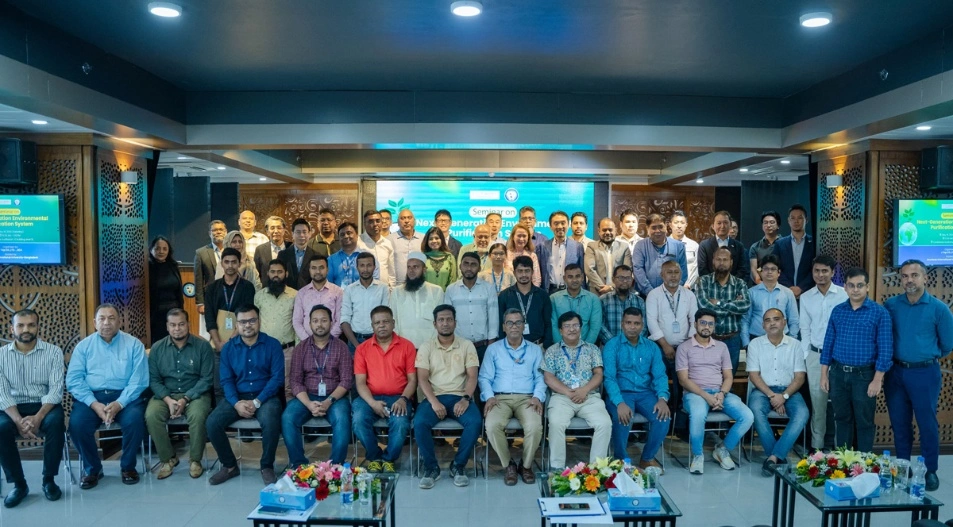
AIUB promotes cross-sectoral cooperation to advance innovative solutions for industrial wastewater treatment and environmental protection. On May 18, 2024, the university hosted the seminar "Next Generation Environmental Purification System", organized in collaboration with the Japan International Cooperation Agency (JICA) and J-TOP Corporation Limited [23].
The seminar presented an advanced Japanese environmental purification technology designed for the garment industry, focusing on the treatment and recycling of industrial wastewater using activated carbon technology. The event was inaugurated by JICA's Chief Representative in Bangladesh, while the Director of the Government of Bangladesh's Department of Environment participated as a special guest. Representatives of garment companies, corporate organizations, industry associations, researchers and faculty members from several universities also attended the event [23].
The initiative established a collaborative platform for exchanging technical knowledge and discussing innovative approaches to industrial wastewater recycling. By bringing together international cooperation agencies, private industry, government representatives and academia, AIUB contributes to strengthening partnerships for pollution prevention, wastewater treatment and sustainable industrial water management [23].
Publication of SDG 6 Progress and Achievements
AIUB promotes transparency and institutional accountability by publicly documenting its contributions to the United Nations Sustainable Development Goals. The university maintains a dedicated SDG 6: Clean Water and Sanitation reporting platform, presenting its initiatives, research activities, community engagement, institutional practices and partnerships related to sustainable water and sanitation management [1].
The publicly accessible report consolidates evidence of AIUB's contributions to clean water and sanitation, providing an institutional overview of its progress and activities. This reporting approach strengthens transparency, facilitates access to sustainability information and supports the dissemination of university contributions to the 2030 Agenda [1].
References
| [1] | American International University-Bangladesh, “SDG 6: Clean Water and Sanitation,” [Online]. Available: https://www.aiub.edu/sustainability/sdg6. [Accessed 2026]. |
| [2] | M. F. Hossain, “Arsenic contamination in Bangladesh — an overview,” [Online]. Available: https://www.sciencedirect.com/science/article/pii/S0167880905004329. [Accessed 2026]. |
| [3] | S. Salehin, T. A. Meem, A. J. Islam, and N. Al Islam, “Design and development of a low-cost IoT-based water quality monitoring system,” [Online]. Available: https://link.springer.com/chapter/10.1007/978-981-19-8032-9_51. [Accessed 2026]. |
| [4] | R. Ahmed, T. Riyad, A. Haque, and M. H. Bhuyan, “Harvesting solar power for IoT-driven water purification and monitoring systems,” [Online]. Available: https://ieeexplore.ieee.org/document/11021914/. [Accessed 2026]. |
| [5] | A. Abdullah Al, S. A. Aktab, S. I. Trisha, and M. Hasan, “IoT based water purification system using solar energy,” [Online]. Available: https://www.ijert.org/solar-assisted-water-purification-system-using-iot-ijertv15is020719. [Accessed 2026]. |
| [6] | D. D. Purkaystha, S. Saha, A. Das Gupta, D. Banik, and M. H. Bhuyan, “Design and implementation of an IoT-based smart bio-toilet with hygiene maintaining system,” [Online]. Available: http://eprints.intimal.edu.my/2283/1/joit2025_33.pdf. [Accessed 2026]. |
| [7] | D. D. Purkaystha, S. Saha, A. Das Gupta, D. Banik, and M. H. Bhuyan, “Design of an IoT-based smart bio-toilet scheme with hygiene-preserving,” [Online]. Available: https://iuojs.intimal.edu.my/index.php/joit/article/view/832. [Accessed 2026]. |
| [8] | American International University-Bangladesh, “AIUB SDG Activity Report 2022 | SDG 6: Clean Water and Sanitation.,” [Online]. Available: https://www.aiub.edu/iqac/sdgs/aiub-sdg-activity-report-2022/SDG6-AIUBActivityReportof2022. [Accessed 2026]. |
| [9] | American International University-Bangladesh, “AIUB Faculty received research grant under BAS-USDA Endowment Program,” [Online]. Available: https://www.library.aiub.edu/aiub-faculty-received-research-grant-under-bas-usda-endowment-program. . [Accessed 2026]. |
| [10] | American International University-Bangladesh, “Inception workshop on BAS-USDA research project held at AIUB,” [Online]. Available: https://www.iqac.aiub.edu/inception-workshop-on-bas-usda-research-project-held-at-aiub. [Accessed 2026]. |
| [11] | American International University-Bangladesh, “AIUB SDG Activity Report 2023 | SDG 6: Clean Water and Sanitation.,” [Online]. Available: https://www.aiub.edu/iqac/sdgs/aiub-sdg-activity-report-2023/SDG6-AIUBActivityReportof2023. [Accessed 2026]. |
| [12] | American International University-Bangladesh, “Health & Wellness,” [Online]. Available: https://www.aiub.edu/oncampus/health-and-wellness. [Accessed 2026]. |
| [13] | American International University-Bangladesh, “Training on Food Hygiene, Cleaning and Services,” [Online]. Available: https://www.aiub.edu/training-on-food-hygiene-cleaning-and-services. [Accessed 2026]. |
| [14] | American International University-Bangladesh, “AIUB Good Health and Wellbeing,” [Online]. Available: https://aiub.edu/sustainability/aiub-good-health-and-wellbeing. [Accessed 2026]. |
| [15] | American International University-Bangladesh, “Sustainability at AIUB,” [Online]. Available: https://www.aiub.edu/sustainability. [Accessed 2026]. |
| [16] | American International University-Bangladesh, “Why Study Here.,” [Online]. Available: https://www.aiub.edu/about/why-study-here. [Accessed 2026]. |
| [17] | American International University-Bangladesh, “Dr. Anwarul Abedin Lecture Series on 'Advancing Water, Sanitation and Hygiene (WASH) through ICT Solutions',” [Online]. Available: https://www.aiub.edu/dr-anwarul-abedin-lecture-series-on--advancing-water-sanitation-and-hygiene-wash-through-ict-solutions. [Accessed 2026]. |
| [18] | American International University-Bangladesh, “World Environment Day 2022 Celebrated,” [Online]. Available: https://www.aiub.edu/world-environment-day-2022-celebrated. [Accessed 2026]. |
| [19] | American International University-Bangladesh, “Students of AIUB: Standing with the Flood-Effected,” [Online]. Available: https://www.aiub.edu/students-of-aiub-standing-with-the-flood-effected. [Accessed 2026]. |
| [20] | American International University-Bangladesh, “AIUB Social Welfare Club — 'Shomoy': 'Standing with the Flood-Effected 2022',” [Online]. Available: https://www.aiub.edu/aiub-social-welfare-club--shomoy-standing-with-the-flood-effected-2022. [Accessed 2026]. |
| [21] | American International University-Bangladesh, “AIUB hosts dissemination workshop on solar irrigation and climate adaptation,” [Online]. Available: https://www.aiub.edu/aiub-hosts-dissemination-workshop-on-solar-irrigation-and-climate-adaptation. [Accessed 2026]. |
| [22] | American International University-Bangladesh, “Policy Engagement Workshop on collaborative research — 'Social Innovation Through Technology Nudging: Developing a Behavioral Toolkit for Diffusing Solar Irrigation',” [Online]. Available: https://www.aiub.edu/policy-engagement-workshop-on-collaborative-research---social-innovation-through-technology-nudging-developing-a-behavioral-toolkit-for-diffusing-solar-irrigation. [Accessed 2026]. |
| [23] | American International University-Bangladesh, “Seminar on 'Next Generation Environmental Purification System',” [Online]. Available: https://www.aiub.edu/seminar-on-next-generation-environmental-purification-system. [Accessed 2026]. |