


TABLE OF CONTENTS
Partnerships with Public Bodies on Housing and Urban Development
MoU with the Housing and Building Research Institute (HBRI)
Collaboration with National Higher Education and Accreditation Authorities
Institutional Commitment to Cooperation with Government and Local Organisations
Affordable Housing and Community Development: The Korail Project
Project Background and Objectives
Research and Knowledge Exchange on Affordable Housing
Community-Based Activities and Student Participation
National Recognition and Contribution to the SDGs
Research and Student Contributions to Sustainable Urban Planning
Research on Sustainable Urban Mobility and Traffic Management
SDG 11.4.7: Does your university as a body work with local authorities to address planning issues/development, including ensuring that local residents are able to access affordable housing?
Partnerships with Public Bodies on Housing and Urban Development
MoU with the Housing and Building Research Institute (HBRI)
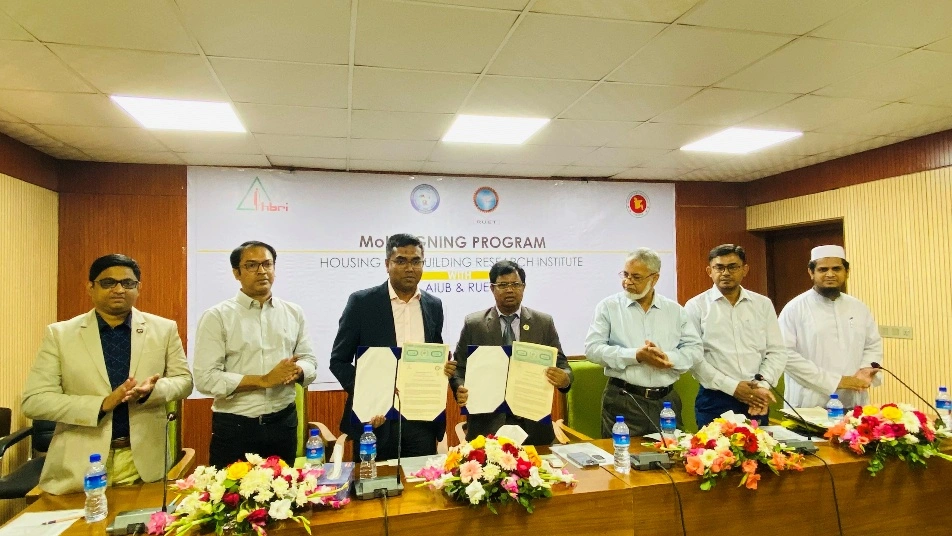
On 14 March 2023, AIUB signed a Memorandum of Understanding (MoU) with the Housing and Building Research Institute (HBRI), Bangladesh's national institution for housing and building research, at HBRI's premises [1]. The signing ceremony brought together AIUB's Pro-Vice Chancellor and Head of the Department of Architecture, alongside HBRI's Director General and senior researchers [1].
The agreement establishes a framework for long-term institutional cooperation in the following areas [1]:
- Research and development in architecture, engineering and construction.
- Exchange of information, resources and facilities.
- Implementation of joint projects and academic programmes.
Following the signing ceremony, architecture students from AIUB's Design Studios VIII and IX visited HBRI's laboratories, model houses and factory. During the visit, HBRI researchers introduced the students to the institute's innovations and ongoing work in housing and building technologies [1]. This collaboration strengthens the connection between architectural education, applied research and national expertise in housing development, while providing students with practical exposure to innovative construction solutions.
Collaboration with National Higher Education and Accreditation Authorities
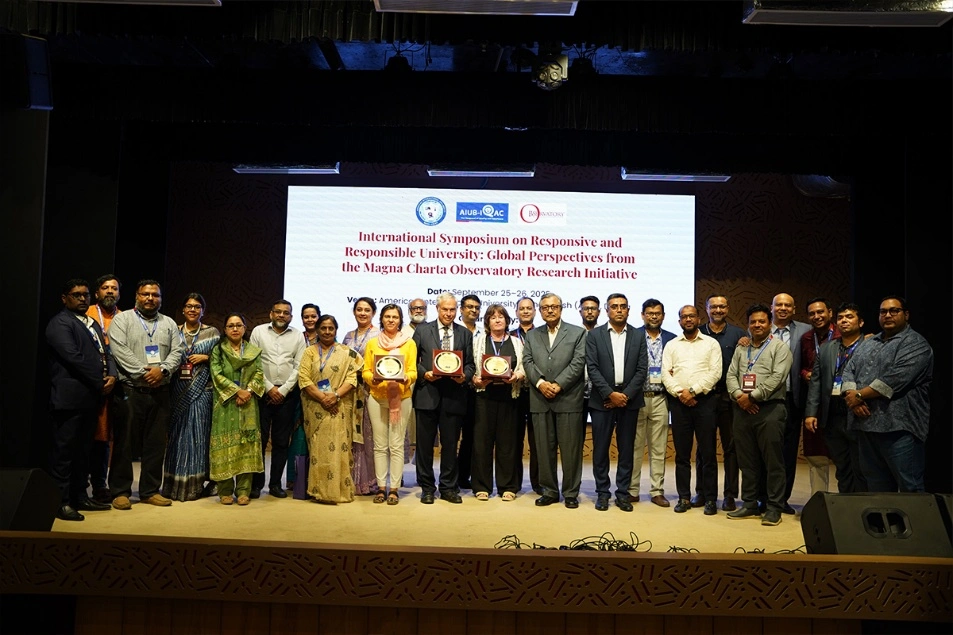
On 25 and 26 September 2025, AIUB hosted the International Symposium on Responsive and Responsible Universities in collaboration with the Magna Charta Observatory [2], [3]. The event brought together more than 150 participants and featured contributions from Bangladesh's University Grants Commission (UGC) and Bangladesh Accreditation Council (BAC), addressing the role of universities in strengthening their engagement with communities [3].
As part of the symposium, AIUB presented its community engagement project in Dhaka's Korail settlement, showcasing its institutional contribution to addressing community needs through university-led initiatives [2]. The event provided a platform for dialogue and knowledge exchange between AIUB, national higher education authorities and the wider academic community on the social responsibilities of universities and their contributions to local development.
Institutional Commitment to Cooperation with Government and Local Organisations
AIUB's Climate Action Plan establishes an institutional commitment to collaborate with local organisations, businesses, non-governmental organisations (NGOs) and government agencies to expand and strengthen its climate action initiatives [4]. The plan also promotes knowledge sharing and public engagement through workshops, seminars and public lectures, encouraging community participation in climate-related activities [4].
This commitment provides a framework for cooperation between AIUB and public and community stakeholders, supporting collective action and the exchange of knowledge to address environmental challenges and contribute to more sustainable communities.
Affordable Housing and Community Development: The Korail Project
AIUB contributes to affordable housing and community development through its engagement in Korail, an informal settlement in Dhaka. The initiative combines research, interdisciplinary student participation and community-based activities to support the social and economic development of women, children and other underserved residents.
Project Background and Objectives
AIUB is a signatory of the Magna Charta Universitatum 2020, a global declaration outlining the fundamental values and responsibilities of universities [5]. Under the Magna Charta Observatory's Responsive and Responsible University initiative, AIUB partnered with Mykolas Romeris University in Lithuania to implement a community development project in Korail. The initiative focuses on improving the social and economic conditions of women, children and underprivileged communities [5].
Recognising the challenges associated with population density and limited access to essential services in Korail, the project addresses several interconnected development priorities [5]. These include low-cost and sustainable housing, women's empowerment and educational opportunities for underprivileged children. By integrating housing-related activities with broader social development initiatives, AIUB adopts a community-oriented approach to improving living conditions.
Research and Knowledge Exchange on Affordable Housing
AIUB integrates academic research and international knowledge exchange into its community engagement activities. In June 2024, AIUB faculty members participated in the Magna Charta Observatory's Research Workshop II, presenting research on university-community engagement. The work included housing solutions for low-income groups and free educational opportunities for underprivileged children, using Korail as the research setting [6].
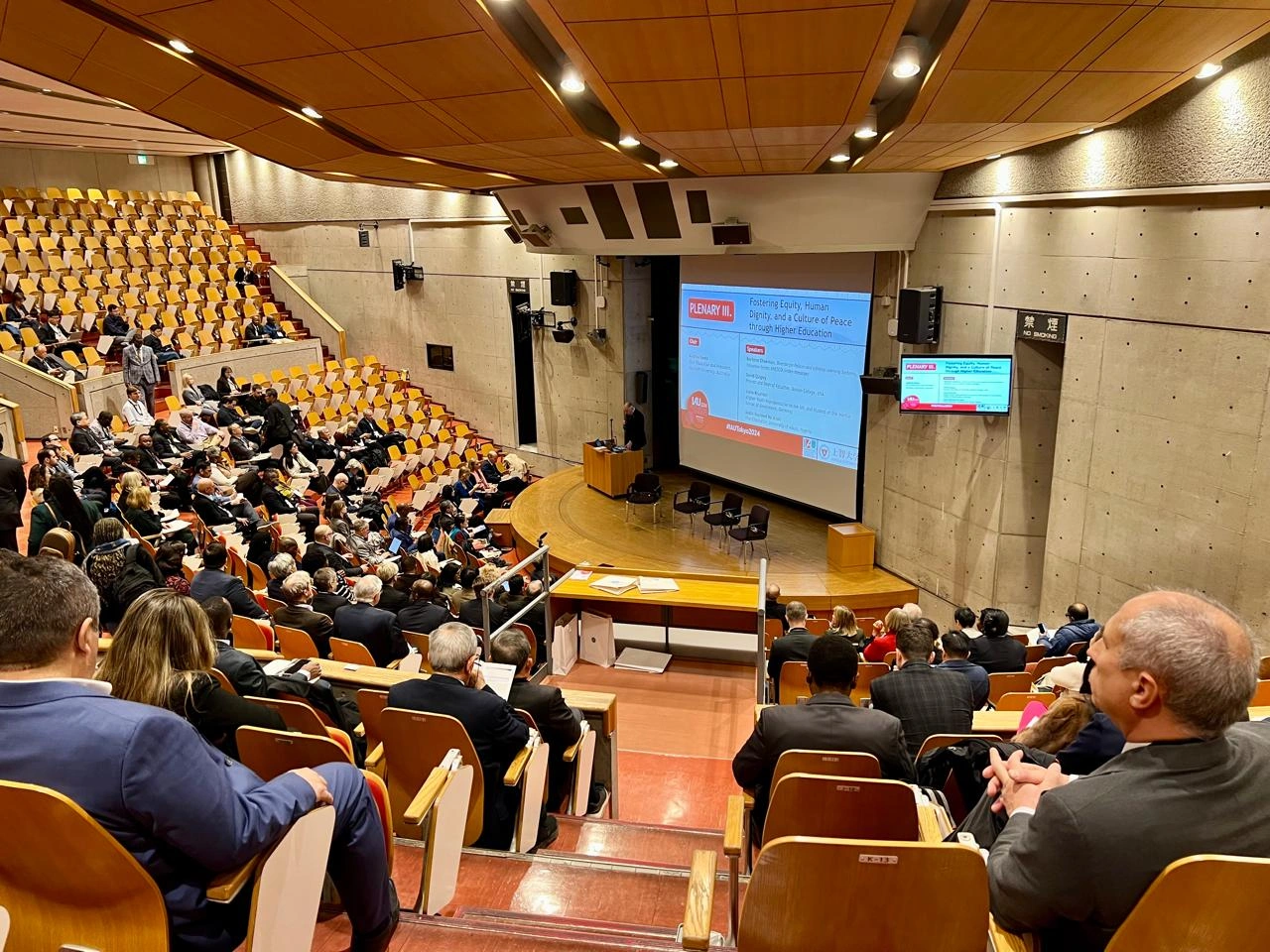
In November 2024, AIUB further presented its Korail case study at the International Association of Universities (IAU) 2024 Conference. The presentation addressed low-cost housing, women's empowerment, education and youth entrepreneurship as interconnected areas of community development [7].
These academic contributions strengthen AIUB's engagement with international university networks and promote the exchange of knowledge and experiences on affordable housing and inclusive community development.
Community-Based Activities and Student Participation
AIUB translates its research and institutional commitments into community-based activities through interdisciplinary student participation. The Korail initiative implemented several activities involving local residents, including [8]:
- Low-cost housing improvements: activities aimed at supporting more affordable and sustainable housing conditions.
- Adolescent health campaigns: community awareness activities addressing health and well-being.
- Creative moral education sessions: educational activities for children and young people.
- Women's economic empowerment: vocational training and peer-led microfinance support to encourage economic participation and entrepreneurship.
Approximately 40 AIUB students from the Departments of Architecture, Business Administration and Public Health participated in the initiative, alongside members of the Shomoy Club [8]. This interdisciplinary collaboration brought together academic knowledge and student engagement to address different dimensions of community development. The direct involvement of local residents also encouraged community participation in identifying and addressing their needs [8].
National Recognition and Contribution to the SDGs
In 2025, AIUB received the Best Sustainable Initiative – University award at the SDG Brand Champion Awards, organised by the Bangladesh Brand Forum, in recognition of its Korail project [8]. The initiative contributes to several Sustainable Development Goals, particularly SDG 11 (Sustainable Cities and Communities), by addressing affordable housing and supporting the development of underserved urban communities [8].
The project's progress and institutional recognition are reflected in the following milestones:
| Milestone | Date |
| Announcement of the Korail project and AIUB's Magna Charta Universitatum signatory status | April 2024 [5] |
| Presentation of research at the Magna Charta Observatory Research Workshop II | June 2024 [6] |
| Presentation of the Korail case study at the IAU 2024 Conference | November 2024 [7] |
| Recognition with the Best Sustainable Initiative – University award | 2025 [8] |
| Presentation of the project at the International Symposium in Dhaka | September 2025 [2] |
Research and Student Contributions to Sustainable Urban Planning
AIUB contributes to sustainable urban planning through academic research and student-led initiatives that address urban mobility, traffic management and the documentation of local communities and cultural heritage. These activities generate knowledge and practical insights relevant to policymakers, urban planners and other stakeholders involved in Dhaka's development.
Research on Sustainable Urban Mobility and Traffic Management
AIUB supports research on urban transportation challenges and sustainable mobility solutions through student-led academic studies.
- Dhaka Metro Rail (2025): AIUB students investigated the impact of MRT Line 6 on commuting patterns between Uttara and Motijheel. The study found that approximately 59.41% of passengers who previously relied on other forms of public transportation had shifted to the metro. It also reported a 66.67% reduction in average commuting time among the passengers studied [9]. The research highlights the contribution of mass rapid transit to improving urban mobility and provides insights relevant to the planning and development of Dhaka's public transportation network.
- Traffic management research: AIUB's study, Beyond the Gridlock, examines human-operated and automated traffic management systems in Dhaka through a comparative analysis. The research proposes a roadmap for sustainable traffic management solutions, providing insights for policymakers, urban planners and traffic management authorities working to address urban congestion [10].
Documentation of Local Communities and Built Heritage
AIUB promotes the documentation of local environments and cultural heritage as part of its academic engagement with communities.
On 15 July 2023, AIUB Media and Mass Communication students participated in a community development project in Jamdani Village, Bargaon, Sonargaon [12]. Working alongside architecture students from Bangladesh University of Engineering and Technology (BUET) and other professionals, they documented the village's built environment, cultural landscape and the stories of its traditional Jamdani weaving community [12].
This interdisciplinary initiative combined media documentation, architectural perspectives and community engagement to record the village's distinctive cultural and physical characteristics. The resulting documentation provides valuable knowledge for understanding local settlement patterns, preserving cultural identity and informing community-sensitive approaches to development and heritage conservation.
References
| [1] | American International University-Bangladesh, “AIUB & HBRI Sign MoU to Collaborate on Research and Development,” [Online]. Available: https://www.aiub.edu/aiub--hbri-sign-mou-to-collaborate-on-research-and-development. [Accessed 2026]. |
| [2] | American International University-Bangladesh, “AIUB Hosts International Symposium on Responsive and Responsible Universities in Collaboration with Magna Charta Observatory,” [Online]. Available: https://www.aiub.edu/aiub-hosts-international-symposium-on-responsive-and-responsible-universities-in-collaboration-with-magna-charta-observatory. [Accessed 2026]. |
| [3] | The Daily Star, “AIUB hosts International Symposium on Responsive and Responsible Universities in collaboration with Magna Charta Observatory,” [Online]. Available: https://epfs.thedailystar.net/TDS/2025/10/02/Bangladesh/CAM/5_06/81a6ca31fdf31d24_06.pdf. [Accessed 2026]. |
| [4] | American International University-Bangladesh, “AIUB Climate Action Plan,” [Online]. Available: https://www.aiub.edu/sustainability/aiub-climate-action-plan. [Accessed 2026]. |
| [5] | American International University-Bangladesh, “AIUB is a signatory of Magna Charta Universitatum (MCU),” [Online]. Available: https://aiub.edu/aiub-is-a-signatory-of-magna-charta-universitatum-mcu. [Accessed 2026]. |
| [6] | American International University-Bangladesh, “AIUB faculty members participated in Magna Charta Observatory Research Workshop II,” [Online]. Available: https://www.aiub.edu/aiub-faculty-members-participated-in-magna-charta-observatory-research-workshop-ii. [Accessed 2026]. |
| [7] | American International University-Bangladesh, “MCO project 'Responsible and Responsive Universities – A case study of AIUB' presented at IAU 2024 conference,” [Online]. Available: https://www.aiub.edu/mco-project-responsible-and-responsive-universities--a-case-study-of-aiub-presented-at-iau-2024-conference. [Accessed 2026]. |
| [8] | Dhaka Tribune , “AIUB wins 'Best Sustainable Initiative–University' at SDG Brand Champion Awards 2025,” [Online]. Available: https://www.dhakatribune.com/bangladesh/event/386478/aiub-wins-best-sustainable-initiative%E2%80%93university. [Accessed 2026]. |
| [9] | P. Roy, J. F. Ayshe, M. I. A. S. Arnob, and M. I. H. Bappy, “Impact of MRT Line 6 (Dhaka Metro Rail) on Commuter Modal Shift, Travel Time Reduction, and Future Expansion Prospects,” [Online]. Available: https://www.scribd.com/presentation/920262037/Final-Poster-Presentation. [Accessed 2026]. |
| [10] | The Business Standard, “AIUB students participates in community development project,” [Online]. Available: https://www.tbsnews.net/node/668526. [Accessed 2026]. |