


TABLE OF CONTENTS
Efficient Use of Developed Urban Land
Early Development within Existing Urban Buildings
Permanent Campus Integrated into Dhaka's Urban Fabric
Compact and Vertical Campus Development
Environmental Planning and Green Campus Development
Environmental and Social Impact Assessments
Green Infrastructure and Nature-Integrated Campus Design
Environmental Standards under the Climate Action Plan
Research, Institutional Partnerships and Environmental Monitoring
Research on Sustainable Campus Transportation
Institutional Partnership with the Housing and Building Research Institute
SDG 11.4.9: Does your university as a body build on brownfield sites, where possible (brownfield sites are those where there has been previous, recent building)?
Efficient Use of Developed Urban Land
AIUB's campus development reflects an approach to making effective use of land within Dhaka's established urban environment. From its initial facilities in Mohakhali and Banani to its permanent campus in Kuril, the university has developed its academic infrastructure within the city's urban fabric, combining vertical construction with the strategic use of available space.
Early Development within Existing Urban Buildings
AIUB initially operated in Mohakhali before relocating to Banani, where regular academic classes commenced in 1995 [1]. For more than two decades, the university conducted its academic activities in a group of campus buildings along Kemal Ataturk Avenue in Banani, accommodating approximately 5,000 students [2].
This initial development enabled AIUB to establish and expand its academic operations within an already developed urban area, making use of existing buildings and the surrounding city infrastructure.
Permanent Campus Integrated into Dhaka's Urban Fabric
The foundation stone of AIUB's permanent campus at Kuril was laid by the Minister of Education on 27 March 2012 [3]. The university subsequently relocated to its permanent campus on Kuratoli Road, Kuril, Khilkhet, Dhaka, in 2017 [1].
Located in Kuratoli mouza, within Dhaka North and adjacent to the established Bashundhara residential area, the campus forms part of a developed urban setting [4]. Its location connects the university with the surrounding residential community and benefits from the existing urban road network and infrastructure.
Compact and Vertical Campus Development
AIUB's permanent campus was planned on approximately 22 bigha (7.26 acres) of land [4]. The development incorporates four principal buildings: the Academic, Library, Administrative and Laboratory complexes, interconnected by internal roads [4].
A key feature of this design is the 11-storey Academic Building, which also incorporates two basement parking levels [4]. The vertical configuration makes efficient use of the available urban land by accommodating academic facilities across multiple floors, while underground parking provides additional functional space without requiring equivalent surface-level development.
This spatial arrangement supports the university's ability to accommodate diverse academic and administrative functions within a compact urban site, while preserving opportunities for landscaped and green areas.
Key Characteristics of AIUB's Permanent Campus
| Feature | Details |
| Location | Kuratoli, Kuril, Dhaka North, adjacent to the Bashundhara residential area [4] |
| Urban setting | Established urban area [1] |
| Planned land area | Approximately 22 bigha (7.26 acres) [4] |
| Main buildings | Academic, Library, Administrative and Laboratory complexes [4] |
| Tallest building | 11-storey Academic Building with two basement parking floors [4] |
| Foundation stone laid | 27 March 2012 [3] |
| Relocation to permanent campus | 2017 [1] |
Environmental Planning and Green Campus Development
AIUB incorporates environmental considerations into its campus planning and development, combining environmental and social assessments, green infrastructure and institutional sustainability standards. These initiatives support the responsible use of urban land while creating a healthy and environmentally conscious academic environment.
Environmental and Social Impact Assessments
On 16 March 2014, AIUB signed an agreement with the Center for Environmental and Geographic Information Services (CEGIS) to conduct a needs assessment, an Environmental Impact Assessment (EIA) and a Social Impact Assessment (SIA) for its permanent campus development [4].
These assessments addressed the environmental and social implications of the campus project, incorporating considerations related to the surrounding land, natural resources and neighbouring communities into the development process. This approach reflects AIUB's commitment to integrating environmental protection and community considerations into campus planning.
The campus development plan also incorporates tree belts along the site boundaries, creating green buffer zones between the university complex and its surrounding areas [4]. These vegetated areas contribute to the integration of natural elements into the campus layout while providing a transition between the university facilities and the neighbouring urban environment.
Green Infrastructure and Nature-Integrated Campus Design
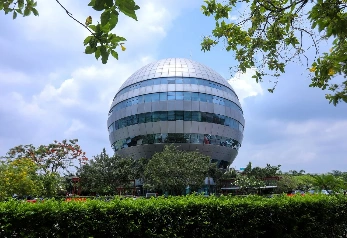
AIUB's permanent campus combines modern academic infrastructure with extensive green spaces and natural features [5]. Its open architectural design integrates nature into the university environment, providing students, faculty and staff with surroundings that support creativity, innovation and wellbeing [6].
The campus incorporates several landscaped and natural features, including a large green field, flower-lined pedestrian pathways, a fountain and a campus lake [7]. These elements contribute to a greener campus environment and demonstrate how urban institutional land can accommodate academic facilities alongside landscaped areas and natural features.
By integrating green infrastructure into its campus design, AIUB promotes a more sustainable and welcoming urban learning environment.
Environmental Standards under the Climate Action Plan
AIUB's Climate Action Plan establishes sustainability principles that guide campus development, infrastructure management and environmental performance [8]. These principles include:
- Environmentally friendly construction materials: prioritising sustainable materials in building and infrastructure projects [8].
- Green space development: incorporating and maintaining green areas across the campus [8].
- Biodiversity enhancement: planting diverse tree species to strengthen campus vegetation and support local biodiversity [8].
- Energy-efficient infrastructure: promoting efficient appliances, lighting and cooling systems, alongside renewable energy solutions such as solar panels [8].
These institutional guidelines connect responsible land management with broader environmental objectives. Combined with campus greening initiatives and the university's net-zero carbon commitments, they reinforce AIUB's approach to developing and managing its urban campus in an environmentally responsible manner [9].
Research, Institutional Partnerships and Environmental Monitoring
AIUB complements its campus development and environmental management initiatives with research, institutional collaborations and monitoring activities. These efforts strengthen the university's capacity to promote sustainable approaches to infrastructure planning, construction and building management.
Research on Sustainable Campus Transportation
AIUB researchers conducted a study on an eco-friendly transportation system for the proposed permanent campus, exploring the integration of electric vehicles with solar energy [10]. The research addressed sustainable mobility solutions for the university's urban environment, highlighting opportunities to combine renewable energy technologies with lower-emission transportation systems.
This research reflects AIUB's commitment to incorporating environmental considerations into campus planning and exploring innovative approaches to reducing the environmental impact of university operations.
Institutional Partnership with the Housing and Building Research Institute
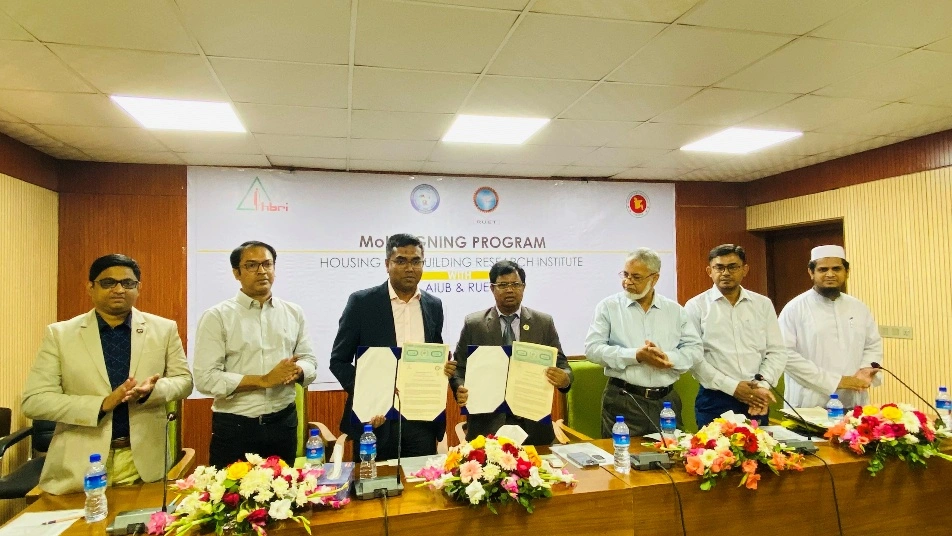
In March 2023, AIUB signed a Memorandum of Understanding (MoU) with the Housing and Building Research Institute (HBRI), establishing a framework for long-term cooperation in research and development across architecture, engineering and construction [11].
As part of this collaboration, AIUB architecture students visited HBRI's laboratories, model houses and factory, gaining direct exposure to innovative building technologies, construction practices and research applications [11].
The partnership strengthens the connection between academic education and applied research in the built environment, providing opportunities to explore innovative approaches to architecture, construction and sustainable infrastructure development.
Monitoring the Environmental Footprint of Campus Buildings
AIUB has undertaken an initiative to assess, monitor and reduce the carbon footprint associated with its campus buildings [12]. This initiative supports the systematic evaluation of building-related emissions and provides an institutional basis for identifying opportunities to improve environmental performance.
By monitoring the environmental footprint of its infrastructure, AIUB reinforces its commitment to responsible building management, energy efficiency and the continuous improvement of campus sustainability.
References
| [1] | Wikipedia, “American International University-Bangladesh,” [Online]. Available: https://en.wikipedia.org/wiki/American_International_University-Bangladesh. [Accessed 2026]. |
| [2] | University Admission, “American International University,” [Online]. Available: https://univarsityadmission.blogspot.com/2008/10/american-international-university.html. [Accessed 2026]. |
| [3] | The Daily Star, “Permanent campus of AIUB,” [Online]. Available: https://www.thedailystar.net/node/915145. [Accessed 2026]. |
| [4] | Center for Environmental and Geographic Information Services (CEGIS), “CEGIS to conduct EIA/SIA for AIUB,” [Online]. Available: https://www.cegisbd.com/. [Accessed 2026]. |
| [5] | American International University-Bangladesh, “SDGs,” [Online]. Available: https://www.aiub.edu/iqac/sdgs. [Accessed 2026]. |
| [6] | American International University-Bangladesh, “Green Campus,” [Online]. Available: https://aiub.edu/oncampus/green-campus. [Accessed 2026]. |
| [7] | Dhaka Tribune, “Where art meets architecture,” [Online]. Available: https://www.dhakatribune.com/magazine/weekend-tribune/139596/where-art-meets-architecture. [Accessed 2026]. |
| [8] | American International University-Bangladesh, “AIUB Climate Action Plan,” [Online]. Available: https://www.aiub.edu/sustainability/aiub-climate-action-plan. [Accessed 2026]. |
| [9] | The Daily Star, “Pioneering innovation and sustainable academic growth,” [Online]. Available: https://www.thedailystar.net/supplements/universities-tomorrow/news/pioneering-innovation-and-sustainable-academic-growth-4233381. [Accessed 2026]. |
| [10] | N. Chowdhury, C. A. Hossain, S. R. Zishan, M. Brenna, and M. Longo, “Eco-friendly transportation system in proposed permanent campus of American International University-Bangladesh,” [Online]. Available: https://dspace.aiub.edu/jspui/bitstream/123456789/1501/1/18.pdf. [Accessed 2026]. |
| [11] | American International University-Bangladesh, “AIUB & HBRI Sign MoU to Collaborate on Research and Development,” [Online]. Available: https://www.aiub.edu/aiub--hbri-sign-mou-to-collaborate-on-research-and-development. [Accessed 2026]. |
| [12] | American International University-Bangladesh, “Campus Building Footprint, CO2 Emission and Race to Net Zero.,” [Online]. Available: https://www.aiub.edu/sustainability/aiub-campus-footprint-co2-emission-and-race-to-net-zero. [Accessed 2026]. |