

SDG 8.2
Overview and sub-indicators for SDG 8.2
SDG 8.2.1

TABLE OF CONTENTS
AIUB's Living Wage Policy and Pay Structure
A Living Wage for Every Employee
A Uniform and Structured Pay Scale
Compensation Above Statutory Minimum Wages
Bangladesh's National Wage Framework and Living Wage Benchmarks
The Government's National Pay Scale
Independent Living Wage Benchmark for Dhaka
National Wage and Living Wage Reference Points
Beyond Salary: Employee Benefits That Support Financial Well-Being
Health and Life Insurance Protection
Interest-Free Financial Assistance
Educational Benefits for Employees and Their Families
Long-Term Financial Security and Retirement Benefits
Governance, Fairness and Transparency in Employee Compensation
Equal Treatment and Protection of Employee Rights
Employee Grievance and Complaint Mechanisms
SDG 8.2.1: Does your university as a body pay all staff and faculty at least the living wage, defined as the local “living wage” (if government defines this) or the local poverty indicator for a family of four (expressed as an hourly wage)?
AIUB's Living Wage Policy and Pay Structure
A Living Wage for Every Employee
AIUB ensures that all faculty and staff members receive compensation at or above the local living wage [1]. This commitment covers the entire workforce, regardless of position, department, gender or employment category, reinforcing the University's dedication to fair and adequate remuneration.
A Uniform and Structured Pay Scale
AIUB maintains a standardized pay scale covering all academic and administrative employees. The University's salary structure is aligned with the wage policy established by the Government of Bangladesh (GOB) [2][3], providing a consistent framework for determining employee compensation.
The pay structure incorporates three key principles:
- Clearly defined salary grades. Each position is assigned a specific pay grade, establishing consistent compensation levels across the University's workforce.
- Consistent remuneration criteria. A unified salary framework applies to academic and administrative personnel, promoting fairness and consistency across faculties and administrative departments.
- Alignment with national wage policies. The University's pay structure follows the GOB wage framework, maintaining consistency with nationally established remuneration guidelines.
Compensation Above Statutory Minimum Wages
AIUB's salary structure provides compensation above the minimum wage levels established by the Government of Bangladesh for different economic sectors through official gazette notifications [3]. This approach demonstrates the University's commitment to offering competitive remuneration that exceeds statutory minimum requirements, including for employees in lower-paid positions.
Additionally, AIUB's institutional commitment to fair compensation is reflected in its SDG 8 activities, which reaffirm that all employees receive salaries at or above the local living wage within the University's GOB-aligned pay framework [4].
Equal Pay for Equal Work
AIUB promotes gender pay equity through its standardized salary structure, which determines compensation according to position and corresponding pay grade rather than personal characteristics [2], [3]. This framework establishes consistent remuneration criteria for women and men performing equivalent roles. The University also monitors salary levels across its pay structure to support gender equality and maintain fair compensation practices [1], [4].
Bangladesh's National Wage Framework and Living Wage Benchmarks
Bangladesh's wage system combines sector-specific minimum wage regulations with a national pay structure for public servants. These frameworks provide important reference points for understanding the country's remuneration policies and the context in which AIUB establishes its institutional pay scale.
Sector-Specific Minimum Wages
Under the Bangladesh Labour Act, 2006, the Minimum Wages Board establishes minimum wage rates for different economic sectors. The Board includes representatives of employers and workers, alongside independent members, and its wage determinations are formalized through official gazette notifications [5].
A notable example is the ready-made garment (RMG) sector, where the minimum monthly wage for entry-level workers was increased from Tk 8,000 to Tk 12,500 in November 2023 [6].
AIUB's institutional pay structure provides compensation above the applicable sectoral minimum wage benchmarks, reflecting the University's commitment to competitive remuneration and fair employment practices.
The Government's National Pay Scale
The National Pay Scale establishes the remuneration framework for public servants in Bangladesh through a structured system of 20 salary grades. It also serves as an important reference for understanding the Government of Bangladesh's wage policy, which informs AIUB's institutional salary structure.
8th National Pay Scale (2015). Effective from July 1, 2015, this framework established basic monthly salaries ranging from Tk 8,250 for Grade 20 to Tk 78,000 for Grade 1 [7].
National Pay Scale 2026. Published through a government gazette in September 2026 and effective retroactively from July 1, 2026, the revised framework establishes a minimum basic monthly salary of Tk 20,000 for Grade 20. Its implementation follows a phased schedule extending to July 2027 [8].
AIUB's alignment with the national wage policy provides an institutional framework for maintaining structured and consistent remuneration practices in the context of Bangladesh's evolving salary regulations.
Independent Living Wage Benchmark for Dhaka
As AIUB is located in Dhaka, the city's living wage benchmark provides a relevant reference for assessing adequate employee compensation within the local economic context.
The Global Living Wage Coalition (GLWC), applying the internationally recognized Anker methodology, estimates the 2025 living wage for Dhaka City at Tk 30,459 per month. This benchmark considers the income required to support a typical family of four, based on an estimated 1.58 working adults per household [9].
This independent benchmark provides an important reference point for AIUB's commitment to ensuring that employees receive compensation at or above the local living wage.
National Wage and Living Wage Reference Points
The following table summarizes the main wage frameworks and benchmarks relevant to AIUB's institutional remuneration policy.
| Reference point | Monthly amount (Tk) | Reference |
| RMG sector minimum wage, entry-level (2023) | 12,500 | [6] |
| National Pay Scale 2015, Grade 20 basic salary | 8,250 | [7] |
| National Pay Scale 2026, Grade 20 basic salary | 20,000 | [8] |
| GLWC living wage estimate, Dhaka City (2025) | 30,459 | [9] |
These national and independent reference points provide complementary perspectives on minimum remuneration and the cost of achieving an adequate standard of living in Bangladesh. AIUB's GOB-aligned salary structure and commitment to paying all employees at or above the local living wage reflect the University's approach to fair, structured and responsible compensation.
Beyond Salary: Employee Benefits That Support Financial Well-Being
AIUB complements its salary structure with a comprehensive range of employee benefits designed to strengthen financial security, support family well-being and promote professional development. These benefits address important aspects of employees' lives, including healthcare, education, family responsibilities and long-term financial planning, contributing to their overall economic well-being.
Health and Life Insurance Protection
AIUB provides health and life insurance benefits to its employees, extending financial protection across its workforce.
- Health insurance. All employees, including women and members of underrepresented groups, have access to the University's health insurance scheme, which facilitates access to healthcare services and medical facilities [10].
- Life insurance. AIUB extends life insurance coverage to all employees, irrespective of religion, race, colour, nationality, marital status, sexual orientation or gender identity, reinforcing its commitment to inclusive employee protection [10].
- Group insurance agreements. AIUB strengthens its collective insurance coverage through institutional agreements with insurance providers. On March 28, 2023, the University renewed its agreement with Chartered Life Insurance Company Limited, extending group insurance benefits to management, faculty members, officials and staff [11]. Subsequently, in April 2026, AIUB signed an agreement with Protective Islami Life Insurance Limited to provide group insurance coverage to its entire workforce, further reinforcing employee welfare and financial security [12].
Interest-Free Financial Assistance
AIUB offers interest-free financial assistance to full-time employees, helping them address important personal, educational and financial needs.
- Emergency loans. Full-time employees can access interest-free loans to manage urgent financial requirements arising from emergencies. Eligibility is determined according to years of service [10].
- Study loans. Full-time employees may obtain interest-free loans to pursue graduate or postgraduate education. Eligibility considers years of service, financial needs and opportunities for professional growth [10].
These provisions offer employees accessible financial support for unexpected circumstances and educational investments without incurring interest charges.
Educational Benefits for Employees and Their Families
AIUB supports employees' educational aspirations and extends important academic benefits to their immediate families, helping reduce the financial burden associated with higher education.
- Tuition fee waivers. Full-time academic and administrative employees are eligible for tuition fee waivers when enrolling in graduate programmes at AIUB. The benefit also extends to employees' first-degree relatives pursuing undergraduate or graduate studies at the University [10].
- Study leave. Full-time employees may receive study leave to pursue graduate or postgraduate education in Bangladesh or abroad while maintaining their employment relationship with the University [10].
- Travel and academic development grants. AIUB provides financial support for employees participating in academic and professional development activities, including research publication, conference presentations, international exchange programmes and training opportunities at national and international levels [10].
These initiatives support lifelong learning while helping employees and their families access higher education and professional development opportunities.
Family and Parental Support
AIUB provides family-oriented benefits that help employees balance professional responsibilities with childcare and family commitments.
- Paid maternity leave. Permanent female academic and administrative employees receive paid maternity leave, supporting their well-being during childbirth and facilitating their return to professional activities [13].
- Paid paternity leave. Permanent male employees are also entitled to paid paternity leave, enabling them to participate in childcare and support their families following the birth of a child [14].
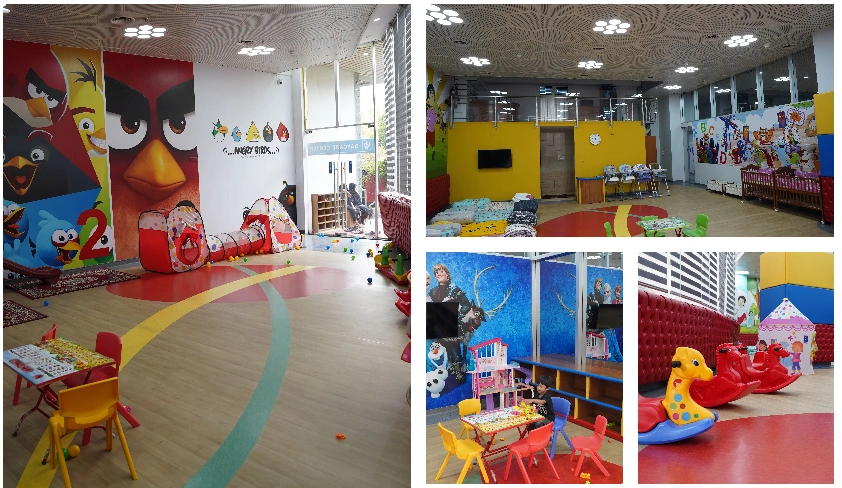
- On-campus daycare facility. AIUB operates an on-campus daycare facility serving employees and students with young children. The facility provides a safe and supportive environment where children can learn, play and develop while their parents attend to their academic or professional responsibilities [15]. Its services are overseen by an approved Childcare Committee responsible for monitoring operations and service quality. The facility operates from 7:45 a.m. to 5:00 p.m., accommodating parents during the working day [16].
Long-Term Financial Security and Retirement Benefits
AIUB supports employees' long-term financial well-being through institutional savings and service-related benefits.
- Contributory Provident Fund (CPF). Established on July 1, 2008, the CPF provides a structured savings mechanism through contributions from both employees and the University, helping employees accumulate financial resources for their future [10].
- Gratuity. Since January 1, 2016, AIUB has provided gratuity benefits to employees as a lump-sum financial entitlement recognizing their years of service and contributing to their long-term financial security [10].
- Additional employee benefits. The University also provides supplementary benefits based on employees' needs and merit, further supporting workforce welfare and institutional recognition [10].
Governance, Fairness and Transparency in Employee Compensation
AIUB supports its remuneration policies with institutional responsibilities, non-discrimination principles and transparent procedures. These mechanisms promote consistent employment practices, protect employee rights and reinforce accountability in the administration of compensation and benefits.
Office of Human Resources
AIUB's Human Resource Department (HRD) oversees employment-related processes for academic and non-academic personnel. Its responsibilities include human resource planning, recruitment and selection, employee training, performance appraisal, regulatory compliance and staff retention [2].
The HRD also administers the University's standardized pay structure and coordinates employee benefits, ensuring the consistent implementation of institutional employment policies [2].
Equal Treatment and Protection of Employee Rights
AIUB promotes fair employment practices through policies that protect employees against discrimination and uphold fundamental labour rights.
- Non-discrimination. The University recruits qualified candidates regardless of age, gender, sexual orientation, race, disability, religion or ethnic origin, reinforcing equal employment opportunities across its workforce [3].
- Protection of outsourced workers. AIUB extends its commitment to equal employment rights to outsourced personnel, including outsourced faculty and staff, supporting fair treatment across different employment arrangements [3].
- Prohibition of forced and child labour. AIUB prohibits forced labour, modern slavery, human trafficking and child labour. Its employment policies establish that all faculty and staff members, whether permanent, contractual or temporary, must be at least 18 years old [3].
- Freedom of association. AIUB recognizes employees' freedom of association and supports their right to engage in collective bargaining [4].
Employee Grievance and Complaint Mechanisms
AIUB maintains an institutional appeal and grievance process that enables employees to raise concerns regarding workplace rights, compensation and professional conduct [17].
Employees can submit complaints or suggestions to the Office of Human Resources through designated forms, email or complaint and suggestion boxes. The University also maintains the confidentiality of complainants' identities, supporting a secure and accessible reporting process [2].
These mechanisms reinforce accountability in employment administration and provide employees with formal channels to communicate concerns and seek institutional attention to workplace matters.
Public Transparency and Institutional Commitment
AIUB makes its institutional commitments to fair remuneration and employee welfare publicly accessible through its website and SDG reporting. Its published policies and institutional disclosures communicate the University's approach to living wages, compensation principles and employee benefits [18], [1], [4], [10].
By making these commitments available to its employees and the wider community, AIUB promotes transparency and demonstrates institutional accountability in its employment and remuneration practices.
References
| [1] | American International University-Bangladesh, “Employment Policies and Practices,” [Online]. Available: https://aiub.edu/sustainability/sdg8/sdg8-initiative/employment-policies-and-practices. [Accessed 2026]. |
| [2] | American International University-Bangladesh, “Office of Human Resources,” [Online]. Available: https://www.aiub.edu/offices/hrd. [Accessed 2026]. |
| [3] | American International University-Bangladesh, “AIUB Non-Discriminatory Employment Policy,” [Online]. Available: https://aiub.edu/offices/hrd/aiub-non-discriminatory-employment-policy. [Accessed 2026]. |
| [4] | American International University-Bangladesh, “SDG 8: Decent Work and Economic Growth – AIUB Activity Report of 2023,” [Online]. Available: https://www.aiub.edu/iqac/sdgs/aiub-sdg-activity-report-2023/sdg8-aiubactivityreportof2023. [Accessed 2026]. |
| [5] | The Financial Express, “Govt initiates formation of new wage board for workers.,” [Online]. Available: https://thefinancialexpress.com.bd/national/govt-initiates-formation-of-new-wage-board-for-workers. [Accessed 2026]. |
| [6] | Y. Wardad, “Govt gazette on RMG wage published,” [Online]. Available: https://today.thefinancialexpress.com.bd/print/govt-gazette-on-rmg-wage-published-1699812621. [Accessed 2026]. |
| [7] | Prothom Alo, “8th pay scale gazette published.,” [Online]. Available: https://en.prothomalo.com/bangladesh/8th-pay-scale-gazette-published-2. [Accessed 2026]. |
| [8] | Prothom Alo, “Minimum salary in government jobs is Tk 33,000, what's the maximum?,” [Online]. Available: https://en.prothomalo.com/bangladesh/px5oxn5r22. [Accessed 2026]. |
| [9] | Global Living Wage Coalition, “Bangladesh,” [Online]. Available: https://www.globallivingwage.org/countries/bangladesh/. [Accessed 2026]. |
| [10] | American International University-Bangladesh, “Employee Benefits & Policies,” [Online]. Available: https://aiub.edu/offices/hrd/employee-benefits. [Accessed 2026]. |
| [11] | American International University-Bangladesh, “Insurance Agreement (Renewal) signed between AIUB and Chartered Life Insurance Company Limited,” [Online]. Available: https://www.aiub.edu/insurance-agreement-renewal-signed-between-aiub-and-chartered-life-insurance-company-limited. [Accessed 2026]. |
| [12] | The Financial Express, “AIUB signs insurance deal with Protective Islami Life Insurance,” [Online]. Available: https://thefinancialexpress.com.bd/trade/aiub-signs-insurance-deal-with-protective-islami-life-insurance. [Accessed 2026]. |
| [13] | American International University-Bangladesh, “Maternity Leave Policy,” [Online]. Available: https://aiub.edu/offices/hrd/employee-benefits/maternity-leave-policy. [Accessed 2026]. |
| [14] | American International University-Bangladesh, “Paternity Leave Policy,” [Online]. Available: https://aiub.edu/offices/hrd/employee-benefits/paternity-leave-policy-. [Accessed 2026]. |
| [15] | American International University-Bangladesh, “Daycare Facilities,” [Online]. Available: https://aiub.edu/oncampus/aiub-daycare-facilities. [Accessed 2026]. |
| [16] | American International University-Bangladesh, “AIUB Childcare Facilities,” [Online]. Available: https://www.aiub.edu/iqac/women-development/aiub-childcare-facilities. [Accessed 2026]. |
| [17] | American International University-Bangladesh, “Employment Practice Appeal Process,” [Online]. Available: https://aiub.edu/sustainability/sdg8/sdg8-initiative/employment-practice-appeal-process. [Accessed 2026]. |
| [18] | American International University-Bangladesh, “SDG 8: Decent Work and Economic Growth.,” [Online]. Available: https://www.aiub.edu/sustainability/sdg8. [Accessed 2026]. |
SDG 8.2.2
TABLE OF CONTENTS
Recognition of Freedom of Association and Collective Bargaining
Institutional Recognition of Employees' Rights
Inclusion of Women and International Employees
Protection Through Non-Discriminatory Employment Practices
Legal Framework Supporting Employees' Rights
Constitutional Protection of Freedom of Association
International Labour Organization (ILO) Conventions
Institutional Platforms for Employee Association and Representation
AIUB Network of Excellence (ANOE)
Women in the Power Sector Professional Network (WePOWER)
Diversity and Equality Committee
Equality, Diversity and Inclusion (EDI) Center
Employee Grievance, Consultation and Protection Mechanisms
Employment Practice Appeal Process
Complaint Committee and Protection Against Sexual Harassment
SDG 8.2.2: Does your university as a body recognise unions & labour rights (freedom of association & collective bargaining) for all, including women & international staff?
Recognition of Freedom of Association and Collective Bargaining
Institutional Recognition of Employees' Rights
AIUB recognises and supports the rights of all employees, including women and international staff, to freely associate and engage in collective bargaining [1]. This commitment is also reflected in the University's SDG activities, which reaffirm its support for employees' freedom to form associations and participate in collective bargaining [2].
By recognising these rights, AIUB provides an institutional framework in which faculty and staff can organise around their professional interests, express shared concerns and engage in collective representation. This commitment reinforces employees' participation and promotes an inclusive working environment.
Inclusion of Women and International Employees
AIUB extends its commitment to freedom of association to women and international employees, ensuring that these groups are explicitly recognised within its institutional framework [1].
Women. All women at AIUB, including students, faculty members and administrative employees, are members of the AIUB Women Forum. The Forum provides a platform for women's representation, advocacy and participation in institutional decision-making [1].
International employees. AIUB welcomes both Bangladeshi and international professionals, providing employment opportunities to citizens and foreign nationals in accordance with the principles established in the Charter of the United Nations and the Constitution of Bangladesh [3]. This inclusive employment framework complements the University's commitment to recognising the rights of its international workforce.
Protection Through Non-Discriminatory Employment Practices
AIUB reinforces its commitment to employees' rights through its Non-Discriminatory Employment Policy. The policy establishes merit-based recruitment and equal employment rights regardless of age, gender, sexual orientation, race, disability, religion or ethnic origin. These protections also extend to employees engaged through outsourcing arrangements [3].
By promoting equal treatment across its workforce, AIUB fosters an environment in which employees can exercise their rights and participate in institutional associations without discrimination.
Legal Framework Supporting Employees' Rights
AIUB's commitment to freedom of association and collective bargaining is supported by Bangladesh's constitutional provisions, national labour legislation and ratified international labour standards. These legal instruments establish the framework within which the University recognises and promotes employees' labour rights.
Constitutional Protection of Freedom of Association
Article 38 of the Constitution of the People's Republic of Bangladesh guarantees citizens the right to form associations and unions, subject to reasonable restrictions established by law in the interests of morality or public order [4]. This constitutional provision establishes an important foundation for freedom of association and reinforces the principles recognised in AIUB's institutional commitment to employees' rights.
International Labour Organization (ILO) Conventions
Bangladesh has ratified the two fundamental International Labour Organization (ILO) conventions addressing freedom of association and collective bargaining. These conventions provide internationally recognised standards for protecting workers' rights.
| ILO Convention | Main protection | Ratification by Bangladesh |
| Freedom of Association and Protection of the Right to Organise Convention, 1948 (No. 87) | Protects workers' right to establish and join organisations of their own choosing. | 1972 [5] |
| Right to Organise and Collective Bargaining Convention, 1949 (No. 98) | Protects workers against anti-union discrimination and promotes voluntary collective bargaining between workers' organisations and employers. | 1972 [6] |
AIUB's recognition of employees' freedom to associate and engage in collective bargaining reflects the principles established by these international labour standards, reinforcing its commitment to an inclusive and rights-based working environment.
National Labour Legislation
The Bangladesh Labour Act, 2006 establishes the national regulatory framework for employment relations, including provisions on trade union formation, workers' representation and industrial relations under Chapter XIII [7]. AIUB's commitment to employees' rights is situated within this national framework and is complemented by institutional initiatives that support employee representation and participation.
Institutional Platforms for Employee Association and Representation
AIUB supports employees' freedom of association and participation through institutional forums, professional networks and representative committees. These platforms enable faculty and staff to organise around shared interests, contribute to institutional initiatives and participate in discussions concerning professional development, equality and workplace policies.
AIUB Women Forum (AWF)
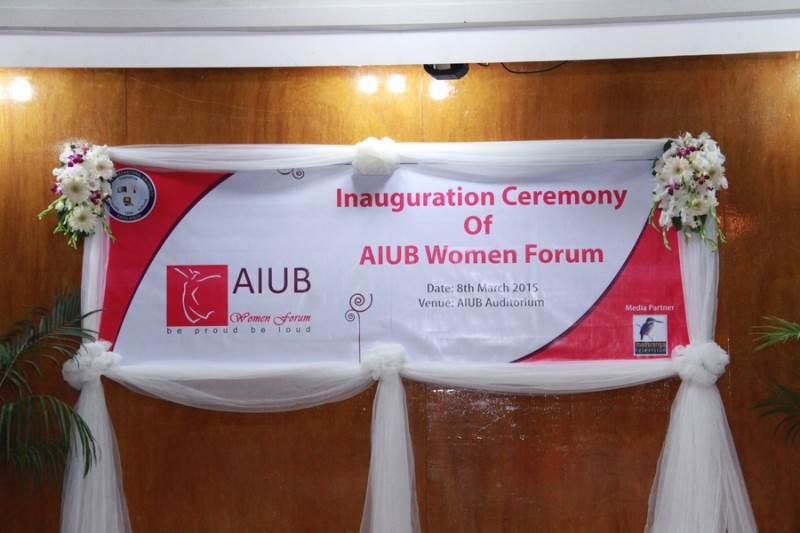
The AIUB Women Forum (AWF) was inaugurated on 8 March 2015, in celebration of International Women's Day, at the AIUB Auditorium [8]. The Forum promotes women's empowerment at all levels of decision-making, with a focus on education, entrepreneurship and leadership. It also connects women's rights advocates, NGOs, women's organisations and women entrepreneurs [1], [8].
Membership and representation
All women at AIUB, including students, faculty members and administrative employees, are members of the Forum [9]. This university-wide membership structure provides women employees with an institutional platform to connect, express shared interests and participate in initiatives promoting women's rights and empowerment.
Activities and engagement
The AWF advocates for women's rights and addresses issues affecting women's participation in education, industry and leadership. Its activities include awareness programmes on women's empowerment, women's health, gender-based violence and equal opportunities [1], [9], [10]. Notable initiatives include:
- "Your Story Matters" (22 March 2023). An International Women's Day panel discussion addressing women's mental well-being and the support services available to AIUB students, faculty members and officials [11].
- International Women's Day celebration (9 March 2025). An event organised jointly by the AIUB Women Forum, faculty members and university directors, strengthening institutional engagement with women's empowerment [12].
AIUB Network of Excellence (ANOE)
The AIUB Network of Excellence (ANOE) is a professional association that brings together researchers from across the University's interdisciplinary research community [1]. It promotes the exchange of knowledge and resources, collaboration in research funding opportunities, ethical research practices and innovation. ANOE also advocates for the research interests and professional needs of AIUB staff [1].
By providing an organised platform for researchers to collaborate and represent shared professional interests, ANOE strengthens academic association and collective engagement within the University.
Women in the Power Sector Professional Network (WePOWER)
AIUB became the first educational institution to join the South Asia Women in Power Sector Professional Network (WePOWER) as an institutional member [13]. WePOWER is a voluntary regional network comprising 50 public and private energy utilities across eight South Asian countries, dedicated to increasing women's participation in the energy workforce and promoting their representation in science, technology, engineering and mathematics (STEM) fields [13].
AIUB joined the network as an institutional partner in July 2024 and is the only educational institution among WePOWER's partners in Bangladesh [14]. This partnership connects AIUB's women faculty and staff with a broader professional community, expanding opportunities for networking, knowledge exchange and career development.
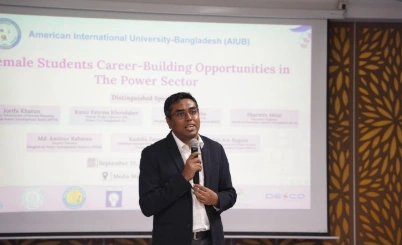
In September 2024, AIUB and the WePOWER Bangladesh Chapter jointly organised the seminar "Female Students Career-Building Opportunities in Power Sector", promoting awareness of professional opportunities and women's participation in the power sector [13].
Diversity and Equality Committee
AIUB's Diversity and Equality Committee provides a formal institutional mechanism for employee representation and participation in matters concerning equality, diversity and human rights. Chaired by the Vice Chancellor, the Committee includes representatives of academic and administrative employees, alongside members from different university offices and the student community [15], [16].
Its membership includes representatives from each faculty, the Office of the Registrar, the Office of Human Resources, the Office of Student Affairs, the Institutional Quality Assurance Cell (IQAC) and the Office of Administration [16].
The Committee's responsibilities include:
1. Periodically reviewing institutional policies on diversity, equality, inclusion and human rights, and recommending improvements [16].
2. Monitoring the implementation of these policies across the University [16].
3. Encouraging and supporting students, faculty members and employees in participating in diversity and equality initiatives [15].
4. Organising capacity-building activities on diversity and equality for students, faculty and employees [15].
This representative structure enables academic and administrative employees to contribute to institutional discussions and initiatives concerning their working environment and equal treatment.
Equality, Diversity and Inclusion (EDI) Center
The Equality, Diversity and Inclusion (EDI) Center provides institutional support, resources and advocacy for minority employees, students and communities [17]. It offers an inclusive and welcoming environment where individuals from minority groups can connect, build supportive networks and participate in the university community [17].
The Center also promotes institutional equity through policy advocacy and provides resources for addressing diversity-related conflicts through mediation and support services [17]. These activities complement AIUB's representative structures by strengthening inclusion, mutual support and employee engagement across the University.
Employee Grievance, Consultation and Protection Mechanisms
AIUB provides institutional channels that enable employees to communicate concerns, submit complaints and seek the review of employment-related decisions. These mechanisms promote transparency, accountability and fair treatment, complementing the University's commitment to freedom of association and employee representation.
Office of Human Resources
The Human Resource Department (HRD) supports academic and non-academic employees throughout their employment, with responsibilities that include regulatory compliance and staff retention [18].
AIUB provides employees with multiple channels for submitting complaints and suggestions to the Office of Human Resources. Faculty and staff can raise concerns individually or collectively through dedicated forms, email and complaint and suggestion boxes. The University maintains the confidentiality of individuals and the information submitted through these channels, encouraging employees to communicate workplace concerns in a secure environment [18].
Employment Practice Appeal Process
AIUB maintains a formal appeal process that enables employees to raise concerns regarding employment practices, including matters related to their rights, remuneration and workplace conduct [19].
This mechanism provides employees with an institutional avenue to request the review of decisions affecting their employment and seek fair and transparent treatment. By establishing a structured process for addressing employment-related concerns, AIUB reinforces accountability and supports the protection of employees' rights.
Complaint Committee and Protection Against Sexual Harassment
AIUB has established a dedicated Complaint Committee to address sexual harassment cases in accordance with the guidelines issued by the High Court Division of the Supreme Court of Bangladesh [2].
The Committee provides an institutional mechanism for addressing harassment complaints and supports the protection of employees' dignity, safety and equal participation in the workplace. This mechanism is particularly relevant to fostering an environment in which women can participate confidently in professional activities, institutional forums and university associations.
Institutional Channels and Their Functions
AIUB's grievance, representation and support mechanisms operate across different areas of employee engagement and institutional governance.
| Institutional mechanism | Main function | Contribution to employees |
| Office of Human Resources [18] | Receives individual and collective complaints and suggestions through confidential channels. | Facilitates communication and the expression of workplace concerns. |
| Employment Practice Appeal Process [19] | Reviews concerns regarding employment rights, remuneration and workplace conduct. | Provides a formal avenue for seeking review of employment-related decisions. |
| Complaint Committee [2] | Addresses sexual harassment complaints under the applicable judicial guidelines. | Supports employees' safety, dignity and protection from harassment. |
| Diversity and Equality Committee [15], [16] | Reviews institutional policies and monitors their implementation. | Promotes employee representation and participation in equality-related matters. |
| EDI Center [17] | Provides advocacy, support and mediation concerning diversity and inclusion. | Strengthens inclusion and access to institutional support. |
References
| [1] | American International University-Bangladesh, “Forums and Networks at AIUB,” [Online]. Available: https://aiub.edu/sustainability/sdg8/sdg8-initiative/forums-and-networks-at-aiub. [Accessed 2026]. |
| [2] | American International University-Bangladesh, “SDG 8: Decent Work and Economic Growth – AIUB Activity Report of 2023,” [Online]. Available: https://www.aiub.edu/iqac/sdgs/aiub-sdg-activity-report-2023/sdg8-aiubactivityreportof2023. [Accessed 2026]. |
| [3] | American International University-Bangladesh, “AIUB Non-Discriminatory Employment Policy,” [Online]. Available: https://aiub.edu/offices/hrd/aiub-non-discriminatory-employment-policy. [Accessed 2026]. |
| [4] | Legislative and Parliamentary Affairs Division, Government of Bangladesh , “The Constitution of the People's Republic of Bangladesh, Article 38: Freedom of association,” [Online]. Available: https://bdlaws.minlaw.gov.bd/act-print-367/section-print-24586.html. [Accessed 2026]. |
| [5] | International Labour Organization, “Factsheet No. 2: Freedom of Association and the Right to Organize,” [Online]. Available: https://tradefordecentwork.ilo.org/wp-content/uploads/2024/09/Factsheet-No.-2-on-Technical-Note.pdf. [Accessed 2026]. |
| [6] | International Labour Organization, “Factsheet No. 4: The Right to Organise and Collective Bargaining,” [Online]. Available: https://tradefordecentwork.ilo.org/wp-content/uploads/2024/09/Factsheet-No.-4-on-Technical-Note.pdf. . [Accessed 2026]. |
| [7] | The Daily Star, “Rights Advocacy: trade unions under the Bangladesh Labour Act, 2006,” [Online]. Available: https://www.thedailystar.net/law-our-rights/rights-advocacy/news/trade-union-the-collective-voice-against-workers-predicament-3136926. [Accessed 2026]. |
| [8] | American International University-Bangladesh, “The Launching of the AIUB Women Forum,” [Online]. Available: https://www.aiub.edu/the-launching-of-the-aiub-women-forum. [Accessed 2026]. |
| [9] | American International University-Bangladesh, IQAC, “AIUB Women Forum (AWF),” [Online]. Available: https://www.aiub.edu/iqac/women-development/aiub-women-forum-awf. [Accessed 2026]. |
| [10] | American International University-Bangladesh, “AIUB's Contributions to Gender Equity and Women Empowerment,” [Online]. Available: https://dspace.aiub.edu/jspui/bitstream/123456789/226/1/AIUB%e2%80%99s%20Contributions%20to%20Gender%20Equity%20and%20Women%20Empower.pdf. [Accessed 2026]. |
| [11] | American International University-Bangladesh, “Your Story Matters’ – International Women's Day (IWD) 2023 Celebration,” [Online]. Available: https://www.aiub.edu/your-story-matters---international-womens-day-iwd-2023-celebration. [Accessed 2026]. |
| [12] | American International University-Bangladesh, “International Women's Day Celebration at AIUB,” [Online]. Available: https://www.aiub.edu/international-womens-day-celebration-at-aiub. [Accessed 2026]. |
| [13] | American International University-Bangladesh, “AIUB Is an Institutional Partner of WePOWER,” [Online]. Available: https://www.aiub.edu/aiub-is-an-institutional-partner-of-wepower. [Accessed 2026]. |
| [14] | American International University-Bangladesh, “AIUB at the Regional Business Meeting of WePOWER,” [Online]. Available: https://www.aiub.edu/aiub-at-the-regional-business-meeting-of-wepower. [Accessed 2026]. |
| [15] | American International University-Bangladesh, “Diversity and Equality Committee,” [Online]. Available: https://aiub.edu/administration/institutional-policy/diversity-and-equality-committee. [Accessed 2026]. |
| [16] | American International University-Bangladesh, “Student representation at American International University-Bangladesh (AIUB),” [Online]. Available: https://aiub.edu/sustainability/student-representation-at-american-international-university-bangladesh-aiub. [Accessed 2026]. |
| [17] | American International University-Bangladesh, “Equality, Diversity and Inclusion (EDI) Center.,” [Online]. Available: https://aiub.edu/oncampus/equality-diversity-and-inclusion-edi-center. [Accessed 2026]. |
| [18] | American International University-Bangladesh, “Office of Human Resources,” [Online]. Available: https://www.aiub.edu/offices/hrd. [Accessed 2026]. |
| [19] | American International University-Bangladesh, “Employment Practice Appeal Process,” [Online]. Available: https://aiub.edu/sustainability/sdg8/sdg8-initiative/employment-practice-appeal-process. [Accessed 2026]. |
SDG 8.2.3
TABLE OF CONTENTS
AIUB's Policies on Ending Workplace Discrimination
AIUB Non-discrimination Policy
AIUB Non-Discriminatory Employment Policy
Protection Across the Grounds Specified in Indicator 8.2.3
Non-discrimination in Pay and Employee Benefits
Integration into the University's Institutional Framework
The Legal and International Framework
The Constitution of Bangladesh
International Labour Standards
Governance: Institutional Oversight and Implementation of Non-discrimination Policies
Diversity and Equality Committee
Equality, Diversity and Inclusion (EDI) Center
Reporting Discrimination: Complaint Procedures and Protection Mechanisms
Policy Regarding Discrimination Complaints for Employees
Policy Regarding Sexual Harassment Complaints for Employees
Confidentiality and Protection of Complainants
Grievance and Appeal Mechanisms
Reporting Channels at a Glance
Awareness, Capacity Building and Inclusion Initiatives
Diversity and Equality Training
Awareness Activities on Workers' Rights, Gender Justice and Equality
SDG 8.2.3: Does your university as a body have a policy on discrimination in the workplace (including discrimination based on religion, sexuality, gender, age)?
AIUB's Policies on Ending Workplace Discrimination
AIUB establishes a comprehensive institutional framework to prevent discrimination and promote equal treatment in the workplace. Its policies ensure that employment decisions, workplace opportunities and employee benefits are guided by principles of fairness, merit and respect for individual rights.
AIUB Non-discrimination Policy
AIUB's Non-discrimination Policy establishes the University's overarching commitment to equal treatment for students and employees [1]. It requires decisions affecting members of the university community to be based on individual merit, without discrimination or harassment on the grounds of religion, race, colour, age, disability, nationality, marital status or sexual orientation, including gender identity [2].
The policy covers student admissions, employment, and participation in all university programmes and activities. It also establishes the Office of Human Resources as the institutional office responsible for addressing employee inquiries and complaints related to non-discrimination [2].
AIUB Non-Discriminatory Employment Policy
AIUB's Non-Discriminatory Employment Policy translates these principles into specific workplace commitments. The University ensures that qualified employees are recruited and provided with equal access to employment rights, privileges, programmes and activities, regardless of their personal characteristics [3].
The policy explicitly identifies the following protected grounds:
1. Age
2. Gender or gender identity
3. Sexual orientation
4. Race
5. Disability
6. Colour
7. Religion
8. National or ethnic origin [3]
Additionally, AIUB extends its commitment to employment inclusion to underrepresented and underprivileged groups [2]. Its organisational principles affirm that individuals have equal opportunities to work at the University regardless of religion, race, caste, sex or place of birth, reflecting the integration of human rights principles into institutional policies and employment practices [4].
Protection Across the Grounds Specified in Indicator 8.2.3
AIUB's non-discrimination framework addresses the principal grounds identified in Indicator 8.2.3, establishing explicit protections and inclusion commitments across different aspects of employment.
| Ground specified in the indicator | AIUB's institutional commitment |
| Religion | Religion is explicitly recognised as a protected ground under both the Non-discrimination Policy and the Non-Discriminatory Employment Policy [2], [3]. |
| Sexuality | Sexual orientation, including gender identity, is explicitly covered by AIUB's non-discrimination commitments [2], [3]. |
| Gender | Gender and gender identity are protected grounds under the employment policy. AIUB also establishes equal pay for women and men [3]. |
| Age | Age is expressly identified as a protected ground in the University's non-discrimination framework [2], [3]. |
| Refugee status | AIUB's inclusion framework identifies newly settled refugees among the underrepresented groups receiving institutional support, complementing its employment protections concerning nationality and national or ethnic origin [2], [3], [5]. |
Non-discrimination in Pay and Employee Benefits
AIUB extends its equal-treatment principles to remuneration and employee benefits, reinforcing fairness throughout the employment relationship.
- Equal pay: AIUB applies a uniform pay scale to faculty members and staff, ensuring that remuneration is not differentiated on the basis of gender [3].
- Equal benefits: All AIUB employees are covered by life insurance, irrespective of religion, race, colour, nationality, marital status or sexual orientation, including gender identity [4].
These provisions demonstrate how the University's non-discrimination commitments extend beyond recruitment to encompass employees' financial conditions and workplace benefits.
Integration into the University's Institutional Framework
AIUB's commitment to ending discrimination is embedded in its broader institutional values and governance framework. The University promotes equity, justice and non-discrimination in its roles as both an employer and an institution of higher education, applying principles of fairness in its engagement with the academic community [6].
This commitment is further consolidated by AIUB's Equality, Diversity and Inclusion Policy, which integrates the University's Non-discrimination Policy with related admission policies supporting underrepresented groups and students with disabilities [7].
AIUB's SDG 8 institutional reporting further documents its commitment to maintaining policies and practices that promote equal treatment and prevent workplace discrimination [8]. Together, these institutional provisions establish a comprehensive framework for protecting employees' rights and fostering an inclusive working environment.
The Legal and International Framework
AIUB's commitment to workplace equality and non-discrimination is supported by the constitutional guarantees of Bangladesh and the country's adherence to international labour standards. These frameworks establish important principles of equal treatment, employment opportunities and fair remuneration, which are reflected in the University's institutional policies and employment practices.
The Constitution of Bangladesh
The Constitution of Bangladesh establishes fundamental guarantees of equality and non-discrimination through three key provisions [9]:
- Article 27 – Equality before the law: Establishes that all citizens are equal before the law and entitled to equal protection.
- Article 28 – Protection against discrimination: Prohibits discrimination by the State against citizens solely on the grounds of religion, race, caste, sex or place of birth.
- Article 29 – Equality of opportunity in public employment: Guarantees equal opportunities for citizens in employment within the service of the Republic, regardless of religion, race, caste, sex or place of birth.
AIUB incorporates these constitutional principles into its Non-Discriminatory Employment Policy, affirming equal employment opportunities regardless of religion, race, caste, sex or place of birth. This alignment reflects the University's commitment to upholding the fundamental principles of equality and fairness in its employment practices (Section 2.2).
International Labour Standards
Bangladesh has ratified key International Labour Organization (ILO) conventions addressing discrimination and equality in employment. These international commitments provide an established framework for promoting fair treatment and equal opportunities in the workplace [10].
| ILO Convention | Core principle | Ratification by Bangladesh |
| Discrimination (Employment and Occupation) Convention, 1958 (No. 111) | Promotes equality of opportunity and treatment in employment and occupation, addressing discrimination in the workplace. | 1972 [10] |
| Equal Remuneration Convention, 1951 (No. 100) | Establishes the principle of equal remuneration for men and women for work of equal value. | 1998 [10] |
AIUB's institutional policies reflect these international labour principles in its employment framework. The University's uniform pay scale and commitment to equal remuneration for women and men support the principle established under Convention No. 100. Similarly, its comprehensive non-discrimination policies reinforce the principles of equality of opportunity and treatment promoted by Convention No. 111 [3].
Governance: Institutional Oversight and Implementation of Non-discrimination Policies
AIUB has established dedicated institutional bodies to oversee its equality, diversity and non-discrimination commitments. These bodies contribute to policy development, implementation monitoring, employee support and the promotion of an inclusive university environment, ensuring that institutional responsibilities are clearly assigned.
Diversity and Equality Committee
The Diversity and Equality Committee plays a central role in overseeing equality and addressing discrimination-related matters within the University community [11]. Chaired by the Vice Chancellor, the Committee brings together representatives of academic and administrative staff, ensuring institutional participation in diversity and equality initiatives [11].
Its membership includes representatives from each faculty, the Office of the Registrar, the Office of Human Resources, the Office of Student Affairs, the Institutional Quality Assurance Cell (IQAC), the Office of Administration and the student community [12].
The Committee carries out several key responsibilities:
- Policy review: Periodically reviewing diversity, equality, inclusion and human rights policies and recommending relevant updates and revisions [12].
- Implementation monitoring: Monitoring the implementation of institutional policies and initiatives across the University [12].
- Institutional support: Encouraging and supporting students, faculty members and employees participating in diversity and equality activities [11].
- Awareness and capacity building: Organising diversity and equality training activities for students, faculty members and employees [11].
- Progress evaluation: Assessing progress in diversity and equality and evaluating its impact on different university stakeholders [11].
These responsibilities provide an institutional mechanism for maintaining, monitoring and strengthening AIUB's equality and non-discrimination framework.
Equality, Diversity and Inclusion (EDI) Center
The Equality, Diversity and Inclusion (EDI) Center provides dedicated support, resources and advocacy for minority employees, students and communities [13]. Its activities extend to employment-related inclusion, particularly through collaboration with the Office of Human Resources.
The Center's main responsibilities include:
- Employee support: Providing assistance to minority employees and students in addressing their specific needs, concerns and challenges [13].
- Inclusive recruitment and retention: Collaborating with the Office of Human Resources on initiatives that support the recruitment and retention of minority employees [13].
- Policy development: Advocating for institutional policy changes that strengthen equity, diversity and inclusion [13].
- Data collection and evaluation: Gathering information about minority employees' experiences to support informed decision-making and assess institutional progress [13].
- Conflict resolution: Facilitating the resolution of diversity- and inclusion-related conflicts through mediation and support [13].
By combining employee support, recruitment initiatives, policy advocacy and institutional assessment, the EDI Center contributes to embedding inclusive employment practices across AIUB.
Ethics Committee
AIUB's Ethics Committee comprises members with diverse areas of expertise and is responsible for overseeing and promoting ethical standards within the University [14]. Its institutional ethical framework establishes non-discrimination as a fundamental principle expected of all members of the university community [14].
This framework reinforces the University's commitment to ethical conduct, respect for individual rights and fairness in institutional relationships.
Office of Human Resources
The Office of Human Resources serves as an institutional contact point for employees seeking guidance or wishing to raise concerns under AIUB's Non-discrimination Policy. It receives and addresses employee inquiries and complaints related to discrimination [2].
In addition to its employment management responsibilities, the Office collaborates with the EDI Center on recruitment and retention initiatives for minority employees [13]. This coordination connects employee support mechanisms with broader institutional efforts to promote equal employment opportunities and an inclusive workplace.
Together, these institutional bodies establish a governance structure that supports the implementation, oversight and continuous development of AIUB's non-discrimination commitments.
Reporting Discrimination: Complaint Procedures and Protection Mechanisms
AIUB provides employees with established channels to report discrimination, harassment and other workplace concerns. These mechanisms facilitate the submission of complaints, ensure appropriate institutional attention and support the confidential handling of reported matters.
Policy Regarding Discrimination Complaints for Employees
AIUB's Policy Regarding Discrimination Complaints for Employees reinforces the University's commitment to preventing discrimination and harassment on the grounds of religion, race, colour, age, disability, nationality, marital status or sexual orientation, including gender identity [2].
The Office of Human Resources is responsible for receiving employee inquiries and complaints under this policy [15]. Employees can report concerns using the following channels:
- Designated complaint form: Employees can complete the official complaint form to communicate discrimination-related concerns.
- Email submission: Completed complaint forms can be sent directly to the Office of Human Resources at hr@aiub.edu.
- Confidential complaint box: Employees can submit completed forms through the complaint box located in Annex 1 [16].
AIUB also provides a separate suggestion form, allowing employees to submit proposals and contribute to improvements in the University's workplace practices [16].
Policy Regarding Sexual Harassment Complaints for Employees
AIUB maintains specific procedures for addressing sexual harassment and misconduct in the workplace. Its Policy Regarding Sexual Harassment Complaints for Employees establishes dedicated mechanisms for receiving and addressing complaints of this nature [17].
A designated Complaint Committee is constituted in accordance with the guidelines established by the High Court Division of the Supreme Court of Bangladesh [16]. These guidelines originate from the landmark 2009 judgment addressing sexual harassment in workplaces and educational institutions. The judgment established the importance of institutional complaint committees responsible for receiving complaints, conducting investigations and making recommendations [18].
AIUB's Complaint Committee provides a dedicated institutional mechanism for handling sexual harassment complaints, reinforcing the University's commitment to a safe, respectful and inclusive working environment.
Confidentiality and Protection of Complainants
Confidentiality is an important component of AIUB's complaint-handling framework. The University's policies protect the confidentiality of complainants and the information submitted during the complaint process [15], [17].
These provisions support a respectful reporting environment in which employees' concerns and personal information are handled with appropriate discretion throughout the complaint-handling process.
Grievance and Appeal Mechanisms
AIUB provides employees with institutional channels to raise concerns involving workplace rights, remuneration, harassment and professional conduct. Employees can bring these matters directly to the Office of Human Resources, which serves as a point of contact for addressing employment-related grievances [19].
The University's broader employment practices also incorporate an appeal process for concerns involving employee rights, pay and workplace conduct [19]. These mechanisms complement the specific discrimination and sexual harassment complaint procedures, providing employees with additional avenues to seek institutional attention and resolution.
Reporting Channels at a Glance
AIUB's complaint-handling framework provides different reporting routes according to the nature of the employee's concern.
| Type of concern | Responsible institutional body | Available reporting channels |
| Discrimination based on protected grounds | Office of Human Resources [15] | Designated complaint form submitted by email to hr@aiub.edu or through the complaint box in Annex 1 [16]. |
| Sexual harassment | Designated Complaint Committee [16] | Complaint procedures established under the University's sexual harassment policy [16]. |
| Other employment-related grievances involving rights, pay or workplace conduct | Office of Human Resources [19] | Institutional grievance and appeal mechanisms [19]. |
These reporting channels reinforce AIUB's commitment to ensuring that employees have accessible institutional mechanisms to communicate concerns and seek appropriate attention to discrimination, harassment and other workplace matters.
Awareness, Capacity Building and Inclusion Initiatives
AIUB complements its institutional non-discrimination policies with educational activities, awareness initiatives and programmes that promote equality, respect for individual rights and inclusive employment practices. These efforts contribute to strengthening awareness across the university community and supporting women's participation and continuity in professional life.
Diversity and Equality Training
AIUB promotes awareness of diversity and equal treatment through dedicated training and capacity-building initiatives.
- Diversity training: The Equality, Diversity and Inclusion (EDI) Center provides diversity training and educational workshops for students, faculty members and employees. These activities raise awareness of diversity-related issues and promote an inclusive university culture [13].
- Equality capacity building: The Diversity and Equality Committee coordinates appropriate diversity and equality capacity-building activities for students, faculty members and employees, reinforcing institutional awareness of equality and inclusion principles [4].
By extending these activities to academic and administrative employees, AIUB reinforces the importance of respectful workplace relationships and equal treatment across the University.
Awareness Activities on Workers' Rights, Gender Justice and Equality
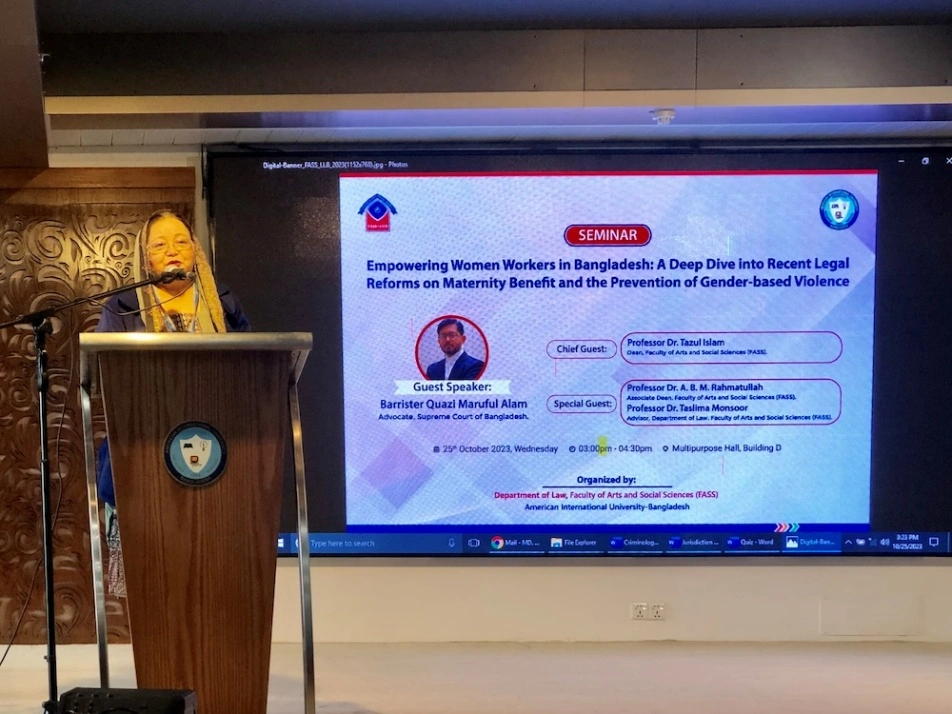
AIUB organises and participates in educational events that address gender equality, women's rights and human rights, contributing to greater awareness of issues affecting women's participation in professional and social life.
- Seminar on Women's Workers' Rights (25 October 2023): The Department of Law organised a seminar titled "Empowering Women Workers in Bangladesh: A Deep Dive into Recent Legal Reforms on Maternity Benefit and the Prevention of Gender-Based Violence". The event brought together Law students and BBA students majoring in Human Resource Management to examine legal protections concerning maternity benefits and gender-based violence in the workplace [20].
- Shomotontro – Gender Justice and Diversity Programme (June 2023): AIUB's Institutional Quality Assurance Cell (IQAC) and AIUB Women Forum jointly hosted BRAC's two-day Gender Justice and Diversity programme. The initiative included a dialogue session at the AIUB Auditorium, providing a platform for engagement with gender justice and diversity issues [21].
- HROC Legal Skills Boot Camp (2025): Students from the Department of Law participated in workshops designed to strengthen legal knowledge and awareness of human rights [2]. This initiative complements AIUB's broader commitment to promoting respect for human rights and equality within the university community.
Supporting Women's Return to Work and Career Continuity
AIUB promotes women's professional continuity and recognises the importance of supporting employees returning to their careers after maternity and caregiving breaks.
The University celebrated the first International Returning Mothers Day, recognising women who resume their professional activities after career interruptions [22]. Additionally, AIUB collaborates with WePOWER under its Retention pillar to support women's return to work following maternity or caregiving breaks [22].
These initiatives highlight AIUB's commitment to women's career continuity and the promotion of an inclusive professional environment in which maternity and caregiving responsibilities are recognised as important considerations in employment retention.
References
| [1] | American International University-Bangladesh, “AIUB Non-discrimination Policy,” [Online]. Available: https://aiub.edu/administration/institutional-policy/aiub-non-discrimination-policy. [Accessed 2026]. |
| [2] | American International University-Bangladesh, “Non-Discrimination Policy at AIUB Against Women and Irrespective to Any Gender Identity,” [Online]. Available: https://aiub.edu/sustainability/sdg5/sdg5-initiative/non-discrimination-policy-at-aiub-against-women-and-irrespective-to-any-gender-identity. [Accessed 2026]. |
| [3] | American International University-Bangladesh, “AIUB Non-Discriminatory Employment Policy,” [Online]. Available: https://aiub.edu/offices/hrd/aiub-non-discriminatory-employment-policy. [Accessed 2026]. |
| [4] | American International University-Bangladesh, “Employment Policies and Practices,” [Online]. Available: https://aiub.edu/sustainability/sdg8/sdg8-initiative/employment-policies-and-practices. [Accessed 2026]. |
| [5] | AIUB's Commitment to Inclusivity, “American International University-Bangladesh,” [Online]. Available: https://www.aiub.edu/iqac/sdgs/aiub-sdg-activity-report-2023/sdg1-aiubactivityreportof2023/sdg-initiative/aiub-s-commitment-to-inclusivity. [Accessed 2026]. |
| [6] | American International University-Bangladesh, “Institutional Policy,” [Online]. Available: https://aiub.edu/administration/institutional-policy. [Accessed 2026]. |
| [7] | American International University-Bangladesh, “Equality, Diversity and Inclusion Policy,” [Online]. Available: https://aiub.edu/sustainability/equality-diversity-and-inclusion-policy-. [Accessed 2026]. |
| [8] | American International University-Bangladesh, “SDG 8: Decent Work and Economic Growth – AIUB Activity Report of 2023,” [Online]. Available: https://www.aiub.edu/iqac/sdgs/aiub-sdg-activity-report-2023/sdg8-aiubactivityreportof2023. [Accessed 2026]. |
| [9] | Banglapedia, “Fundamental Rights,” [Online]. Available: https://en.banglapedia.org/index.php/Fundamental_Rights. . [Accessed 2026]. |
| [10] | International Labour Organization, “Compilation of selected observations and direct requests of the Committee of Experts on the Application of Conventions and Recommendations: Bangladesh,” [Online]. Available: https://tradefordecentwork.ilo.org/wp-content/uploads/2024/09/Compilation-of-selected-observations-and-direct-requests-of-the-Committee-of-Experts-on-the-Application-of-Conventions-and-Recommendations-Bangladesh.pdf. [Accessed 2026]. |
| [11] | American International University-Bangladesh, “Diversity and Equality Committee,” [Online]. Available: https://aiub.edu/administration/institutional-policy/diversity-and-equality-committee. [Accessed 2026]. |
| [12] | American International University-Bangladesh, “Student representation at American International University-Bangladesh (AIUB),” [Online]. Available: https://aiub.edu/sustainability/student-representation-at-american-international-university-bangladesh-aiub-. [Accessed 2026]. |
| [13] | American International University-Bangladesh, “Equality, Diversity and Inclusion (EDI) Center.,” [Online]. Available: https://aiub.edu/oncampus/equality-diversity-and-inclusion-edi-center. [Accessed 2026]. |
| [14] | American International University-Bangladesh, “AIUB support and facilitate a holistic ethical organizational culture,” [Online]. Available: https://aiub.edu/sustainability/aiub-support-and-facilitate-a-holistic-ethical-organizational-culture. [Accessed 2026]. |
| [15] | American International University-Bangladesh, “Policy Regarding Discrimination Complaints for Employees,” [Online]. Available: https://aiub.edu/offices/hrd/policy-regarding-discrimination-complaints-for-employees. [Accessed 2026]. |
| [16] | American International University-Bangladesh, “Policy at AIUB that Protects Those Reporting Discrimination from Educational or Employment Disadvantages,” [Online]. Available: https://aiub.edu/sustainability/sdg5/sdg5-initiative/policy-at-aiub-that-protects-those-reporting-discrimination-from-educational-or-employment-disadvantages. [Accessed 2026]. |
| [17] | American International University-Bangladesh, “Policy Regarding Sexual Harassment Complaints for Employees,” [Online]. Available: https://aiub.edu/offices/hrd/policy-regarding-sexual-harassment-complaints-for-employees. [Accessed 2026]. |
| [18] | Prothom Alo, “High Court directive on preventing sexual harassment in workplaces and educational institutions,” [Online]. Available: https://en.prothomalo.com/amp/story/bangladesh/6e7pdlx9oz. . [Accessed 2026]. |
| [19] | American International University-Bangladesh, “Employment Practice Appeal Process,” [Online]. Available: https://aiub.edu/sustainability/sdg8/sdg8-initiative/employment-practice-appeal-process. [Accessed 2026]. |
| [20] | American International University-Bangladesh, “A Seminar on ‘Recent Legal Reforms on Maternity Benefit and the Prevention of Gender Based Violence’ Organized by the Department of Law,” [Online]. Available: https://www.aiub.edu/a-seminar-on-recent-legal-reforms-on-maternity-benefit-and-the-prevention-of-gender-based-violence-organized-by-the-department-of-law. [Accessed 2026]. |
| [21] | American International University-Bangladesh, “AIUB-IQAC Hosted ‘Shomotontro’, an Initiative on Gender Justice and Diversity Program by BRAC NGO, to Address SDG 5,” [Online]. Available: https://www.aiub.edu/aiub-iqac-hosted-shomotontro-an-initiative-on-gender-justice-and-diversity-program-by-brac-ngo-to-address-sdg-5. [Accessed 2026]. |
| [22] | American International University-Bangladesh, “Maternity Policy at AIUB that Supports Women Participation,” [Online]. Available: https://aiub.edu/sustainability/sdg5/sdg5-initiative/maternity-policy-at-aiub-that-supports-women-participation. [Accessed 2026]. |
SDG 8.2.4
TABLE OF CONTENTS
Explicit Prohibition of Exploitative Labour Practices
Prevention of Child Labour Through a Minimum Employment Age
Commitment Beyond the University
Human Dignity and Respect for Human Rights
Key Elements of AIUB's Commitment
Extending the Commitment to Outsourced and Third-Party Workers
Protection of Third-Party Workers
Equal Rights in Outsourced Employment
A Consistent Approach to Labour Rights
The Legal and International Framework Supporting AIUB's Commitment
International Labour Standards
AIUB's Minimum Employment Age: A Higher Institutional Standard
Employment Safeguards Supporting the Prevention of Labour Exploitation
Fair and Transparent Compensation
Social Protection and Financial Security
Equal Employment Opportunities and Non-Discrimination
Confidential Reporting and Employee Grievance Mechanisms
Education, Awareness and Research on Labour and Human Rights
Seminar on the Rights of Women Workers (25 October 2023)
HROC Legal Skills Boot Camp (September 2025)
Research on Refugee Protection (June 2026)
Advancing Labour Rights Awareness Through Academic Engagement
SDG 8.2.4: Does your university as a body have a policy commitment to no forced labour, no modern slavery and no human trafficking, and no child labour?
AIUB's Policy Commitment
AIUB demonstrates its commitment to preventing modern slavery and protecting fundamental labour rights through its Non-Discriminatory Employment Policy, published by the Office of Human Resources. The policy establishes clear employment standards and explicitly prohibits practices that violate human dignity and workers' rights across the University [1].
Explicit Prohibition of Exploitative Labour Practices
AIUB explicitly prohibits forced labour, modern slavery, human trafficking and child labour, in accordance with the applicable national and international legal frameworks [1]. These provisions establish a clear institutional position against all four forms of exploitation addressed by Indicator 8.2.4.
By aligning its employment policy with national legislation and international labour standards, including the relevant International Labour Organization conventions, AIUB reinforces its commitment to protecting workers' fundamental rights and ensuring ethical employment practices [1].
Prevention of Child Labour Through a Minimum Employment Age
AIUB establishes a minimum employment age of 18 years for all faculty and staff, regardless of whether they are employed on a permanent, contractual or temporary basis [1], [2]. This requirement provides a clear and consistent safeguard against child labour across the University's workforce.
By applying the same minimum age requirement to all employment categories, AIUB reinforces its commitment to responsible recruitment and the protection of young people's rights.
Commitment Beyond the University
AIUB extends its position against exploitative labour practices beyond its internal employment framework. The University strongly condemns forced labour, modern slavery, human trafficking and child labour at both national and international levels [3].
Furthermore, AIUB promotes national and international engagement grounded in compassion, empathy and sincerity [2]. These principles reflect the University's broader commitment to human rights, ethical conduct and responsible engagement with society and its external partners.
Human Dignity and Respect for Human Rights
AIUB's commitment to fair and ethical employment is embedded in its broader institutional values. The University's employment practices are guided by policies that promote equity, inclusivity and respect for human dignity [4].
Additionally, AIUB incorporates the principles of human rights into its organisational policies and institutional norms [1]. This approach reinforces a workplace culture founded on respect, equal treatment and the protection of individual rights.
Key Elements of AIUB's Commitment
| Commitment area | AIUB's institutional provisions |
| Forced labour | Explicitly prohibited in all forms under the University's employment policy [1]. |
| Modern slavery | Explicitly prohibited as part of AIUB's commitment to ethical employment [1]. |
| Human trafficking | Explicitly prohibited under the University's institutional framework [1]. |
| Child labour | Prohibited, with a minimum employment age of 18 years for all faculty and staff [1], [2]. |
| Employment coverage | Minimum age and employment safeguards apply to permanent, contractual and temporary faculty and staff [1], [4]. |
| Broader commitment | Condemnation of exploitative labour practices at national and international levels [3]. |
Extending the Commitment to Outsourced and Third-Party Workers
AIUB extends its commitment to ethical employment and the protection of labour rights beyond its directly employed workforce. The University's approach encompasses outsourced personnel and third-party workers, reinforcing consistent employment principles across the services and activities associated with its operations [3], [4].
Protection of Third-Party Workers
AIUB extends its commitment against modern slavery, forced labour, human trafficking and child labour to third-party workers [3], [4]. This approach reflects the University's recognition that the protection of fundamental labour rights applies to everyone contributing to its institutional activities, regardless of their employment arrangement.
By including third-party personnel within this commitment, AIUB reinforces its position in favour of fair treatment, human dignity and responsible employment practices across its working environment.
Equal Rights in Outsourced Employment
AIUB recognises different forms of outsourcing, including arrangements involving faculty and staff, while guaranteeing equal rights for all employees [1]. This principle reinforces the University's commitment to equitable employment conditions and ensures that outsourcing arrangements are aligned with its institutional values.
The University's approach places particular emphasis on equal treatment and respect for workers' rights, regardless of the employment arrangement through which individuals contribute to its academic and operational activities.
A Consistent Approach to Labour Rights
By extending its commitment to outsourced and third-party workers and upholding equal rights across employment arrangements, AIUB promotes a consistent approach to labour protection throughout its institutional operations.
This commitment reinforces the University's broader efforts to foster ethical working relationships, uphold human dignity and promote responsible employment practices among the individuals and organisations involved in delivering its services.
The Legal and International Framework Supporting AIUB's Commitment
AIUB's commitment to preventing forced labour, modern slavery, human trafficking and child labour is aligned with the national legislation of Bangladesh and internationally recognised labour standards. These legal instruments provide an established framework for protecting fundamental labour rights and reinforce the principles reflected in the University's employment policies [1], [5]– [6].
National Legal Framework
Bangladesh has established a legal framework that prohibits forced labour and human trafficking and provides legal protection against exploitative labour practices. Key provisions include:
- Constitution of Bangladesh, Article 34. The Constitution explicitly prohibits all forms of forced labour and establishes that violations constitute punishable offences [5].
- Prevention and Suppression of Human Trafficking Act, 2012. This legislation criminalises human trafficking and specifically addresses forced and bonded labour under Section 9, providing legal safeguards against labour exploitation [5].
- Penal Code, 1860, Section 374. This provision prohibits the unlawful compulsion of individuals to work against their will and establishes penalties for such offences, including imprisonment and/or fines [5].
These legal provisions reinforce the importance of voluntary employment, individual freedom and the protection of workers from exploitation.
International Labour Standards
Bangladesh has ratified the relevant International Labour Organization (ILO) conventions addressing forced labour, human trafficking and child labour, including the fundamental conventions on forced labour and the worst forms of child labour, as well as the 2014 Protocol to the Forced Labour Convention [7]– [8].
The following instruments are particularly relevant to the University's commitment under Indicator 8.2.4:
| International instrument | Main protection addressed | Ratification by Bangladesh |
| Forced Labour Convention, 1930 (No. 29) | Elimination of forced or compulsory labour in all its forms [8]. | 22 June 1972 [8] |
| Abolition of Forced Labour Convention, 1957 (No. 105) | Abolition of forced labour as a means of political coercion, labour discipline, punishment or discrimination [8]. | 22 June 1972 [8] |
| Worst Forms of Child Labour Convention, 1999 (No. 182) | Prohibition and elimination of the worst forms of child labour, including slavery, trafficking and forced labour involving children [7]. | 12 March 2001 [7] |
| Protocol of 2014 to the Forced Labour Convention | Prevention and elimination of forced labour, including measures addressing human trafficking for labour exploitation [6]. | 20 January 2022 [6] |
| Minimum Age Convention, 1973 (No. 138) | Establishment of a minimum age for admission to employment and progressive elimination of child labour [6]. | 22 March 2022 [6] |
AIUB's Minimum Employment Age: A Higher Institutional Standard
The ILO Minimum Age Convention (No. 138) establishes 15 years as the general minimum age for admission to employment, while allowing countries with insufficiently developed economies and educational facilities to initially specify a minimum age of 14 years. Bangladesh adopted this provision and established 14 years as its specified minimum age upon ratification in March 2022 [6], [9].
AIUB applies a higher institutional standard by requiring all faculty and staff, including permanent, contractual and temporary employees, to be at least 18 years old [1], [4]. This requirement exceeds Bangladesh's specified minimum age under Convention No. 138 by four years and reinforces the University's commitment to responsible recruitment and the prevention of child labour.
By aligning its employment practices with national legislation and international labour standards, while establishing its own higher minimum employment age, AIUB demonstrates its commitment to protecting workers' rights and promoting ethical employment.
Employment Safeguards Supporting the Prevention of Labour Exploitation
AIUB reinforces its commitment to ethical employment by providing fair compensation, financial security, equal treatment and accessible mechanisms for addressing workplace concerns. These employment safeguards contribute to a working environment in which employees' rights, dignity and well-being are protected.
Fair and Transparent Compensation
AIUB promotes fair remuneration through two key employment provisions:
- Living wage commitment. The University pays all employees, including faculty and staff, at or above the local living wage, supporting their ability to meet their essential needs through employment [3].
- Uniform salary structure. AIUB applies a dedicated and uniform pay scale for faculty and staff, aligned with the Government of Bangladesh's wage policy. This structure provides compensation and benefits that exceed the minimum wages established through government gazette notifications [1].
These provisions demonstrate AIUB's commitment to fair compensation, transparent remuneration practices and financial stability for its workforce.
Social Protection and Financial Security
AIUB provides a comprehensive range of employee benefits designed to support financial security, personal well-being and long-term employment stability [10]. These provisions include:
- Health and life insurance: coverage provided to all employees.
- Financial assistance: interest-free emergency loans and study loans available to full-time employees.
- Retirement and long-term benefits: a Contributory Provident Fund established on 1 July 2008 and a gratuity scheme introduced on 1 January 2016.
- Family support: paid maternity and paternity leave for permanent employees.
These benefits strengthen employees' financial security by providing access to healthcare coverage, financial assistance, retirement savings and family-related support. The availability of interest-free emergency loans also provides employees with an institutional source of financial assistance when unexpected expenses arise.
Equal Employment Opportunities and Non-Discrimination
AIUB upholds equal employment opportunities by recruiting qualified individuals without discrimination based on age, gender, sexual orientation, race, disability, colour, religion, or national or ethnic origin. The University's recruitment practices extend opportunities to both Bangladeshi citizens and foreign nationals [1].
This inclusive approach reinforces fair access to employment and promotes a workplace founded on equal treatment, diversity and respect for individual rights. By applying these principles throughout its recruitment practices, AIUB supports an employment environment in which professional opportunities are based on qualifications and merit.
Confidential Reporting and Employee Grievance Mechanisms
AIUB provides employees with accessible channels to communicate workplace concerns, submit complaints and offer suggestions through the Office of Human Resources [11]. Available mechanisms include:
- Submission of complaints and suggestions through dedicated forms.
- Direct communication with the Office of Human Resources by email.
- Physical complaint and suggestion boxes.
- Confidential handling of the identity of individuals submitting reports.
Additionally, AIUB maintains an employment practice appeal process that provides employees with a formal mechanism to raise concerns regarding their employment rights, compensation and workplace conduct [12].
These reporting and appeal mechanisms reinforce institutional accountability and provide employees with established channels to communicate concerns and seek assistance in matters affecting their workplace rights and well-being.
Education, Awareness and Research on Labour and Human Rights
AIUB extends its commitment to labour rights and human dignity into its academic activities by promoting legal education, professional development and research on human rights and the protection of vulnerable populations. The Department of Law contributes to these efforts by engaging students in discussions, training programmes and research addressing workers' rights, legal protections and social justice.
Seminar on the Rights of Women Workers (25 October 2023)
AIUB's Department of Law organised a seminar entitled "Empowering Women Workers in Bangladesh: A Deep Dive into Recent Legal Reforms on Maternity Benefit and the Prevention of Gender-Based Violence." The event brought together Law students and BBA students majoring in Human Resource Management, providing an academic platform to examine legal reforms concerning maternity benefits and the prevention of gender-based violence in the workplace [13].
The seminar strengthened students' understanding of employment rights, gender equality and the legal safeguards available to women workers, particularly in areas relevant to fair and dignified working conditions.
HROC Legal Skills Boot Camp (September 2025)
AIUB Law students participated in the HROC Legal Skills Boot Camp 2025, a three-day residential programme organised by the Human Rights Observation Center. The programme brought together 120 participants representing 30 universities across Bangladesh to strengthen their legal competencies, human rights knowledge and community engagement skills [14].
This participation provided AIUB students with opportunities to develop practical legal skills and deepen their understanding of human rights protection, reinforcing the University's contribution to legal education and awareness.
Research on Refugee Protection (June 2026)
AIUB faculty members and students presented research at the International Conference on Evolving Refugee Protection Architectures in South Asia 2026, including a paper examining legal orders in Bangladesh's Rohingya refugee camps [15].
The research addresses legal and institutional dimensions of refugee protection in a context involving populations particularly vulnerable to human trafficking, forced labour and other forms of exploitation. By contributing academic perspectives to discussions on refugee protection, AIUB supports broader efforts to advance human rights and strengthen legal safeguards for vulnerable communities.
Advancing Labour Rights Awareness Through Academic Engagement
AIUB integrates labour rights, human rights protection and legal awareness into its academic engagement through seminars, specialised training and research activities. These initiatives provide students and academic participants with opportunities to examine employment protections, understand legal safeguards and engage with challenges affecting vulnerable populations.
By connecting academic learning with contemporary labour and human rights issues, AIUB reinforces the role of higher education in promoting awareness, legal knowledge and respect for fundamental human rights.
References
| [1] | American International University-Bangladesh, “AIUB Non-Discriminatory Employment Policy,” [Online]. Available: https://aiub.edu/offices/hrd/aiub-non-discriminatory-employment-policy. [Accessed 2026]. |
| [2] | American International University-Bangladesh, “SDG 8: Decent Work and Economic Growth – AIUB Activity Report of 2023,” [Online]. Available: https://www.aiub.edu/iqac/sdgs/aiub-sdg-activity-report-2023/sdg8-aiubactivityreportof2023. [Accessed 2026]. |
| [3] | American International University-Bangladesh, “Employment Policies and Practices,” [Online]. Available: https://aiub.edu/sustainability/sdg8/sdg8-initiative/employment-policies-and-practices. [Accessed 2026]. |
| [4] | American International University-Bangladesh, “SDG 8: Decent Work and Economic Growth.,” [Online]. Available: https://www.aiub.edu/sustainability/sdg8. [Accessed 2026]. |
| [5] | Antislavery in Domestic Legislation, “Bangladesh,” [Online]. Available: https://antislaverylaw.ac.uk/country/bangladesh/. [Accessed 2026]. |
| [6] | International Labour Organization, “Bangladesh,” [Online]. Available: https://tradefordecentwork.ilo.org/country/bangladesh/. [Accessed 2026]. |
| [7] | International Labour Organization, “Bangladesh ratifies fundamental ILO Convention on child labour,” [Online]. Available: https://www.ilo.org/resource/news/bangladesh-ratifies-fundamental-ilo-convention-child-labour. . [Accessed 2026]. |
| [8] | International Labour Organization, “Compilation of selected observations and direct requests of the Committee of Experts on the Application of Conventions and Recommendations: Bangladesh,” [Online]. Available: https://tradefordecentwork.ilo.org/wp-content/uploads/2024/09/Compilation-of-selected-observations-and-direct-requests-of-the-Committee-of-Experts-on-the-Application-of-Conventions-and-Recommendations-Bangladesh.pdf. [Accessed 2026]. |
| [9] | The Daily Star, “Bangladesh submits ratification instruments for ILO's minimum age convention,” [Online]. Available: https://online92.thedailystar.net/business/news/bangladesh-submits-ratification-instruments-ilos-minimum-age-convention-2988101. [Accessed 2026]. |
| [10] | American International University-Bangladesh, “Employee Benefits & Policies,” [Online]. Available: https://aiub.edu/offices/hrd/employee-benefits. [Accessed 2026]. |
| [11] | American International University-Bangladesh, “Office of Human Resources,” [Online]. Available: https://www.aiub.edu/offices/hrd. [Accessed 2026]. |
| [12] | American International University-Bangladesh, “Employment Practice Appeal Process,” [Online]. Available: https://aiub.edu/sustainability/sdg8/sdg8-initiative/employment-practice-appeal-process. [Accessed 2026]. |
| [13] | American International University-Bangladesh, “A Seminar on ‘Recent Legal Reforms on Maternity Benefit and the Prevention of Gender Based Violence’ Organized by the Department of Law,” [Online]. Available: https://www.aiub.edu/a-seminar-on-recent-legal-reforms-on-maternity-benefit-and-the-prevention-of-gender-based-violence-organized-by-the-department-of-law. [Accessed 2026]. |
| [14] | American International University-Bangladesh, “Students of Law Shine at HROC Legal Skills Boot Camp 2025,” [Online]. Available: https://www.aiub.edu/students-of-law-shine-at-hroc-legal-skills-boot-camp-2025. [Accessed 2026]. |
| [15] | American International University-Bangladesh, “AIUB Law Faculty and Students Presented Research at an International Refugee Law Conference,” [Online]. Available: https://aiub.edu/aiub-law-faculty-and-students-presented-research-at-an-international-refugee-law-conference. [Accessed 2026]. |
SDG 8.2.5
TABLE OF CONTENTS
AIUB's Policy on Equivalent Rights in Outsourcing
Institutional Policy Framework
Equal Rights for Directly Employed and Outsourced Workers
Commitment to Human Rights and Equal Opportunities
Extension of Labour Rights Commitments to Third-Party Workers
Employment Rights and Protections for Outsourced and Third-Party Workers
Protection Against Labour Exploitation
Non-Discrimination and Equal Employment Rights
Institutional Channels for Complaints and Appeals
National Legal Framework Supporting Outsourced Workers in Bangladesh
Bangladesh Labour (Amendment) Act, 2013
AIUB's Institutional Commitment Complementing National Labour Standards
Implementation of Equal Employment Rights in Practice
Human Resources Oversight and Employment Compliance
Training Opportunities for University and Third-Party Service Staff
SDG 8.2.5: Does your university as a body have a policy on guaranteeing equivalent rights of workers if/when outsourcing activities to third parties?
AIUB's Policy on Equivalent Rights in Outsourcing
Institutional Policy Framework
AIUB establishes its commitment to equal rights in employment through its Non-Discriminatory Employment Policy, administered by the Office of Human Resources and applicable across the University [1]. This commitment is also reflected in the University's publicly documented employment practices under SDG 8 [2].
Equal Rights for Directly Employed and Outsourced Workers
AIUB's Non-Discriminatory Employment Policy establishes two complementary principles:
- Recognition of outsourcing arrangements. The University permits all forms of outsourcing, including arrangements involving faculty and staff [1].
- Guarantee of equal rights. The policy explicitly guarantees equal rights for all employees [1].
Together, these provisions establish an institutional framework in which outsourcing arrangements operate alongside AIUB's commitment to equal employment rights. The University recognises equality as a fundamental principle governing its employment practices, regardless of the employment arrangements adopted.
Commitment to Human Rights and Equal Opportunities
AIUB integrates human rights principles into its organisational policies and institutional norms. Its policy also recognises employment opportunities for both Bangladeshi and foreign nationals, in accordance with the principles of the United Nations Charter and the Constitution of Bangladesh [1]. These provisions reinforce the University's commitment to human dignity, non-discrimination and equal treatment as essential elements of its employment framework.
Extension of Labour Rights Commitments to Third-Party Workers
AIUB extends its commitment to responsible employment practices to workers engaged through third parties. The University maintains a firm position against modern slavery, child labour, forced labour and human trafficking, while promoting safe and ethical working environments for all employees, including third-party workers [2], [3]. This approach reinforces the University's commitment to protecting workers' rights and promoting ethical labour practices across its employment arrangements.
Employment Rights and Protections for Outsourced and Third-Party Workers
AIUB's commitment to equal rights is supported by a broader framework of employment protections, covering non-discrimination, ethical working conditions, fair remuneration and mechanisms for addressing workplace concerns. The University also explicitly extends key labour-rights commitments to third-party workers, reinforcing its approach to responsible employment practices [2]– [4].
The following table summarises the University's principal employment protections and their relevance to outsourced and third-party workers.
| Protection | AIUB's institutional commitment | Relevance to outsourced and third-party workers |
| Protection from exploitation | Prohibition of forced labour, modern slavery, human trafficking and child labour [1]. | Explicit extension of these commitments to third-party workers [2], [3]. |
| Minimum employment age | All faculty and staff, whether permanent, contractual or temporary, are at least 18 years old [1]. | The policy covers different employment arrangements, including contractual and temporary positions [1]. |
| Non-discrimination and equal treatment | Prohibition of discrimination based on age, gender, gender identity, sexual orientation, race, disability, colour, religion, and national or ethnic origin [1]. | Supported by the University's guarantee of equal rights for all employees [1]. |
| Fair remuneration | Employees receive at least the local living wage, under a uniform pay scale aligned with the Government of Bangladesh's wage policy [2], [1]. | Reinforced by the institutional commitment to equal rights for all employees [1]. |
| Safe and ethical working conditions | Promotion of a safe and ethical working environment for all employees [2]. | The commitment explicitly extends to third-party workers [2]. |
| Complaints and appeals | Confidential complaint channels and a formal appeal process for employment-related concerns [5], [4]. | These mechanisms support the University's broader commitment to addressing employee concerns and promoting fair workplace practices. |
Protection Against Labour Exploitation
AIUB maintains a firm commitment to preventing labour exploitation in all its employment arrangements. The University prohibits forced labour, modern slavery, human trafficking and child labour, explicitly extending these commitments to workers engaged through third parties [2]– [3]. This approach reinforces the University's responsibility to promote ethical labour practices and protect workers' dignity, regardless of the employment arrangements involved.
Non-Discrimination and Equal Employment Rights
AIUB's Non-Discriminatory Employment Policy establishes equal rights and prohibits discrimination on multiple grounds, including age, gender, disability, religion, sexual orientation and national or ethnic origin [1]. These principles form part of the University's broader employment framework and reinforce its commitment to fair treatment and equal opportunities across its workforce.
The policy's explicit guarantee of equal rights for all employees, combined with its recognition of outsourcing arrangements, provides an institutional basis for promoting equitable treatment across different employment arrangements [1].
Institutional Channels for Complaints and Appeals
AIUB provides employees with several channels for submitting complaints and suggestions to the Office of Human Resources, including an online form, email and complaint and suggestion boxes located on campus. The University also maintains confidentiality regarding the identity of individuals submitting reports [5].
Additionally, its employment practices include an appeal process through which employment-related concerns involving employee rights, remuneration and workplace conduct can be addressed [4]. These mechanisms reinforce AIUB's commitment to accountability, fair treatment and the protection of employment rights.
National Legal Framework Supporting Outsourced Workers in Bangladesh
AIUB's commitment to equal employment rights is reinforced by Bangladesh's national labour legislation, which establishes regulatory requirements for contracting agencies and recognises the employment status of workers supplied through outsourcing arrangements.
Bangladesh Labour (Amendment) Act, 2013
The Bangladesh Labour (Amendment) Act, 2013, which amended the Bangladesh Labour Act, 2006, establishes important provisions governing the supply of workers through contracting agencies [6]. These include:
- Registration of contracting agencies. Agencies supplying workers to public or private organisations must be registered with the Government, in accordance with the applicable legal requirements [6].
- Legal recognition of supplied workers. Workers supplied by contracting agencies are recognised as workers of the respective contractors and remain within the scope of the Bangladesh Labour Act [6].
These provisions establish a regulatory framework for outsourced employment, ensuring that workers supplied by contracting agencies fall within the national labour-law framework governing employment relationships.
Bangladesh Labour Rules, 2015
The Bangladesh Labour Rules, 2015, further support the regulation of outsourced employment by defining an outsourcing company as an establishment registered under the Labour Act that supplies workers or performs activities or services under an agreement [7]. The Rules also establish administrative procedures and registration requirements for manpower supply agencies [8].
Together, the Labour Act and its implementing Rules provide a regulatory foundation for the operation of outsourcing agencies and the employment arrangements they facilitate.
AIUB's Institutional Commitment Complementing National Labour Standards
AIUB complements Bangladesh's national labour framework with its own institutional commitment to equal employment rights. Its Non-Discriminatory Employment Policy explicitly permits outsourcing arrangements, including those involving faculty and staff, while guaranteeing equal rights for all employees [1].
Furthermore, the University explicitly extends its commitments against modern slavery, forced labour, child labour and human trafficking, as well as its promotion of safe and ethical working conditions, to third-party workers [2], [3].
By combining compliance with the national regulatory framework and its institutional employment commitments, AIUB reinforces its approach to responsible outsourcing, ethical employment and the protection of workers' rights.
Implementation of Equal Employment Rights in Practice
Outsourced Services at AIUB
AIUB engages external service providers to support selected aspects of its campus operations. These arrangements include:
- Campus security. The University incorporates security services and surveillance solutions into its campus operations, including CCTV systems, archway scanners, metal detectors, luggage scanners and automated access-control facilities [9].
- Student accommodation. AIUB facilitates student accommodation in residential facilities near the campus, with separate male and female dormitories operating under supervision [10].
- Food services. Food provision on campus includes an in-house cafeteria, food carts and the AIUB canteen operated as Café Shanzaib [10], [11].
These arrangements illustrate the different service activities supporting the University's operations and provide context for its institutional commitment to responsible outsourcing and equal employment rights [2], [1].
Human Resources Oversight and Employment Compliance
AIUB's Office of Human Resources plays a central role in managing and supporting the University's employment practices. Its responsibilities include human resource planning, recruitment and selection, training and development, performance appraisal, organisational culture, HR compliance and employee retention [5].
These functions provide an institutional framework for managing employment practices and supporting the implementation of the University's Non-Discriminatory Employment Policy, including its commitment to equal rights for all employees [1], [5].
Training Opportunities for University and Third-Party Service Staff
AIUB promotes professional development and service quality by including third-party service personnel in relevant training activities.
On 2 September 2022, the Training and Development section of the Office of Human Resources organised a full-day training session on food hygiene, cleaning and service practices at the AIUB Training and Research Centre in Sreepur. Participants included AIUB service personnel, such as office assistants, supervisors, kitchen staff, chefs and housekeepers, as well as employees of the University's canteen, Café Shanzaib. Approximately 30 participants attended the session [11].
The inclusion of Café Shanzaib personnel alongside AIUB's own service staff demonstrates the University's practical approach to extending professional development opportunities beyond its directly employed workforce. This initiative promotes shared service standards, workplace knowledge and skills development among individuals contributing to the University's campus operations [11].
Institutional Channels for Workplace Concerns
AIUB maintains confidential complaint and suggestion channels administered by the Office of Human Resources. Employees can communicate workplace concerns using an online form, email or complaint and suggestion boxes located on campus, with confidentiality maintained regarding the identity of individuals submitting reports [5].
The University's employment practice appeal process also provides a formal mechanism for addressing concerns involving employee rights, remuneration and workplace conduct [4]. These institutional mechanisms reinforce AIUB's commitment to accountability, fair employment practices and the protection of workplace rights.
References
| [1] | American International University-Bangladesh, “AIUB Non-Discriminatory Employment Policy,” [Online]. Available: https://aiub.edu/offices/hrd/aiub-non-discriminatory-employment-policy. [Accessed 2026]. |
| [2] | American International University-Bangladesh, “Employment Policies and Practices,” [Online]. Available: https://aiub.edu/sustainability/sdg8/sdg8-initiative/employment-policies-and-practices. [Accessed 2026]. |
| [3] | American International University-Bangladesh, “SDG 8: Decent Work and Economic Growth – AIUB Activity Report of 2023,” [Online]. Available: https://www.aiub.edu/iqac/sdgs/aiub-sdg-activity-report-2023/sdg8-aiubactivityreportof2023. [Accessed 2026]. |
| [4] | American International University-Bangladesh, “Employment Practice Appeal Process,” [Online]. Available: https://aiub.edu/sustainability/sdg8/sdg8-initiative/employment-practice-appeal-process. [Accessed 2026]. |
| [5] | American International University-Bangladesh, “Office of Human Resources,” [Online]. Available: https://www.aiub.edu/offices/hrd. [Accessed 2026]. |
| [6] | Government of Bangladesh, “Bangladesh Labour (Amendment) Act, 2013 (Act No. 30 of 2013),” [Online]. Available: https://webarchive.archive.unhcr.org/20230526103029if_/https://www.refworld.org/pdfid/5d4a999a4.pdf. [Accessed 2026]. |
| [7] | Ministry of Labour and Employment, Government of Bangladesh, “Bangladesh Labour Rules, 2015,",” [Online]. Available: https://cdn2.ogrlegal.com/files/labour/rules/Bangladesh-Labour-Rules-2015-English_Unofficial.pdf. [Accessed 2026]. |
| [8] | OGR Legal, “Key points of the Bangladesh Labour Rules 2015,” [Online]. Available: https://resource.ogrlegal.com/?p=437. [Accessed 2026]. |
| [9] | American International University-Bangladesh, “Security,” [Online]. Available: https://aiub.edu/oncampus/security. [Accessed 2026]. |
| [10] | American International University-Bangladesh, “OnCampus – Accommodation Facilities for AIUB Students,” [Online]. Available: https://aiub.edu/oncampus. [Accessed 2026]. |
| [11] | American International University-Bangladesh, “Training on Food Hygiene, Cleaning and Services,” [Online]. Available: https://www.aiub.edu/training-on-food-hygiene-cleaning-and-services. [Accessed 2026]. |
SDG 8.2.6
TABLE OF CONTENTS
AIUB's Pay Scale Equity Policy
A Uniform Pay Scale for Faculty and Staff
Equal Remuneration Regardless of Gender
Equality and Non-Discrimination in Employment and Remuneration
Commitment to Monitoring and Addressing Gender Pay Gaps
Measuring and Addressing Gender Pay Gaps
Continuous Monitoring of Pay Equity
A Structured Framework for Assessing Pay Equity
Institutional Oversight and Action on Equality
National and International Framework for Equal Pay
The Constitution of Bangladesh
International Labour Standards
Alignment Between Legal Standards and AIUB's Institutional Practices
Institutional Measures Supporting Gender Pay Equity
Equal Access to Employee Benefits
Supporting Career Continuity and Work-Family Balance
Equal Opportunities for Professional Development
Women's Empowerment, Voice and Leadership
Institutional Governance and Employee Complaint Mechanisms
Diversity and Equality Committee
SDG 8.2.6: Does your university as a body have a policy on pay scale equity including a commitment to measurement and elimination of gender pay gaps?
AIUB's Pay Scale Equity Policy
AIUB establishes its commitment to fair and equitable remuneration through its Non-Discriminatory Employment Policy, issued by the Office of Human Resources [1]. The policy incorporates a structured pay scale framework and principles of equal treatment, ensuring that compensation practices align with the University's commitment to equality of opportunity and non-discrimination.
A Uniform Pay Scale for Faculty and Staff
AIUB maintains a dedicated and uniform pay scale structure for its academic and administrative employees, in accordance with the Government of Bangladesh (GOB) wage policy [1]. This framework promotes consistency and transparency in remuneration across the University through three key principles:
1. Position-based remuneration. Salaries are determined according to established positions and corresponding grades within the pay scale, providing a consistent basis for compensation.
2. Consistent application across employee categories. The same structured framework applies to faculty members and administrative staff, supporting equitable remuneration practices across academic departments and administrative offices.
3. Transparent salary progression. Clearly defined grades and steps establish a structured basis for salary progression, allowing employees to understand how remuneration develops throughout their careers under consistent institutional criteria.
Equal Remuneration Regardless of Gender
AIUB's uniform pay scale supports the principle of equal pay for equal work, ensuring that remuneration is governed by established salary grades rather than gender-based considerations [1], [2]. This approach reinforces the University's commitment to gender equality in the workplace and promotes fair compensation practices for women and men across academic and administrative positions.
Equality and Non-Discrimination in Employment and Remuneration
AIUB's commitment to fair compensation forms part of its broader institutional principles of respect for human dignity, equality of opportunity and academic freedom [1]. These principles are embedded in the University's internal and external policies, including those governing employee remuneration.
The Non-Discriminatory Employment Policy prohibits discrimination based on age, gender, gender identity, sexual orientation, race, disability, colour, religion, and national or ethnic origin. It also ensures that employees have equal access to the rights, privileges, programmes and activities available within the University [1]. By extending these principles across employment conditions, AIUB reinforces an inclusive working environment in which compensation and professional opportunities are guided by equality and non-discrimination.
Commitment to Monitoring and Addressing Gender Pay Gaps
AIUB further reinforces its commitment to pay equity by actively measuring and addressing gender pay gaps as part of its institutional approach to fair compensation [3]. This commitment extends the University's equal remuneration principles beyond the establishment of a uniform pay scale, incorporating ongoing attention to salary equity and the identification of potential disparities.
The University's approach to measuring and addressing gender pay gaps is further detailed in Section 3.
Measuring and Addressing Gender Pay Gaps
Continuous Monitoring of Pay Equity
AIUB incorporates the continuous measurement and monitoring of gender pay gaps into its institutional approach to fair compensation. Tracking pay scales for gender equity is an established practice at the University, supporting its commitment to ensuring fair remuneration and fostering balanced, respectful and inclusive working conditions across its operations [3].
This ongoing attention to pay equity reinforces the University's commitment to identifying potential salary disparities and promoting equitable compensation for women and men throughout its workforce.
A Structured Framework for Assessing Pay Equity
AIUB's uniform pay scale provides a consistent framework for promoting and assessing remuneration equity across academic and administrative positions [1]. The established salary grades and corresponding pay structures offer a common basis for considering compensation practices and reinforcing equal treatment regardless of gender.
This framework supports pay equity in three complementary dimensions:
1. Consistency within salary grades. The application of a common pay scale establishes consistent remuneration criteria for employees occupying positions within the same salary grade.
2. Equitable access to career progression. The structured grading system provides a common framework for professional advancement, supporting equal opportunities for women and men to progress within the University's academic and administrative workforce.
3. Continuity in remuneration practices. The established salary structure provides a consistent basis for maintaining equitable compensation as employees join the University and advance in their professional careers.
Institutional Oversight and Action on Equality
AIUB complements its pay equity commitments with institutional mechanisms that promote the implementation and continuous review of equality and inclusion policies.
The University's Diversity and Equality Committee, chaired by the Vice Chancellor, periodically reviews policies concerning diversity, equality, inclusion and human rights, recommends appropriate policy changes, and monitors their implementation [4] [5]. This governance structure reinforces institutional accountability and supports the integration of equality principles into the University's employment practices.
The Committee's work complements AIUB's commitment to measuring and addressing gender pay gaps, contributing to an institutional environment guided by fairness, equal opportunity and respect for all employees.
AIUB's Approach to Pay Equity
AIUB's approach combines a structured remuneration framework, continuous monitoring and institutional oversight to promote gender pay equity.
| Key component | Institutional approach |
| Establish | A uniform pay scale aligned with the Government of Bangladesh wage policy provides a consistent remuneration framework for faculty and staff [1]. |
| Measure | Gender equity in pay scales is continuously monitored as part of the University's fair compensation commitment [3]. |
| Address | AIUB commits to addressing gender pay gaps to promote equitable remuneration [3]. |
| Review | The Diversity and Equality Committee periodically reviews equality policies and monitors their implementation [4], [5]. |
National and International Framework for Equal Pay
AIUB's commitment to gender pay equity is aligned with the national legal framework of Bangladesh and internationally recognised labour standards. These frameworks establish fundamental principles of equal remuneration, non-discrimination and equality of opportunity, reinforcing the University's institutional commitment to fair employment and compensation practices.
Bangladesh Labour Act, 2006
Section 345 of the Bangladesh Labour Act, 2006 establishes the principle of equal remuneration for male, female and workers with disabilities performing work of the same nature or standard [6] [7]. This provision reinforces the importance of fair compensation and non-discriminatory wage practices.
AIUB's uniform pay scale reflects these principles by establishing a consistent remuneration framework for academic and administrative employees, supporting equitable compensation regardless of gender [1].
The Constitution of Bangladesh
Article 29 of the Constitution of Bangladesh establishes the principle of equality of opportunity in public employment [8]. This constitutional commitment forms part of the country's broader framework for promoting equal treatment and access to employment opportunities.
In alignment with these principles, AIUB incorporates equality and non-discrimination into its institutional employment policies, ensuring that employees have equal access to employment-related rights, privileges and opportunities regardless of gender [1].
International Labour Standards
AIUB's approach to pay equity is also consistent with internationally recognised labour standards established by the International Labour Organization (ILO).
The Equal Remuneration Convention, 1951 (No. 100) establishes the principle of equal remuneration for men and women for work of equal value [9]. Bangladesh ratified this convention in 1998, reinforcing its commitment to international standards on gender equality in compensation [10].
Similarly, the Discrimination (Employment and Occupation) Convention, 1958 (No. 111) promotes equality of opportunity and treatment in employment and occupation, addressing discrimination across various grounds, including sex. Bangladesh ratified this convention in 1972 [10].
By incorporating non-discrimination and equal remuneration principles into its employment framework, AIUB reinforces its alignment with these internationally recognised standards [1].
Alignment Between Legal Standards and AIUB's Institutional Practices
| Legal or international instrument | Key principle | Alignment with AIUB's practices |
| Bangladesh Labour Act, 2006 – Section 345 | Equal remuneration for men, women and workers with disabilities performing work of the same nature or standard [6], [7]. | A uniform pay scale provides a consistent framework for remuneration across faculty and staff [1]. |
| ILO Equal Remuneration Convention, 1951 (No. 100) | Equal remuneration for men and women for work of equal value [9]. | AIUB's pay equity policy promotes fair compensation and non-discriminatory remuneration practices [3], [1]. |
| ILO Discrimination (Employment and Occupation) Convention, 1958 (No. 111) | Equality of opportunity and treatment in employment and occupation [10]. | AIUB's Non-Discriminatory Employment Policy establishes equal employment rights and protections regardless of gender and other protected characteristics [1]. |
| Constitution of Bangladesh – Article 29 | Equality of opportunity in public employment [8]. | AIUB incorporates equality of opportunity and non-discrimination into its institutional employment policies [1]. |
Institutional Measures Supporting Gender Pay Equity
AIUB complements its commitment to equal remuneration with institutional measures that promote employee well-being, career continuity and equal access to professional development. These initiatives address important aspects of workplace equality, including family responsibilities, financial security, training opportunities and women's participation in leadership. Collectively, they support an inclusive working environment in which women and men can develop their careers under equitable conditions.
Equal Access to Employee Benefits
AIUB provides a range of employment benefits designed to support the financial security, well-being and professional development of its employees, with access established on non-discriminatory terms [11]. These benefits include:
- Health insurance: Medical insurance coverage is available to all employees, including women and members of underrepresented groups.
- Life insurance: Employees are eligible for life insurance regardless of religion, race, colour, nationality, marital status, sexual orientation or gender identity.
- Contributory Provident Fund and gratuity: These benefits provide employees with additional financial security and support their long-term economic well-being.
- Interest-free loans: Full-time employees can access interest-free emergency loans and study loans to address personal financial needs and support their educational development.
These benefits contribute to equitable employment conditions and reinforce AIUB's commitment to employee welfare and financial security.
Supporting Career Continuity and Work-Family Balance
AIUB recognises the importance of supporting employees with family responsibilities and provides institutional measures that facilitate the balance between professional and caregiving commitments.
- Paid maternity leave: Permanent female employees are entitled to paid maternity leave, supporting their well-being during childbirth and facilitating their return to professional responsibilities [11].
- Paid paternity leave: Male academic and administrative employees are also entitled to paternity leave, recognising the importance of fathers' participation in childcare and shared family responsibilities [11].
- Support for returning mothers: As part of its collaboration with WePOWER under the Retention pillar, AIUB promotes women's continued participation in the workforce following maternity and caregiving breaks. The University also celebrated the first International Returning Mothers Day, recognising and honouring women returning to their professional careers after maternity leave [12].
- On-campus daycare facility: The AIUB Daycare Facility provides childcare support for employees with young children during working hours, helping parents manage family responsibilities while maintaining their professional commitments [13].
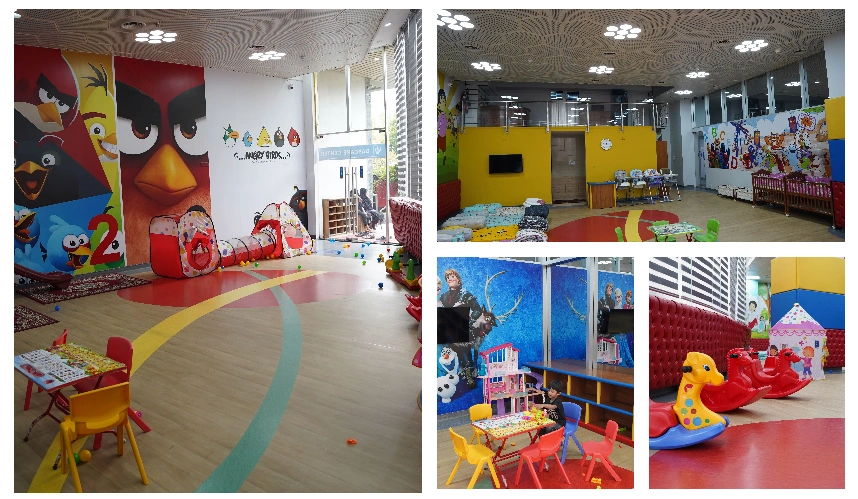
Together, these initiatives strengthen workplace support for parents, encourage women's continued participation in employment and contribute to more sustainable career development.
Equal Opportunities for Professional Development
AIUB promotes continuous learning and professional advancement by providing academic and administrative employees with access to educational and professional development opportunities [11]. These include:
- Tuition fee waivers: Full-time academic and administrative employees are eligible for tuition fee waivers when pursuing graduate programmes at AIUB, supporting their access to further education and advanced qualifications.
- Study leave and travel grants: Employees can access study leave and travel grants to participate in graduate studies, research activities, academic conferences and professional training programmes.
By supporting employees' continued education and professional development, AIUB strengthens opportunities for career advancement and reinforces an employment environment based on equal access to learning and growth.
Women's Empowerment, Voice and Leadership
AIUB further promotes women's empowerment and participation in institutional and professional decision-making through the AIUB Women Forum, inaugurated on 8 March 2015 [14] [15].
The Forum works to empower women at different levels of decision-making, focusing on education, entrepreneurship and leadership development. Its activities provide an institutional platform for promoting women's participation, strengthening their professional capabilities and encouraging greater representation in leadership roles.
By fostering women's empowerment and leadership, AIUB reinforces an organizational culture that values equal opportunities, recognizes women's contributions and supports their professional advancement.
Institutional Governance and Employee Complaint Mechanisms
AIUB supports the implementation of its employment and pay equity commitments with institutional governance structures and accessible channels for employee feedback and complaints. These mechanisms promote accountability, support the consistent application of employment policies and provide employees with formal avenues to raise workplace concerns.
Office of Human Resources
The Office of Human Resources plays a central role in administering AIUB's employment policies and coordinating human resource practices across the University [16]. Its responsibilities encompass human resource planning, recruitment and selection, employee training and development, performance appraisal, regulatory compliance and employee retention.
These functions support the consistent administration of employment practices and reinforce the implementation of institutional policies concerning employee rights, professional development and fair working conditions.
Diversity and Equality Committee
AIUB's commitment to equality and non-discrimination is further supported by its Diversity and Equality Committee, chaired by the Vice Chancellor and comprising representatives from academic and administrative units, as well as the student community [4], [5].
The Committee brings together representatives from each faculty and key institutional offices, including the Office of the Registrar, the Office of Human Resources, the Office of Student Affairs, the Institutional Quality Assurance Cell (IQAC) and the Office of Administration [5].
Its responsibilities include periodically reviewing diversity, equality, inclusion and human rights policies, recommending policy improvements and monitoring their implementation. The Committee also assesses progress in diversity and equality and evaluates the impact of institutional initiatives on the University's stakeholders [4], [5].
This governance structure reinforces institutional accountability and supports the integration of equality and non-discrimination principles into AIUB's employment environment.
Confidential Employee Feedback and Complaint Channels
AIUB provides employees with several channels to communicate concerns, submit complaints and offer suggestions to the Office of Human Resources. These include dedicated forms, email and institutional complaint and suggestion boxes. The University also maintains the confidentiality of individuals raising concerns through these mechanisms [16].
Additionally, AIUB's employment practice appeal process provides a formal mechanism for employees to raise concerns regarding their employment rights, remuneration and workplace conduct [17].
These channels strengthen transparency and accountability in employment management, allowing employees to communicate workplace concerns through established institutional procedures and supporting the fair application of employment policies.
References
| [1] | American International University-Bangladesh, “AIUB Non-Discriminatory Employment Policy,” [Online]. Available: https://aiub.edu/offices/hrd/aiub-non-discriminatory-employment-policy. [Accessed 2026]. |
| [2] | American International University-Bangladesh, “SDG 8: Decent Work and Economic Growth.,” [Online]. Available: https://www.aiub.edu/sustainability/sdg8. [Accessed 2026]. |
| [3] | American International University-Bangladesh, “Employment Policies and Practices,” [Online]. Available: https://aiub.edu/sustainability/sdg8/sdg8-initiative/employment-policies-and-practices. [Accessed 2026]. |
| [4] | American International University-Bangladesh, “Diversity and Equality Committee,” [Online]. Available: https://aiub.edu/administration/institutional-policy/diversity-and-equality-committee. [Accessed 2026]. |
| [5] | American International University-Bangladesh, “Student representation at American International University-Bangladesh (AIUB),” [Online]. Available: https://aiub.edu/sustainability/student-representation-at-american-international-university-bangladesh-aiub-. [Accessed 2026]. |
| [6] | Worksuite, “Labour Act, Section 345 (Law Prohibiting Discrimination or Harassment),” [Online]. Available: https://worksuite.com/glossary/labour-act-bangladesh-law-prohibiting-discrimination-or-harassment. [Accessed 2026]. |
| [7] | The Daily Star, “Confronting gender inequality in Bangladesh's labour laws,” [Online]. Available: https://www.thedailystar.net/supplements/international-womens-day-2026/news/confronting-gender-inequality-bangladeshs-labour-laws-4122936 . [Accessed 2026]. |
| [8] | The Business Standard, “Employment Discrimination: A Bangladeshi perspective,” [Online]. Available: https://www.tbsnews.net/thoughts/employment-discrimination-bangladeshi-perspective-528086. [Accessed 2026]. |
| [9] | Bangladesh Employers' Federation and International Labour Organization, “Gender Operational Manual,” [Online]. Available: https://bef.org.bd/wp-content/uploads/2026/06/Gender-Operational-manual_ILO_BEF_JUNE-2026.pdf. . [Accessed 2026]. |
| [10] | International Labour Organization, “Compilation of selected observations and direct requests of the Committee of Experts on the Application of Conventions and Recommendations: Bangladesh,” [Online]. Available: https://tradefordecentwork.ilo.org/wp-content/uploads/2024/09/Compilation-of-selected-observations-and-direct-requests-of-the-Committee-of-Experts-on-the-Application-of-Conventions-and-Recommendations-Bangladesh.pdf. [Accessed 2026]. |
| [11] | American International University-Bangladesh, “Employee Benefits & Policies,” [Online]. Available: https://aiub.edu/offices/hrd/employee-benefits. [Accessed 2026]. |
| [12] | American International University-Bangladesh, “Maternity Policy at AIUB that Supports Women Participation,” [Online]. Available: https://aiub.edu/sustainability/sdg5/sdg5-initiative/maternity-policy-at-aiub-that-supports-women-participation. [Accessed 2026]. |
| [13] | American International University-Bangladesh, “Daycare Facilities,” [Online]. Available: https://aiub.edu/oncampus/aiub-daycare-facilities. [Accessed 2026]. |
| [14] | American International University-Bangladesh, “The Launching of the AIUB Women Forum,” [Online]. Available: https://www.aiub.edu/the-launching-of-the-aiub-women-forum. [Accessed 2026]. |
| [15] | American International University-Bangladesh, “Forums and Networks at AIUB,” [Online]. Available: https://aiub.edu/sustainability/sdg8/sdg8-initiative/forums-and-networks-at-aiub. [Accessed 2026]. |
| [16] | American International University-Bangladesh, “Office of Human Resources,” [Online]. Available: https://www.aiub.edu/offices/hrd. [Accessed 2026]. |
| [17] | American International University-Bangladesh, “Employment Practice Appeal Process,” [Online]. Available: https://aiub.edu/sustainability/sdg8/sdg8-initiative/employment-practice-appeal-process. [Accessed 2026]. |
SDG 8.2.7
TABLE OF CONTENTS
SDG 8.2.7: Does your university as a body measure/track pay scale gender equity?
How AIUB Monitors Pay Scales for Gender Equity
Regular Monitoring of Gender Pay Equity
Key Dimensions of Pay Scale Monitoring
Institutional Responsibility for Monitoring
Integration with AIUB's Broader Gender Monitoring Framework
A Uniform Pay Scale Supporting Gender Equity
A Standardised Salary Structure for Faculty and Staff
Supporting Transparent Gender Pay Monitoring
Compensation Above Minimum Wage Standards
From Monitoring to Institutional Action
Policy Oversight by the Diversity and Equality Committee
Confidential Employee Feedback and Appeal Mechanisms
AIUB's Institutional Framework for Pay Equity
Legal Framework and Institutional Measures Supporting Gender Equity
National and International Standards for Equal Remuneration
Equal Opportunity and Non-Discrimination in Employment
Supporting Gender Equity Throughout Employees' Careers
SDG 8.2.7: Does your university as a body measure/track pay scale gender equity?
How AIUB Monitors Pay Scales for Gender Equity
Regular Monitoring of Gender Pay Equity
AIUB incorporates gender pay equity into its ongoing approach to monitoring employment practices. The University regularly measures and addresses gender pay gaps, reinforcing its commitment to fair and equitable compensation across its workforce [1]. This approach supports the consistent assessment of salary structures and promotes equal treatment of women and men in the workplace.
Key Dimensions of Pay Scale Monitoring
Monitoring pay scales for gender equity involves examining compensation arrangements and the distribution of employees across the University's salary structure. This includes three important dimensions:
- Pay within salary grades. Assessing whether women and men occupying positions within the same grade receive compensation in accordance with the University's established salary scale.
- Representation across salary grades. Examining the distribution of women and men across different employment grades, including junior and senior positions, to support the assessment of gender representation in higher-paid roles.
- Changes in compensation over time. Monitoring salary developments associated with recruitment, promotions and periodic increments to support the consistent application of equitable compensation practices.
Institutional Responsibility for Monitoring
The Office of Human Resources plays a central role in administering employment and personnel records for AIUB's academic and non-academic staff. Its responsibilities encompass human resource planning, recruitment and selection, performance appraisal, HR compliance, employee retention and database management [2]. By maintaining centralized employment records and overseeing these functions, the Office supports consistent human resource administration and provides an institutional basis for monitoring compensation practices across the University.
Integration with AIUB's Broader Gender Monitoring Framework
Gender pay monitoring forms part of AIUB's broader institutional commitment to measuring and promoting gender equity. The University operates a systematic statistical tracking mechanism dedicated to women, covering key indicators such as female applicants, admissions and enrolments [3]. In addition, AIUB incorporates gender parity monitoring and gender considerations into its institutional operations, reinforcing its commitment to evidence-based approaches to gender equality [4]. These practices demonstrate the University's broader capacity to monitor gender-related outcomes and support equitable institutional policies.
A Uniform Pay Scale Supporting Gender Equity
A Standardised Salary Structure for Faculty and Staff
AIUB maintains a dedicated and uniform pay scale structure applicable to all academic and non-academic employees, in accordance with the Government of Bangladesh (GOB) wage policy [5]. Each position is assigned to a defined salary grade, establishing a consistent framework for determining employee compensation across the University. This standardised structure promotes transparency, consistency and fairness in salary administration.
Supporting Transparent Gender Pay Monitoring
The University's uniform pay scale provides a common reference framework for examining compensation across its workforce. By applying standardised salary grades, AIUB facilitates the comparison of remuneration between women and men and supports the identification of potential differences in pay arrangements.
This structure offers several advantages for gender pay monitoring:
| Dimension | Contribution to gender pay monitoring |
| Direct comparison | Enables the comparison of salaries received by women and men within equivalent salary grades against the same established pay scale. |
| Transparency | Establishes clear salary grades and compensation arrangements, allowing employees and managers to understand how remuneration is structured and progresses. |
| Consistency | Provides a common basis for administering salaries across academic and non-academic positions. |
| Identification of differences | Facilitates the examination of salary variations that may arise across grades and pay levels, supporting the assessment of gender equity in compensation. |
Equal Pay for Women and Men
AIUB's uniform salary structure supports its commitment to equal remuneration regardless of gender. The University reports that there are no gender-based pay differences among its employees, reflecting its commitment to fair compensation and equitable treatment in the workplace [5], [6]. Regular monitoring of compensation practices further supports the consistent application of this principle across the University's workforce.
Compensation Above Minimum Wage Standards
AIUB's compensation framework also ensures that all employees, including academic and non-academic staff, receive remuneration at or above the local living wage [1]. Furthermore, the University's structured pay scale provides compensation above the minimum wage levels established by the Government of Bangladesh for various sectors through official gazette notifications [6]. These arrangements demonstrate AIUB's commitment to providing fair and competitive remuneration while maintaining consistent compensation standards for women and men across the institution.
From Monitoring to Institutional Action
AIUB complements its commitment to monitoring gender pay equity with institutional mechanisms for policy oversight, employee feedback and the resolution of workplace concerns. These arrangements reinforce accountability and support the University's efforts to maintain fair and equitable employment practices.
Addressing Gender Pay Gaps
AIUB's approach to gender pay equity combines regular measurement with a commitment to addressing identified differences in compensation. The University recognises the importance of monitoring gender pay gaps and taking appropriate action to promote fair remuneration across its workforce [1]. This commitment connects salary monitoring with the broader objective of ensuring equitable employment practices.
Policy Oversight by the Diversity and Equality Committee
AIUB's Diversity and Equality Committee provides an institutional framework for overseeing diversity, equality, inclusion and human rights policies. Chaired by the Vice Chancellor, the Committee includes representatives of academic and administrative employees [7]. Its membership encompasses representatives from each faculty, the Office of the Registrar, the Office of Human Resources, the Office of Student Affairs, the Institutional Quality Assurance Cell (IQAC), the Office of Administration and the student community [8].
The Committee has three main responsibilities:
1. Policy review. Periodically examines diversity, equality, inclusion and human rights policies and recommends amendments or revisions to strengthen their implementation [8].
2. Implementation monitoring. Monitors the implementation of institutional policies to support their consistent application across the University [8].
3. Assessment of progress. Evaluates progress in diversity and equality and assesses the impact of related initiatives on the University's stakeholders [7].
By bringing together representatives from different areas of the institution, the Committee strengthens institutional oversight and provides a formal governance structure for advancing gender equality and inclusive employment practices.
Confidential Employee Feedback and Appeal Mechanisms
AIUB provides employees with accessible channels for submitting complaints and suggestions to the Office of Human Resources. These include dedicated forms, email and physical complaint and suggestion boxes. The University maintains the confidentiality of individuals raising concerns, supporting a secure environment for employee feedback [2].
In addition, AIUB's employment practice appeal process provides a formal mechanism for employees to raise concerns regarding their workplace rights, compensation and professional conduct [9]. These channels strengthen employee protection and support the University's commitment to transparent and equitable employment practices.
AIUB's Institutional Framework for Pay Equity
AIUB's approach brings together salary administration, gender equity monitoring, policy oversight and employee feedback mechanisms. The following table summarises the institutional responsibilities and practices supporting this framework:
| Stage | Responsible unit | Institutional practice |
| Salary administration | Office of Human Resources | Applies a uniform, GOB-aligned pay scale to academic and non-academic employees [5]. |
| Gender pay monitoring | AIUB | Regularly monitors pay scales for gender equity and addresses identified pay gaps [1]. |
| Institutional oversight | Diversity and Equality Committee | Reviews equality policies, monitors their implementation and assesses institutional progress [7], [8]. |
| Employee feedback | Office of Human Resources | Receives confidential employee complaints and suggestions through established communication channels [2]. |
| Employment appeals | AIUB | Provides a formal process for addressing concerns relating to employee rights, compensation and workplace conduct [9]. |
Legal Framework and Institutional Measures Supporting Gender Equity
National and International Standards for Equal Remuneration
AIUB's commitment to fair compensation is aligned with national labour legislation and international standards promoting equal remuneration for work of equal value.
- Bangladesh Labour Act, 2006, Section 345. Establishes the requirement to provide equal wages to male, female and disabled workers performing work of equal nature or standard, reinforcing the principle of non-discrimination in remuneration [10].
- ILO Equal Remuneration Convention, 1951 (No. 100). Establishes an international standard requiring equal remuneration for men and women for work of equal value. Bangladesh ratified this Convention in 1998, reflecting its commitment to internationally recognised principles of pay equity [11], [12].
AIUB's salary administration and gender pay monitoring practices are aligned with these national and international principles, providing an institutional framework for promoting fair and equitable remuneration across its workforce.
Equal Opportunity and Non-Discrimination in Employment
AIUB maintains a non-discriminatory employment policy that welcomes qualified individuals regardless of age, gender, sexual orientation, race, disability, colour, religion, or national and ethnic origin [5]. The University's commitment to human dignity and equal opportunity extends across its employment practices, including recruitment, workplace conditions and remuneration. These principles are reinforced by internal and external policies that promote fair treatment and equal employment opportunities for all members of the University community [5].
Supporting Gender Equity Throughout Employees' Careers
AIUB complements its compensation framework with employment benefits and support measures that promote career continuity, work-life balance and equal professional opportunities. These initiatives include:
- Paid maternity and paternity leave. Provides parental leave arrangements that support employees during important family transitions while promoting their continued participation in professional activities [13].
- Support for returning mothers. AIUB collaborates with WePOWER under its Retention pillar and has celebrated the first International Returning Mothers Day, recognising the importance of supporting women as they resume their professional careers following maternity leave [14].
- On-campus daycare facilities. Provides childcare support for employees with young children, helping them balance family responsibilities and professional commitments [15].
- Equal access to professional development. Offers eligible employees tuition fee waivers, study leave and travel grants, supporting continuous learning, academic advancement and professional growth [13].
- Comprehensive employee benefits. Provides employment benefits that include health insurance, life insurance, a Contributory Provident Fund and gratuity, contributing to employees' financial security and well-being [13].
Together, these measures strengthen AIUB's commitment to an inclusive working environment in which women and men can pursue professional development, maintain career continuity and access institutional benefits on equitable terms.
Women's Participation and Leadership in Decision-Making
The AIUB Women Forum, inaugurated on 8 March 2015, promotes women's empowerment and participation at different levels of decision-making. Its activities focus on education, entrepreneurship and leadership development, creating opportunities for women to strengthen their professional capabilities and contribute to institutional and broader societal progress [18], [19].
By encouraging women's participation and leadership, the Forum complements AIUB's broader commitment to gender equality, equal opportunities and an inclusive institutional culture.
References
| [1] | American International University-Bangladesh, “Employment Policies and Practices,” [Online]. Available: https://aiub.edu/sustainability/sdg8/sdg8-initiative/employment-policies-and-practices. [Accessed 2026]. |
| [2] | American International University-Bangladesh, “Office of Human Resources,” [Online]. Available: https://www.aiub.edu/offices/hrd. [Accessed 2026]. |
| [3] | American International University-Bangladesh, “Tracking Women Access Measure,” [Online]. Available: https://www.aiub.edu/iqac/women-development/tracking-women-access-measure. [Accessed 2026]. |
| [4] | American International University-Bangladesh, “SDG 5 Report,” [Online]. Available: https://aiub.edu/sustainability/sdg5/sdg5-report. [Accessed 2026]. |
| [5] | American International University-Bangladesh, “AIUB Non-Discriminatory Employment Policy,” [Online]. Available: https://aiub.edu/offices/hrd/aiub-non-discriminatory-employment-policy. [Accessed 2026]. |
| [6] | American International University-Bangladesh, “SDG 8: Decent Work and Economic Growth – AIUB Activity Report of 2023,” [Online]. Available: https://www.aiub.edu/iqac/sdgs/aiub-sdg-activity-report-2023/sdg8-aiubactivityreportof2023. [Accessed 2026]. |
| [7] | American International University-Bangladesh, “Diversity and Equality Committee,” [Online]. Available: https://aiub.edu/administration/institutional-policy/diversity-and-equality-committee. [Accessed 2026]. |
| [8] | American International University-Bangladesh, “Student representation at American International University-Bangladesh (AIUB),” [Online]. Available: https://aiub.edu/sustainability/student-representation-at-american-international-university-bangladesh-aiub-. [Accessed 2026]. |
| [9] | American International University-Bangladesh, “Employment Practice Appeal Process,” [Online]. Available: https://aiub.edu/sustainability/sdg8/sdg8-initiative/employment-practice-appeal-process. [Accessed 2026]. |
| [10] | Worksuite, “Labour Act, Section 345 (Law Prohibiting Discrimination or Harassment),” [Online]. Available: https://worksuite.com/glossary/labour-act-bangladesh-law-prohibiting-discrimination-or-harassment. [Accessed 2026]. |
| [11] | Bangladesh Employers' Federation and International Labour Organization, “Gender Operational Manual,” [Online]. Available: https://bef.org.bd/wp-content/uploads/2026/06/Gender-Operational-manual_ILO_BEF_JUNE-2026.pdf. . [Accessed 2026]. |
| [12] | International Labour Organization, “Compilation of selected observations and direct requests of the Committee of Experts on the Application of Conventions and Recommendations: Bangladesh,” [Online]. Available: https://tradefordecentwork.ilo.org/wp-content/uploads/2024/09/Compilation-of-selected-observations-and-direct-requests-of-the-Committee-of-Experts-on-the-Application-of-Conventions-and-Recommendations-Bangladesh.pdf. [Accessed 2026]. |
| [13] | American International University-Bangladesh, “Employee Benefits & Policies,” [Online]. Available: https://aiub.edu/offices/hrd/employee-benefits. [Accessed 2026]. |
| [14] | American International University-Bangladesh, “Maternity Policy at AIUB that Supports Women Participation,” [Online]. Available: https://aiub.edu/sustainability/sdg5/sdg5-initiative/maternity-policy-at-aiub-that-supports-women-participation. [Accessed 2026]. |
| [15] | American International University-Bangladesh, “Daycare Facilities,” [Online]. Available: https://aiub.edu/oncampus/aiub-daycare-facilities. [Accessed 2026]. |
SDG 8.2.8
TABLE OF CONTENTS
AIUB's Employment Practice Appeal Process
Institutional Bodies Responsible for Handling Complaints
Connection with AIUB's Employment Policies
How Employees Submit and Appeal Employment-Related Concerns
Step-by-Step Complaint Submission Process
Employee Suggestions and Institutional Feedback
Overview of Employee Complaint and Feedback Channels
Specialised Complaint Procedures and Equality Mechanisms
Policy Regarding Discrimination Complaints for Employees
Policy Regarding Sexual Harassment Complaints for Employees
Equality Governance and Institutional Oversight
Protections for Employees Using Complaint and Appeal Mechanisms
Protection Against Employment-Related Disadvantages
Equal Rights Across Employment Arrangements
Legal Framework and Awareness of Employee Rights
National Legal Framework Supporting Employee Rights
SDG 8.2.8: Does your university as a body have a process for employees to appeal on employee rights and/or pay?
AIUB's Employment Practice Appeal Process
AIUB provides institutional channels through which employees can raise concerns and seek the review of employment-related matters, including employee rights, remuneration and workplace conduct. This appeal framework supports transparency, accountability and the consistent application of the University's employment policies [1].
Scope of the Appeal Process
AIUB's appeal process addresses employee concerns across three principal areas [1]:
| Area | Examples of concerns |
| Employee rights | Unequal treatment, access to employment benefits and leave entitlements, and terms and conditions of employment. |
| Pay and remuneration | Salary, employment grade, placement on the pay scale and pay equity. |
| Workplace conduct | Discrimination, harassment and other forms of inappropriate behaviour affecting employees in the workplace. |
By explicitly addressing employee rights and remuneration, the process provides employees with a formal channel to raise concerns about the application of employment conditions and compensation practices.
Institutional Bodies Responsible for Handling Complaints
AIUB assigns complaint-handling responsibilities to designated institutional offices and committees:
- Office of Human Resources. The Office of Human Resources receives and handles employee inquiries and complaints [1], [2]. Its responsibilities include human resources compliance, performance appraisal and employee retention, supporting the administration and oversight of employment-related matters [3].
- Complaint Committee. AIUB maintains a designated Complaint Committee, established in accordance with the guidelines of the High Court Division of the Supreme Court of Bangladesh, to address complaints of sexual harassment [1].
These institutional mechanisms provide employees with designated channels for raising workplace concerns and support the University's commitment to fair and accountable employment practices.
Connection with AIUB's Employment Policies
The appeal process complements AIUB's broader employment policy framework, which includes a uniform pay scale without gender-based salary differences, a living wage commitment, non-discrimination, equal rights for outsourced workers and the prohibition of forced labour [4].
Together, these policies and complaint-handling mechanisms reinforce AIUB's institutional commitment to equitable employment conditions, fair remuneration and the protection of employee rights. They also provide an organizational framework for addressing concerns related to the implementation of these commitments.
How Employees Submit and Appeal Employment-Related Concerns
AIUB provides employees with accessible formal channels for submitting employment-related complaints and concerns. The University's procedures combine designated institutional contacts, standardized complaint forms and physical and electronic submission options, supporting an organized and confidential process for addressing workplace issues.
Step-by-Step Complaint Submission Process
AIUB establishes the following procedure for employees wishing to raise employment-related concerns [1], [2]:
1. Select the appropriate channel. Employees can direct concerns involving employment rights, remuneration, discrimination and workplace conduct to the Office of Human Resources. Complaints concerning sexual harassment are handled by the designated Complaint Committee [1].
2. Complete the complaint form. AIUB provides a downloadable complaint form that allows employees to document their concerns and formally communicate the matter to the relevant institutional body [2].
3. Submit the complaint. Employees can submit the completed form electronically by emailing hr@aiub.edu or physically by placing it in the complaint box located in Annex 1 [2].
4. Confidential handling. AIUB protects the confidentiality of the complainant and the information provided during the complaint submission process [2].
5. Review and resolution. AIUB's complaint and grievance procedures establish mechanisms for addressing complaints involving alleged violations of the University's non-discrimination commitments, supporting the institutional review and resolution of employment-related concerns [5].
Employee Suggestions and Institutional Feedback
In addition to formal complaint procedures, AIUB provides employees with a dedicated suggestion mechanism to communicate ideas and propose improvements to institutional policies and practices. Employees can complete a downloadable suggestion form and submit it by email to hr@aiub.edu or use the suggestion boxes available in different campus buildings [2].
This mechanism encourages employee participation in institutional improvement and provides an additional channel for communicating feedback on workplace policies and practices.
Overview of Employee Complaint and Feedback Channels
| Channel | Submission method | Responsible body |
| Complaint form – Email | Submit the completed form to hr@aiub.edu [2]. | Office of Human Resources |
| Complaint box | Place the completed complaint form in the designated box in Annex 1 [2]. | Office of Human Resources |
| Suggestion form | Email the completed form to hr@aiub.edu or place it in a suggestion box located in campus buildings [2]. | Office of Human Resources |
| Sexual harassment complaint | Submit the complaint to the designated committee [1]. | Complaint Committee |
Specialised Complaint Procedures and Equality Mechanisms
In addition to its general employment appeal process, AIUB maintains specialised policies and institutional mechanisms to address discrimination, sexual harassment and other workplace concerns. These arrangements reinforce the University's commitment to protecting employee rights, promoting equal treatment and maintaining a respectful working environment.
Policy Regarding Discrimination Complaints for Employees
AIUB's Policy Regarding Discrimination Complaints for Employees establishes the University's commitment to preventing discrimination and harassment in the workplace. The policy prohibits discrimination or harassment against employees on the basis of religion, race, colour, age, disability, nationality, marital status or sexual orientation, including gender identity [2].
The Office of Human Resources is responsible for handling employee inquiries and complaints submitted under this policy [2]. This arrangement provides employees with an institutional channel for raising concerns about unequal treatment in employment conditions, including remuneration, access to benefits and other employment-related rights.
By explicitly addressing protected characteristics and assigning responsibility for complaint handling, the policy reinforces AIUB's commitment to non-discrimination and equitable employment practices.
Policy Regarding Sexual Harassment Complaints for Employees
AIUB maintains a zero-tolerance approach to sexual misconduct in the workplace. Its complaint and grievance procedures establish mechanisms for addressing sexual harassment complaints and supporting the protection of employees [6].
A designated Complaint Committee is constituted in accordance with the guidelines issued by the High Court Division of the Supreme Court of Bangladesh [1]. These guidelines originate from a 2009 High Court judgment requiring public and private workplaces and educational institutions to establish committees responsible for receiving complaints, conducting investigations and making recommendations [7].
AIUB's specialised committee provides an institutional mechanism for handling sexual harassment complaints in accordance with this national judicial framework.
Equality Governance and Institutional Oversight
AIUB's commitment to equality is also supported by its Diversity and Equality Committee, chaired by the Vice Chancellor and comprising representatives from academic and administrative staff [8].
The Committee works continuously to address discrimination and equality-related matters across the University community. Its responsibilities include periodically reviewing equality and human rights policies and monitoring their implementation [9].
This governance structure strengthens institutional oversight of employee rights and equality commitments, complementing AIUB's formal complaint and appeal procedures.
Protections for Employees Using Complaint and Appeal Mechanisms
AIUB reinforces its employee complaint and appeal procedures with safeguards that promote confidentiality, fair treatment and protection against discrimination. These measures support an environment in which employees can raise employment-related concerns, including matters involving remuneration and workplace rights.
Confidentiality
AIUB protects the confidentiality of employees submitting complaints and the information provided during the complaint process [2], [6]. This safeguard supports employees in raising concerns about employment conditions, remuneration and workplace conduct while ensuring that their personal information and submitted complaints receive confidential treatment.
Fair and Equitable Treatment
AIUB's appeal framework is guided by the principles of fair treatment and confidentiality in handling employee complaints [1]. These principles support the consistent administration of grievance procedures and reinforce the University's commitment to addressing employment-related concerns through established institutional channels.
Protection Against Employment-Related Disadvantages
AIUB maintains a policy protecting individuals who report discrimination against educational or employment-related disadvantages [10]. This protection reinforces the University's commitment to ensuring that employees can raise concerns about discriminatory practices without being subjected to adverse treatment for reporting them.
By incorporating this safeguard into its institutional policy framework, AIUB strengthens the protection of employee rights and supports the use of formal complaint mechanisms.
Equal Rights Across Employment Arrangements
AIUB extends its commitment to equal employment rights to workers engaged through outsourced services, establishing equal rights for employees across different forms of outsourcing [4].
This commitment reinforces the University's broader approach to equitable employment conditions and the protection of workers' rights, complementing its institutional framework for addressing workplace concerns.
Legal Framework and Awareness of Employee Rights
AIUB's employment policies and complaint-handling mechanisms operate within a broader legal and institutional framework that promotes equal treatment, fair remuneration and the protection of workplace rights in Bangladesh. The University also supports awareness of these principles through academic activities addressing labour rights, gender equality and employment-related legal protections.
National Legal Framework Supporting Employee Rights
AIUB's employment practices and complaint procedures are aligned with key legal provisions governing workers' rights and workplace protections in Bangladesh.
- Bangladesh Labour Act, 2006. This legislation establishes provisions governing wages, working conditions and dispute resolution. Section 345 specifically requires equal wages for work of equal nature or standard [11], [12]. This principle reinforces the importance of equitable remuneration and provides a legal foundation for addressing concerns involving unequal pay and employment conditions.
- High Court Directive on Sexual Harassment (2009). The directive issued by the High Court Division of the Supreme Court of Bangladesh requires workplaces and educational institutions to establish committees responsible for receiving complaints, conducting investigations and making recommendations in cases of sexual harassment [7]. AIUB's designated Complaint Committee is constituted in accordance with these guidelines, providing an institutional mechanism for addressing such complaints [1].
Together, these legal provisions reinforce the framework supporting employee rights, equal remuneration and appropriate institutional responses to workplace grievances.
Academic Activities Promoting Awareness of Workers' Rights
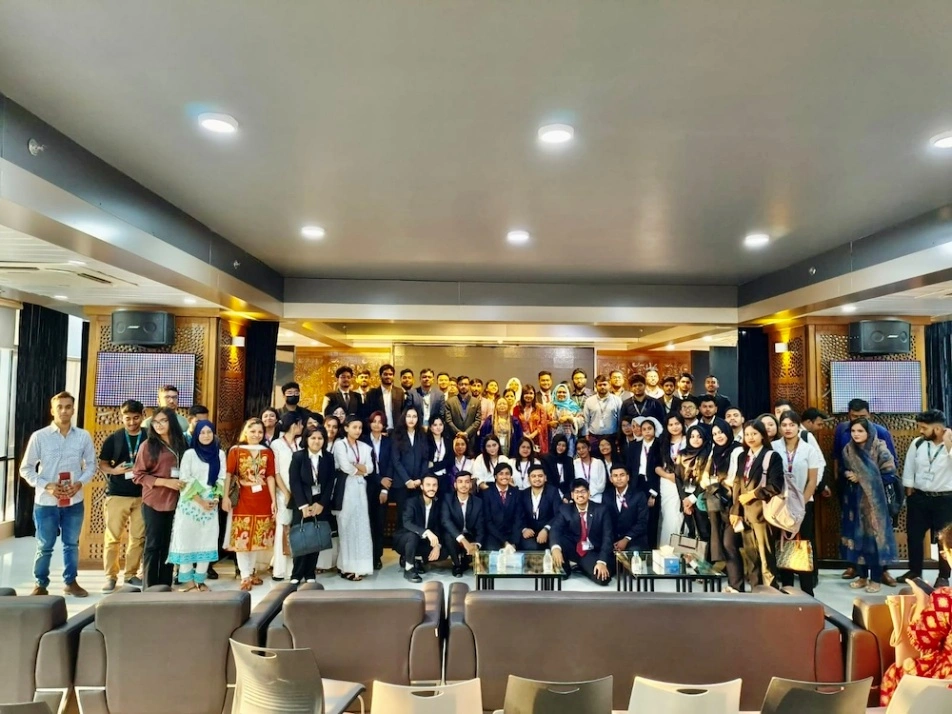
AIUB promotes awareness of employment rights and gender equality through academic initiatives that engage students, researchers and members of the university community in discussions on relevant legal and social issues.
- Seminar on Women's Workers' Rights (25 October 2023). The Department of Law organised a seminar examining recent legal reforms concerning maternity benefits and the prevention of gender-based violence. The event brought together Law students and BBA students majoring in Human Resource Management, strengthening their understanding of workers' rights and the legal responsibilities associated with employment practices [13].
- Second Virtual International Conference on Women's Rights in Emerging Societies (17 February 2024). AIUB co-organised this international academic conference in collaboration with Jus Corpus Law Journal, Symbiosis Law School and Shri Ramswaroop Memorial University. The event featured eight technical sessions and included eight participants from AIUB, providing a platform for academic exchange on women's rights and emerging legal and social challenges [14].
These activities contribute to a broader institutional environment that promotes knowledge of workers' rights, gender equality and the legal principles underpinning fair employment practices.
References
| [1] | American International University-Bangladesh, “Employment Practice Appeal Process,” [Online]. Available: https://aiub.edu/sustainability/sdg8/sdg8-initiative/employment-practice-appeal-process. [Accessed 2026]. |
| [2] | American International University-Bangladesh, “Policy Regarding Discrimination Complaints for Employees,” [Online]. Available: https://aiub.edu/offices/hrd/policy-regarding-discrimination-complaints-for-employees. [Accessed 2026]. |
| [3] | American International University-Bangladesh, “Office of Human Resources,” [Online]. Available: https://www.aiub.edu/offices/hrd. [Accessed 2026]. |
| [4] | American International University-Bangladesh, “Employment Policies and Practices,” [Online]. Available: https://aiub.edu/sustainability/sdg8/sdg8-initiative/employment-policies-and-practices. [Accessed 2026]. |
| [5] | American International University-Bangladesh, “AIUB Non-discrimination Policy,” [Online]. Available: https://aiub.edu/administration/institutional-policy/aiub-non-discrimination-policy. [Accessed 2026]. |
| [6] | American International University-Bangladesh, “Policy Regarding Sexual Harassment Complaints for Employees,” [Online]. Available: https://aiub.edu/offices/hrd/policy-regarding-sexual-harassment-complaints-for-employees. [Accessed 2026]. |
| [7] | Prothom Alo, “High Court directive on preventing sexual harassment in workplaces and educational institutions,” [Online]. Available: https://en.prothomalo.com/amp/story/bangladesh/6e7pdlx9oz. . [Accessed 2026]. |
| [8] | American International University-Bangladesh, “Diversity and Equality Committee,” [Online]. Available: https://aiub.edu/administration/institutional-policy/diversity-and-equality-committee. [Accessed 2026]. |
| [9] | American International University-Bangladesh, “Student representation at American International University-Bangladesh (AIUB),” [Online]. Available: https://aiub.edu/sustainability/student-representation-at-american-international-university-bangladesh-aiub-. [Accessed 2026]. |
| [10] | American International University-Bangladesh, “Policy at AIUB that Protects Those Reporting Discrimination from Educational or Employment Disadvantages,” [Online]. Available: https://aiub.edu/sustainability/sdg5/sdg5-initiative/policy-at-aiub-that-protects-those-reporting-discrimination-from-educational-or-employment-disadvantages. [Accessed 2026]. |
| [11] | Global Law Experts, “Employment Law Bangladesh 2026: Labour Amendment Act, employer duties and provident fund,” [Online]. Available: https://globallawexperts.com/employment-law-bangladesh-2026-labour-amendment-act-employer-duties-provident-fund/. [Accessed 2026]. |
| [12] | Worksuite, “Labour Act, Section 345 (Law Prohibiting Discrimination or Harassment),” [Online]. Available: https://worksuite.com/glossary/labour-act-bangladesh-law-prohibiting-discrimination-or-harassment. [Accessed 2026]. |
| [13] | American International University-Bangladesh, “A Seminar on ‘Recent Legal Reforms on Maternity Benefit and the Prevention of Gender Based Violence’ Organized by the Department of Law,” [Online]. Available: https://www.aiub.edu/a-seminar-on-recent-legal-reforms-on-maternity-benefit-and-the-prevention-of-gender-based-violence-organized-by-the-department-of-law. [Accessed 2026]. |
| [14] | American International University-Bangladesh, “The Second Virtual International Conference on Women's Rights in Emerging Societies,” [Online]. Available: https://www.aiub.edu/the-second-virtual-international-conference-on-womens-rights-in-emerging-societies. [Accessed 2026]. |