


TABLE OF CONTENTS
AIUB's Policies on Ending Workplace Discrimination
AIUB Non-discrimination Policy
AIUB Non-Discriminatory Employment Policy
Protection Across the Grounds Specified in Indicator 8.2.3
Non-discrimination in Pay and Employee Benefits
Integration into the University's Institutional Framework
The Legal and International Framework
The Constitution of Bangladesh
International Labour Standards
Governance: Institutional Oversight and Implementation of Non-discrimination Policies
Diversity and Equality Committee
Equality, Diversity and Inclusion (EDI) Center
Reporting Discrimination: Complaint Procedures and Protection Mechanisms
Policy Regarding Discrimination Complaints for Employees
Policy Regarding Sexual Harassment Complaints for Employees
Confidentiality and Protection of Complainants
Grievance and Appeal Mechanisms
Reporting Channels at a Glance
Awareness, Capacity Building and Inclusion Initiatives
Diversity and Equality Training
Awareness Activities on Workers' Rights, Gender Justice and Equality
SDG 8.2.3: Does your university as a body have a policy on discrimination in the workplace (including discrimination based on religion, sexuality, gender, age)?
AIUB's Policies on Ending Workplace Discrimination
AIUB establishes a comprehensive institutional framework to prevent discrimination and promote equal treatment in the workplace. Its policies ensure that employment decisions, workplace opportunities and employee benefits are guided by principles of fairness, merit and respect for individual rights.
AIUB Non-discrimination Policy
AIUB's Non-discrimination Policy establishes the University's overarching commitment to equal treatment for students and employees [1]. It requires decisions affecting members of the university community to be based on individual merit, without discrimination or harassment on the grounds of religion, race, colour, age, disability, nationality, marital status or sexual orientation, including gender identity [2].
The policy covers student admissions, employment, and participation in all university programmes and activities. It also establishes the Office of Human Resources as the institutional office responsible for addressing employee inquiries and complaints related to non-discrimination [2].
AIUB Non-Discriminatory Employment Policy
AIUB's Non-Discriminatory Employment Policy translates these principles into specific workplace commitments. The University ensures that qualified employees are recruited and provided with equal access to employment rights, privileges, programmes and activities, regardless of their personal characteristics [3].
The policy explicitly identifies the following protected grounds:
1. Age
2. Gender or gender identity
3. Sexual orientation
4. Race
5. Disability
6. Colour
7. Religion
8. National or ethnic origin [3]
Additionally, AIUB extends its commitment to employment inclusion to underrepresented and underprivileged groups [2]. Its organisational principles affirm that individuals have equal opportunities to work at the University regardless of religion, race, caste, sex or place of birth, reflecting the integration of human rights principles into institutional policies and employment practices [4].
Protection Across the Grounds Specified in Indicator 8.2.3
AIUB's non-discrimination framework addresses the principal grounds identified in Indicator 8.2.3, establishing explicit protections and inclusion commitments across different aspects of employment.
| Ground specified in the indicator | AIUB's institutional commitment |
| Religion | Religion is explicitly recognised as a protected ground under both the Non-discrimination Policy and the Non-Discriminatory Employment Policy [2], [3]. |
| Sexuality | Sexual orientation, including gender identity, is explicitly covered by AIUB's non-discrimination commitments [2], [3]. |
| Gender | Gender and gender identity are protected grounds under the employment policy. AIUB also establishes equal pay for women and men [3]. |
| Age | Age is expressly identified as a protected ground in the University's non-discrimination framework [2], [3]. |
| Refugee status | AIUB's inclusion framework identifies newly settled refugees among the underrepresented groups receiving institutional support, complementing its employment protections concerning nationality and national or ethnic origin [2], [3], [5]. |
Non-discrimination in Pay and Employee Benefits
AIUB extends its equal-treatment principles to remuneration and employee benefits, reinforcing fairness throughout the employment relationship.
- Equal pay: AIUB applies a uniform pay scale to faculty members and staff, ensuring that remuneration is not differentiated on the basis of gender [3].
- Equal benefits: All AIUB employees are covered by life insurance, irrespective of religion, race, colour, nationality, marital status or sexual orientation, including gender identity [4].
These provisions demonstrate how the University's non-discrimination commitments extend beyond recruitment to encompass employees' financial conditions and workplace benefits.
Integration into the University's Institutional Framework
AIUB's commitment to ending discrimination is embedded in its broader institutional values and governance framework. The University promotes equity, justice and non-discrimination in its roles as both an employer and an institution of higher education, applying principles of fairness in its engagement with the academic community [6].
This commitment is further consolidated by AIUB's Equality, Diversity and Inclusion Policy, which integrates the University's Non-discrimination Policy with related admission policies supporting underrepresented groups and students with disabilities [7].
AIUB's SDG 8 institutional reporting further documents its commitment to maintaining policies and practices that promote equal treatment and prevent workplace discrimination [8]. Together, these institutional provisions establish a comprehensive framework for protecting employees' rights and fostering an inclusive working environment.
The Legal and International Framework
AIUB's commitment to workplace equality and non-discrimination is supported by the constitutional guarantees of Bangladesh and the country's adherence to international labour standards. These frameworks establish important principles of equal treatment, employment opportunities and fair remuneration, which are reflected in the University's institutional policies and employment practices.
The Constitution of Bangladesh
The Constitution of Bangladesh establishes fundamental guarantees of equality and non-discrimination through three key provisions [9]:
- Article 27 – Equality before the law: Establishes that all citizens are equal before the law and entitled to equal protection.
- Article 28 – Protection against discrimination: Prohibits discrimination by the State against citizens solely on the grounds of religion, race, caste, sex or place of birth.
- Article 29 – Equality of opportunity in public employment: Guarantees equal opportunities for citizens in employment within the service of the Republic, regardless of religion, race, caste, sex or place of birth.
AIUB incorporates these constitutional principles into its Non-Discriminatory Employment Policy, affirming equal employment opportunities regardless of religion, race, caste, sex or place of birth. This alignment reflects the University's commitment to upholding the fundamental principles of equality and fairness in its employment practices (Section 2.2).
International Labour Standards
Bangladesh has ratified key International Labour Organization (ILO) conventions addressing discrimination and equality in employment. These international commitments provide an established framework for promoting fair treatment and equal opportunities in the workplace [10].
| ILO Convention | Core principle | Ratification by Bangladesh |
| Discrimination (Employment and Occupation) Convention, 1958 (No. 111) | Promotes equality of opportunity and treatment in employment and occupation, addressing discrimination in the workplace. | 1972 [10] |
| Equal Remuneration Convention, 1951 (No. 100) | Establishes the principle of equal remuneration for men and women for work of equal value. | 1998 [10] |
AIUB's institutional policies reflect these international labour principles in its employment framework. The University's uniform pay scale and commitment to equal remuneration for women and men support the principle established under Convention No. 100. Similarly, its comprehensive non-discrimination policies reinforce the principles of equality of opportunity and treatment promoted by Convention No. 111 [3].
Governance: Institutional Oversight and Implementation of Non-discrimination Policies
AIUB has established dedicated institutional bodies to oversee its equality, diversity and non-discrimination commitments. These bodies contribute to policy development, implementation monitoring, employee support and the promotion of an inclusive university environment, ensuring that institutional responsibilities are clearly assigned.
Diversity and Equality Committee
The Diversity and Equality Committee plays a central role in overseeing equality and addressing discrimination-related matters within the University community [11]. Chaired by the Vice Chancellor, the Committee brings together representatives of academic and administrative staff, ensuring institutional participation in diversity and equality initiatives [11].
Its membership includes representatives from each faculty, the Office of the Registrar, the Office of Human Resources, the Office of Student Affairs, the Institutional Quality Assurance Cell (IQAC), the Office of Administration and the student community [12].
The Committee carries out several key responsibilities:
- Policy review: Periodically reviewing diversity, equality, inclusion and human rights policies and recommending relevant updates and revisions [12].
- Implementation monitoring: Monitoring the implementation of institutional policies and initiatives across the University [12].
- Institutional support: Encouraging and supporting students, faculty members and employees participating in diversity and equality activities [11].
- Awareness and capacity building: Organising diversity and equality training activities for students, faculty members and employees [11].
- Progress evaluation: Assessing progress in diversity and equality and evaluating its impact on different university stakeholders [11].
These responsibilities provide an institutional mechanism for maintaining, monitoring and strengthening AIUB's equality and non-discrimination framework.
Equality, Diversity and Inclusion (EDI) Center
The Equality, Diversity and Inclusion (EDI) Center provides dedicated support, resources and advocacy for minority employees, students and communities [13]. Its activities extend to employment-related inclusion, particularly through collaboration with the Office of Human Resources.
The Center's main responsibilities include:
- Employee support: Providing assistance to minority employees and students in addressing their specific needs, concerns and challenges [13].
- Inclusive recruitment and retention: Collaborating with the Office of Human Resources on initiatives that support the recruitment and retention of minority employees [13].
- Policy development: Advocating for institutional policy changes that strengthen equity, diversity and inclusion [13].
- Data collection and evaluation: Gathering information about minority employees' experiences to support informed decision-making and assess institutional progress [13].
- Conflict resolution: Facilitating the resolution of diversity- and inclusion-related conflicts through mediation and support [13].
By combining employee support, recruitment initiatives, policy advocacy and institutional assessment, the EDI Center contributes to embedding inclusive employment practices across AIUB.
Ethics Committee
AIUB's Ethics Committee comprises members with diverse areas of expertise and is responsible for overseeing and promoting ethical standards within the University [14]. Its institutional ethical framework establishes non-discrimination as a fundamental principle expected of all members of the university community [14].
This framework reinforces the University's commitment to ethical conduct, respect for individual rights and fairness in institutional relationships.
Office of Human Resources
The Office of Human Resources serves as an institutional contact point for employees seeking guidance or wishing to raise concerns under AIUB's Non-discrimination Policy. It receives and addresses employee inquiries and complaints related to discrimination [2].
In addition to its employment management responsibilities, the Office collaborates with the EDI Center on recruitment and retention initiatives for minority employees [13]. This coordination connects employee support mechanisms with broader institutional efforts to promote equal employment opportunities and an inclusive workplace.
Together, these institutional bodies establish a governance structure that supports the implementation, oversight and continuous development of AIUB's non-discrimination commitments.
Reporting Discrimination: Complaint Procedures and Protection Mechanisms
AIUB provides employees with established channels to report discrimination, harassment and other workplace concerns. These mechanisms facilitate the submission of complaints, ensure appropriate institutional attention and support the confidential handling of reported matters.
Policy Regarding Discrimination Complaints for Employees
AIUB's Policy Regarding Discrimination Complaints for Employees reinforces the University's commitment to preventing discrimination and harassment on the grounds of religion, race, colour, age, disability, nationality, marital status or sexual orientation, including gender identity [2].
The Office of Human Resources is responsible for receiving employee inquiries and complaints under this policy [15]. Employees can report concerns using the following channels:
- Designated complaint form: Employees can complete the official complaint form to communicate discrimination-related concerns.
- Email submission: Completed complaint forms can be sent directly to the Office of Human Resources at hr@aiub.edu.
- Confidential complaint box: Employees can submit completed forms through the complaint box located in Annex 1 [16].
AIUB also provides a separate suggestion form, allowing employees to submit proposals and contribute to improvements in the University's workplace practices [16].
Policy Regarding Sexual Harassment Complaints for Employees
AIUB maintains specific procedures for addressing sexual harassment and misconduct in the workplace. Its Policy Regarding Sexual Harassment Complaints for Employees establishes dedicated mechanisms for receiving and addressing complaints of this nature [17].
A designated Complaint Committee is constituted in accordance with the guidelines established by the High Court Division of the Supreme Court of Bangladesh [16]. These guidelines originate from the landmark 2009 judgment addressing sexual harassment in workplaces and educational institutions. The judgment established the importance of institutional complaint committees responsible for receiving complaints, conducting investigations and making recommendations [18].
AIUB's Complaint Committee provides a dedicated institutional mechanism for handling sexual harassment complaints, reinforcing the University's commitment to a safe, respectful and inclusive working environment.
Confidentiality and Protection of Complainants
Confidentiality is an important component of AIUB's complaint-handling framework. The University's policies protect the confidentiality of complainants and the information submitted during the complaint process [15], [17].
These provisions support a respectful reporting environment in which employees' concerns and personal information are handled with appropriate discretion throughout the complaint-handling process.
Grievance and Appeal Mechanisms
AIUB provides employees with institutional channels to raise concerns involving workplace rights, remuneration, harassment and professional conduct. Employees can bring these matters directly to the Office of Human Resources, which serves as a point of contact for addressing employment-related grievances [19].
The University's broader employment practices also incorporate an appeal process for concerns involving employee rights, pay and workplace conduct [19]. These mechanisms complement the specific discrimination and sexual harassment complaint procedures, providing employees with additional avenues to seek institutional attention and resolution.
Reporting Channels at a Glance
AIUB's complaint-handling framework provides different reporting routes according to the nature of the employee's concern.
| Type of concern | Responsible institutional body | Available reporting channels |
| Discrimination based on protected grounds | Office of Human Resources [15] | Designated complaint form submitted by email to hr@aiub.edu or through the complaint box in Annex 1 [16]. |
| Sexual harassment | Designated Complaint Committee [16] | Complaint procedures established under the University's sexual harassment policy [16]. |
| Other employment-related grievances involving rights, pay or workplace conduct | Office of Human Resources [19] | Institutional grievance and appeal mechanisms [19]. |
These reporting channels reinforce AIUB's commitment to ensuring that employees have accessible institutional mechanisms to communicate concerns and seek appropriate attention to discrimination, harassment and other workplace matters.
Awareness, Capacity Building and Inclusion Initiatives
AIUB complements its institutional non-discrimination policies with educational activities, awareness initiatives and programmes that promote equality, respect for individual rights and inclusive employment practices. These efforts contribute to strengthening awareness across the university community and supporting women's participation and continuity in professional life.
Diversity and Equality Training
AIUB promotes awareness of diversity and equal treatment through dedicated training and capacity-building initiatives.
- Diversity training: The Equality, Diversity and Inclusion (EDI) Center provides diversity training and educational workshops for students, faculty members and employees. These activities raise awareness of diversity-related issues and promote an inclusive university culture [13].
- Equality capacity building: The Diversity and Equality Committee coordinates appropriate diversity and equality capacity-building activities for students, faculty members and employees, reinforcing institutional awareness of equality and inclusion principles [4].
By extending these activities to academic and administrative employees, AIUB reinforces the importance of respectful workplace relationships and equal treatment across the University.
Awareness Activities on Workers' Rights, Gender Justice and Equality
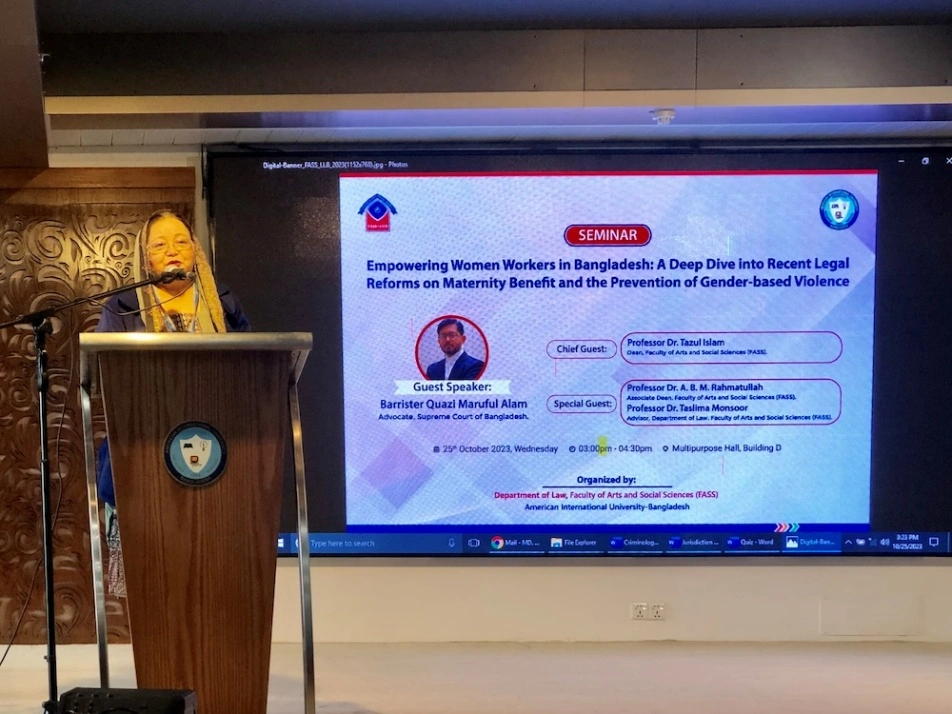
AIUB organises and participates in educational events that address gender equality, women's rights and human rights, contributing to greater awareness of issues affecting women's participation in professional and social life.
- Seminar on Women's Workers' Rights (25 October 2023): The Department of Law organised a seminar titled "Empowering Women Workers in Bangladesh: A Deep Dive into Recent Legal Reforms on Maternity Benefit and the Prevention of Gender-Based Violence". The event brought together Law students and BBA students majoring in Human Resource Management to examine legal protections concerning maternity benefits and gender-based violence in the workplace [20].
- Shomotontro – Gender Justice and Diversity Programme (June 2023): AIUB's Institutional Quality Assurance Cell (IQAC) and AIUB Women Forum jointly hosted BRAC's two-day Gender Justice and Diversity programme. The initiative included a dialogue session at the AIUB Auditorium, providing a platform for engagement with gender justice and diversity issues [21].
- HROC Legal Skills Boot Camp (2025): Students from the Department of Law participated in workshops designed to strengthen legal knowledge and awareness of human rights [2]. This initiative complements AIUB's broader commitment to promoting respect for human rights and equality within the university community.
Supporting Women's Return to Work and Career Continuity
AIUB promotes women's professional continuity and recognises the importance of supporting employees returning to their careers after maternity and caregiving breaks.
The University celebrated the first International Returning Mothers Day, recognising women who resume their professional activities after career interruptions [22]. Additionally, AIUB collaborates with WePOWER under its Retention pillar to support women's return to work following maternity or caregiving breaks [22].
These initiatives highlight AIUB's commitment to women's career continuity and the promotion of an inclusive professional environment in which maternity and caregiving responsibilities are recognised as important considerations in employment retention.
References
| [1] | American International University-Bangladesh, “AIUB Non-discrimination Policy,” [Online]. Available: https://aiub.edu/administration/institutional-policy/aiub-non-discrimination-policy. [Accessed 2026]. |
| [2] | American International University-Bangladesh, “Non-Discrimination Policy at AIUB Against Women and Irrespective to Any Gender Identity,” [Online]. Available: https://aiub.edu/sustainability/sdg5/sdg5-initiative/non-discrimination-policy-at-aiub-against-women-and-irrespective-to-any-gender-identity. [Accessed 2026]. |
| [3] | American International University-Bangladesh, “AIUB Non-Discriminatory Employment Policy,” [Online]. Available: https://aiub.edu/offices/hrd/aiub-non-discriminatory-employment-policy. [Accessed 2026]. |
| [4] | American International University-Bangladesh, “Employment Policies and Practices,” [Online]. Available: https://aiub.edu/sustainability/sdg8/sdg8-initiative/employment-policies-and-practices. [Accessed 2026]. |
| [5] | AIUB's Commitment to Inclusivity, “American International University-Bangladesh,” [Online]. Available: https://www.aiub.edu/iqac/sdgs/aiub-sdg-activity-report-2023/sdg1-aiubactivityreportof2023/sdg-initiative/aiub-s-commitment-to-inclusivity. [Accessed 2026]. |
| [6] | American International University-Bangladesh, “Institutional Policy,” [Online]. Available: https://aiub.edu/administration/institutional-policy. [Accessed 2026]. |
| [7] | American International University-Bangladesh, “Equality, Diversity and Inclusion Policy,” [Online]. Available: https://aiub.edu/sustainability/equality-diversity-and-inclusion-policy-. [Accessed 2026]. |
| [8] | American International University-Bangladesh, “SDG 8: Decent Work and Economic Growth – AIUB Activity Report of 2023,” [Online]. Available: https://www.aiub.edu/iqac/sdgs/aiub-sdg-activity-report-2023/sdg8-aiubactivityreportof2023. [Accessed 2026]. |
| [9] | Banglapedia, “Fundamental Rights,” [Online]. Available: https://en.banglapedia.org/index.php/Fundamental_Rights. . [Accessed 2026]. |
| [10] | International Labour Organization, “Compilation of selected observations and direct requests of the Committee of Experts on the Application of Conventions and Recommendations: Bangladesh,” [Online]. Available: https://tradefordecentwork.ilo.org/wp-content/uploads/2024/09/Compilation-of-selected-observations-and-direct-requests-of-the-Committee-of-Experts-on-the-Application-of-Conventions-and-Recommendations-Bangladesh.pdf. [Accessed 2026]. |
| [11] | American International University-Bangladesh, “Diversity and Equality Committee,” [Online]. Available: https://aiub.edu/administration/institutional-policy/diversity-and-equality-committee. [Accessed 2026]. |
| [12] | American International University-Bangladesh, “Student representation at American International University-Bangladesh (AIUB),” [Online]. Available: https://aiub.edu/sustainability/student-representation-at-american-international-university-bangladesh-aiub-. [Accessed 2026]. |
| [13] | American International University-Bangladesh, “Equality, Diversity and Inclusion (EDI) Center.,” [Online]. Available: https://aiub.edu/oncampus/equality-diversity-and-inclusion-edi-center. [Accessed 2026]. |
| [14] | American International University-Bangladesh, “AIUB support and facilitate a holistic ethical organizational culture,” [Online]. Available: https://aiub.edu/sustainability/aiub-support-and-facilitate-a-holistic-ethical-organizational-culture. [Accessed 2026]. |
| [15] | American International University-Bangladesh, “Policy Regarding Discrimination Complaints for Employees,” [Online]. Available: https://aiub.edu/offices/hrd/policy-regarding-discrimination-complaints-for-employees. [Accessed 2026]. |
| [16] | American International University-Bangladesh, “Policy at AIUB that Protects Those Reporting Discrimination from Educational or Employment Disadvantages,” [Online]. Available: https://aiub.edu/sustainability/sdg5/sdg5-initiative/policy-at-aiub-that-protects-those-reporting-discrimination-from-educational-or-employment-disadvantages. [Accessed 2026]. |
| [17] | American International University-Bangladesh, “Policy Regarding Sexual Harassment Complaints for Employees,” [Online]. Available: https://aiub.edu/offices/hrd/policy-regarding-sexual-harassment-complaints-for-employees. [Accessed 2026]. |
| [18] | Prothom Alo, “High Court directive on preventing sexual harassment in workplaces and educational institutions,” [Online]. Available: https://en.prothomalo.com/amp/story/bangladesh/6e7pdlx9oz. . [Accessed 2026]. |
| [19] | American International University-Bangladesh, “Employment Practice Appeal Process,” [Online]. Available: https://aiub.edu/sustainability/sdg8/sdg8-initiative/employment-practice-appeal-process. [Accessed 2026]. |
| [20] | American International University-Bangladesh, “A Seminar on ‘Recent Legal Reforms on Maternity Benefit and the Prevention of Gender Based Violence’ Organized by the Department of Law,” [Online]. Available: https://www.aiub.edu/a-seminar-on-recent-legal-reforms-on-maternity-benefit-and-the-prevention-of-gender-based-violence-organized-by-the-department-of-law. [Accessed 2026]. |
| [21] | American International University-Bangladesh, “AIUB-IQAC Hosted ‘Shomotontro’, an Initiative on Gender Justice and Diversity Program by BRAC NGO, to Address SDG 5,” [Online]. Available: https://www.aiub.edu/aiub-iqac-hosted-shomotontro-an-initiative-on-gender-justice-and-diversity-program-by-brac-ngo-to-address-sdg-5. [Accessed 2026]. |
| [22] | American International University-Bangladesh, “Maternity Policy at AIUB that Supports Women Participation,” [Online]. Available: https://aiub.edu/sustainability/sdg5/sdg5-initiative/maternity-policy-at-aiub-that-supports-women-participation. [Accessed 2026]. |