


TABLE OF CONTENTS
AIUB's Living Wage Policy and Pay Structure
A Living Wage for Every Employee
A Uniform and Structured Pay Scale
Compensation Above Statutory Minimum Wages
Bangladesh's National Wage Framework and Living Wage Benchmarks
The Government's National Pay Scale
Independent Living Wage Benchmark for Dhaka
National Wage and Living Wage Reference Points
Beyond Salary: Employee Benefits That Support Financial Well-Being
Health and Life Insurance Protection
Interest-Free Financial Assistance
Educational Benefits for Employees and Their Families
Long-Term Financial Security and Retirement Benefits
Governance, Fairness and Transparency in Employee Compensation
Equal Treatment and Protection of Employee Rights
Employee Grievance and Complaint Mechanisms
SDG 8.2.1: Does your university as a body pay all staff and faculty at least the living wage, defined as the local “living wage” (if government defines this) or the local poverty indicator for a family of four (expressed as an hourly wage)?
AIUB's Living Wage Policy and Pay Structure
A Living Wage for Every Employee
AIUB ensures that all faculty and staff members receive compensation at or above the local living wage [1]. This commitment covers the entire workforce, regardless of position, department, gender or employment category, reinforcing the University's dedication to fair and adequate remuneration.
A Uniform and Structured Pay Scale
AIUB maintains a standardized pay scale covering all academic and administrative employees. The University's salary structure is aligned with the wage policy established by the Government of Bangladesh (GOB) [2][3], providing a consistent framework for determining employee compensation.
The pay structure incorporates three key principles:
- Clearly defined salary grades. Each position is assigned a specific pay grade, establishing consistent compensation levels across the University's workforce.
- Consistent remuneration criteria. A unified salary framework applies to academic and administrative personnel, promoting fairness and consistency across faculties and administrative departments.
- Alignment with national wage policies. The University's pay structure follows the GOB wage framework, maintaining consistency with nationally established remuneration guidelines.
Compensation Above Statutory Minimum Wages
AIUB's salary structure provides compensation above the minimum wage levels established by the Government of Bangladesh for different economic sectors through official gazette notifications [3]. This approach demonstrates the University's commitment to offering competitive remuneration that exceeds statutory minimum requirements, including for employees in lower-paid positions.
Additionally, AIUB's institutional commitment to fair compensation is reflected in its SDG 8 activities, which reaffirm that all employees receive salaries at or above the local living wage within the University's GOB-aligned pay framework [4].
Equal Pay for Equal Work
AIUB promotes gender pay equity through its standardized salary structure, which determines compensation according to position and corresponding pay grade rather than personal characteristics [2], [3]. This framework establishes consistent remuneration criteria for women and men performing equivalent roles. The University also monitors salary levels across its pay structure to support gender equality and maintain fair compensation practices [1], [4].
Bangladesh's National Wage Framework and Living Wage Benchmarks
Bangladesh's wage system combines sector-specific minimum wage regulations with a national pay structure for public servants. These frameworks provide important reference points for understanding the country's remuneration policies and the context in which AIUB establishes its institutional pay scale.
Sector-Specific Minimum Wages
Under the Bangladesh Labour Act, 2006, the Minimum Wages Board establishes minimum wage rates for different economic sectors. The Board includes representatives of employers and workers, alongside independent members, and its wage determinations are formalized through official gazette notifications [5].
A notable example is the ready-made garment (RMG) sector, where the minimum monthly wage for entry-level workers was increased from Tk 8,000 to Tk 12,500 in November 2023 [6].
AIUB's institutional pay structure provides compensation above the applicable sectoral minimum wage benchmarks, reflecting the University's commitment to competitive remuneration and fair employment practices.
The Government's National Pay Scale
The National Pay Scale establishes the remuneration framework for public servants in Bangladesh through a structured system of 20 salary grades. It also serves as an important reference for understanding the Government of Bangladesh's wage policy, which informs AIUB's institutional salary structure.
8th National Pay Scale (2015). Effective from July 1, 2015, this framework established basic monthly salaries ranging from Tk 8,250 for Grade 20 to Tk 78,000 for Grade 1 [7].
National Pay Scale 2026. Published through a government gazette in September 2026 and effective retroactively from July 1, 2026, the revised framework establishes a minimum basic monthly salary of Tk 20,000 for Grade 20. Its implementation follows a phased schedule extending to July 2027 [8].
AIUB's alignment with the national wage policy provides an institutional framework for maintaining structured and consistent remuneration practices in the context of Bangladesh's evolving salary regulations.
Independent Living Wage Benchmark for Dhaka
As AIUB is located in Dhaka, the city's living wage benchmark provides a relevant reference for assessing adequate employee compensation within the local economic context.
The Global Living Wage Coalition (GLWC), applying the internationally recognized Anker methodology, estimates the 2025 living wage for Dhaka City at Tk 30,459 per month. This benchmark considers the income required to support a typical family of four, based on an estimated 1.58 working adults per household [9].
This independent benchmark provides an important reference point for AIUB's commitment to ensuring that employees receive compensation at or above the local living wage.
National Wage and Living Wage Reference Points
The following table summarizes the main wage frameworks and benchmarks relevant to AIUB's institutional remuneration policy.
| Reference point | Monthly amount (Tk) | Reference |
| RMG sector minimum wage, entry-level (2023) | 12,500 | [6] |
| National Pay Scale 2015, Grade 20 basic salary | 8,250 | [7] |
| National Pay Scale 2026, Grade 20 basic salary | 20,000 | [8] |
| GLWC living wage estimate, Dhaka City (2025) | 30,459 | [9] |
These national and independent reference points provide complementary perspectives on minimum remuneration and the cost of achieving an adequate standard of living in Bangladesh. AIUB's GOB-aligned salary structure and commitment to paying all employees at or above the local living wage reflect the University's approach to fair, structured and responsible compensation.
Beyond Salary: Employee Benefits That Support Financial Well-Being
AIUB complements its salary structure with a comprehensive range of employee benefits designed to strengthen financial security, support family well-being and promote professional development. These benefits address important aspects of employees' lives, including healthcare, education, family responsibilities and long-term financial planning, contributing to their overall economic well-being.
Health and Life Insurance Protection
AIUB provides health and life insurance benefits to its employees, extending financial protection across its workforce.
- Health insurance. All employees, including women and members of underrepresented groups, have access to the University's health insurance scheme, which facilitates access to healthcare services and medical facilities [10].
- Life insurance. AIUB extends life insurance coverage to all employees, irrespective of religion, race, colour, nationality, marital status, sexual orientation or gender identity, reinforcing its commitment to inclusive employee protection [10].
- Group insurance agreements. AIUB strengthens its collective insurance coverage through institutional agreements with insurance providers. On March 28, 2023, the University renewed its agreement with Chartered Life Insurance Company Limited, extending group insurance benefits to management, faculty members, officials and staff [11]. Subsequently, in April 2026, AIUB signed an agreement with Protective Islami Life Insurance Limited to provide group insurance coverage to its entire workforce, further reinforcing employee welfare and financial security [12].
Interest-Free Financial Assistance
AIUB offers interest-free financial assistance to full-time employees, helping them address important personal, educational and financial needs.
- Emergency loans. Full-time employees can access interest-free loans to manage urgent financial requirements arising from emergencies. Eligibility is determined according to years of service [10].
- Study loans. Full-time employees may obtain interest-free loans to pursue graduate or postgraduate education. Eligibility considers years of service, financial needs and opportunities for professional growth [10].
These provisions offer employees accessible financial support for unexpected circumstances and educational investments without incurring interest charges.
Educational Benefits for Employees and Their Families
AIUB supports employees' educational aspirations and extends important academic benefits to their immediate families, helping reduce the financial burden associated with higher education.
- Tuition fee waivers. Full-time academic and administrative employees are eligible for tuition fee waivers when enrolling in graduate programmes at AIUB. The benefit also extends to employees' first-degree relatives pursuing undergraduate or graduate studies at the University [10].
- Study leave. Full-time employees may receive study leave to pursue graduate or postgraduate education in Bangladesh or abroad while maintaining their employment relationship with the University [10].
- Travel and academic development grants. AIUB provides financial support for employees participating in academic and professional development activities, including research publication, conference presentations, international exchange programmes and training opportunities at national and international levels [10].
These initiatives support lifelong learning while helping employees and their families access higher education and professional development opportunities.
Family and Parental Support
AIUB provides family-oriented benefits that help employees balance professional responsibilities with childcare and family commitments.
- Paid maternity leave. Permanent female academic and administrative employees receive paid maternity leave, supporting their well-being during childbirth and facilitating their return to professional activities [13].
- Paid paternity leave. Permanent male employees are also entitled to paid paternity leave, enabling them to participate in childcare and support their families following the birth of a child [14].
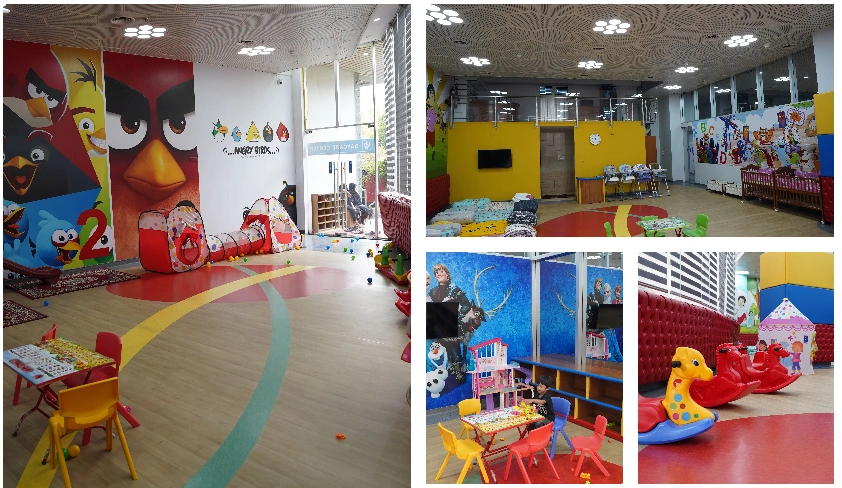
- On-campus daycare facility. AIUB operates an on-campus daycare facility serving employees and students with young children. The facility provides a safe and supportive environment where children can learn, play and develop while their parents attend to their academic or professional responsibilities [15]. Its services are overseen by an approved Childcare Committee responsible for monitoring operations and service quality. The facility operates from 7:45 a.m. to 5:00 p.m., accommodating parents during the working day [16].
Long-Term Financial Security and Retirement Benefits
AIUB supports employees' long-term financial well-being through institutional savings and service-related benefits.
- Contributory Provident Fund (CPF). Established on July 1, 2008, the CPF provides a structured savings mechanism through contributions from both employees and the University, helping employees accumulate financial resources for their future [10].
- Gratuity. Since January 1, 2016, AIUB has provided gratuity benefits to employees as a lump-sum financial entitlement recognizing their years of service and contributing to their long-term financial security [10].
- Additional employee benefits. The University also provides supplementary benefits based on employees' needs and merit, further supporting workforce welfare and institutional recognition [10].
Governance, Fairness and Transparency in Employee Compensation
AIUB supports its remuneration policies with institutional responsibilities, non-discrimination principles and transparent procedures. These mechanisms promote consistent employment practices, protect employee rights and reinforce accountability in the administration of compensation and benefits.
Office of Human Resources
AIUB's Human Resource Department (HRD) oversees employment-related processes for academic and non-academic personnel. Its responsibilities include human resource planning, recruitment and selection, employee training, performance appraisal, regulatory compliance and staff retention [2].
The HRD also administers the University's standardized pay structure and coordinates employee benefits, ensuring the consistent implementation of institutional employment policies [2].
Equal Treatment and Protection of Employee Rights
AIUB promotes fair employment practices through policies that protect employees against discrimination and uphold fundamental labour rights.
- Non-discrimination. The University recruits qualified candidates regardless of age, gender, sexual orientation, race, disability, religion or ethnic origin, reinforcing equal employment opportunities across its workforce [3].
- Protection of outsourced workers. AIUB extends its commitment to equal employment rights to outsourced personnel, including outsourced faculty and staff, supporting fair treatment across different employment arrangements [3].
- Prohibition of forced and child labour. AIUB prohibits forced labour, modern slavery, human trafficking and child labour. Its employment policies establish that all faculty and staff members, whether permanent, contractual or temporary, must be at least 18 years old [3].
- Freedom of association. AIUB recognizes employees' freedom of association and supports their right to engage in collective bargaining [4].
Employee Grievance and Complaint Mechanisms
AIUB maintains an institutional appeal and grievance process that enables employees to raise concerns regarding workplace rights, compensation and professional conduct [17].
Employees can submit complaints or suggestions to the Office of Human Resources through designated forms, email or complaint and suggestion boxes. The University also maintains the confidentiality of complainants' identities, supporting a secure and accessible reporting process [2].
These mechanisms reinforce accountability in employment administration and provide employees with formal channels to communicate concerns and seek institutional attention to workplace matters.
Public Transparency and Institutional Commitment
AIUB makes its institutional commitments to fair remuneration and employee welfare publicly accessible through its website and SDG reporting. Its published policies and institutional disclosures communicate the University's approach to living wages, compensation principles and employee benefits [18], [1], [4], [10].
By making these commitments available to its employees and the wider community, AIUB promotes transparency and demonstrates institutional accountability in its employment and remuneration practices.
References
| [1] | American International University-Bangladesh, “Employment Policies and Practices,” [Online]. Available: https://aiub.edu/sustainability/sdg8/sdg8-initiative/employment-policies-and-practices. [Accessed 2026]. |
| [2] | American International University-Bangladesh, “Office of Human Resources,” [Online]. Available: https://www.aiub.edu/offices/hrd. [Accessed 2026]. |
| [3] | American International University-Bangladesh, “AIUB Non-Discriminatory Employment Policy,” [Online]. Available: https://aiub.edu/offices/hrd/aiub-non-discriminatory-employment-policy. [Accessed 2026]. |
| [4] | American International University-Bangladesh, “SDG 8: Decent Work and Economic Growth – AIUB Activity Report of 2023,” [Online]. Available: https://www.aiub.edu/iqac/sdgs/aiub-sdg-activity-report-2023/sdg8-aiubactivityreportof2023. [Accessed 2026]. |
| [5] | The Financial Express, “Govt initiates formation of new wage board for workers.,” [Online]. Available: https://thefinancialexpress.com.bd/national/govt-initiates-formation-of-new-wage-board-for-workers. [Accessed 2026]. |
| [6] | Y. Wardad, “Govt gazette on RMG wage published,” [Online]. Available: https://today.thefinancialexpress.com.bd/print/govt-gazette-on-rmg-wage-published-1699812621. [Accessed 2026]. |
| [7] | Prothom Alo, “8th pay scale gazette published.,” [Online]. Available: https://en.prothomalo.com/bangladesh/8th-pay-scale-gazette-published-2. [Accessed 2026]. |
| [8] | Prothom Alo, “Minimum salary in government jobs is Tk 33,000, what's the maximum?,” [Online]. Available: https://en.prothomalo.com/bangladesh/px5oxn5r22. [Accessed 2026]. |
| [9] | Global Living Wage Coalition, “Bangladesh,” [Online]. Available: https://www.globallivingwage.org/countries/bangladesh/. [Accessed 2026]. |
| [10] | American International University-Bangladesh, “Employee Benefits & Policies,” [Online]. Available: https://aiub.edu/offices/hrd/employee-benefits. [Accessed 2026]. |
| [11] | American International University-Bangladesh, “Insurance Agreement (Renewal) signed between AIUB and Chartered Life Insurance Company Limited,” [Online]. Available: https://www.aiub.edu/insurance-agreement-renewal-signed-between-aiub-and-chartered-life-insurance-company-limited. [Accessed 2026]. |
| [12] | The Financial Express, “AIUB signs insurance deal with Protective Islami Life Insurance,” [Online]. Available: https://thefinancialexpress.com.bd/trade/aiub-signs-insurance-deal-with-protective-islami-life-insurance. [Accessed 2026]. |
| [13] | American International University-Bangladesh, “Maternity Leave Policy,” [Online]. Available: https://aiub.edu/offices/hrd/employee-benefits/maternity-leave-policy. [Accessed 2026]. |
| [14] | American International University-Bangladesh, “Paternity Leave Policy,” [Online]. Available: https://aiub.edu/offices/hrd/employee-benefits/paternity-leave-policy-. [Accessed 2026]. |
| [15] | American International University-Bangladesh, “Daycare Facilities,” [Online]. Available: https://aiub.edu/oncampus/aiub-daycare-facilities. [Accessed 2026]. |
| [16] | American International University-Bangladesh, “AIUB Childcare Facilities,” [Online]. Available: https://www.aiub.edu/iqac/women-development/aiub-childcare-facilities. [Accessed 2026]. |
| [17] | American International University-Bangladesh, “Employment Practice Appeal Process,” [Online]. Available: https://aiub.edu/sustainability/sdg8/sdg8-initiative/employment-practice-appeal-process. [Accessed 2026]. |
| [18] | American International University-Bangladesh, “SDG 8: Decent Work and Economic Growth.,” [Online]. Available: https://www.aiub.edu/sustainability/sdg8. [Accessed 2026]. |